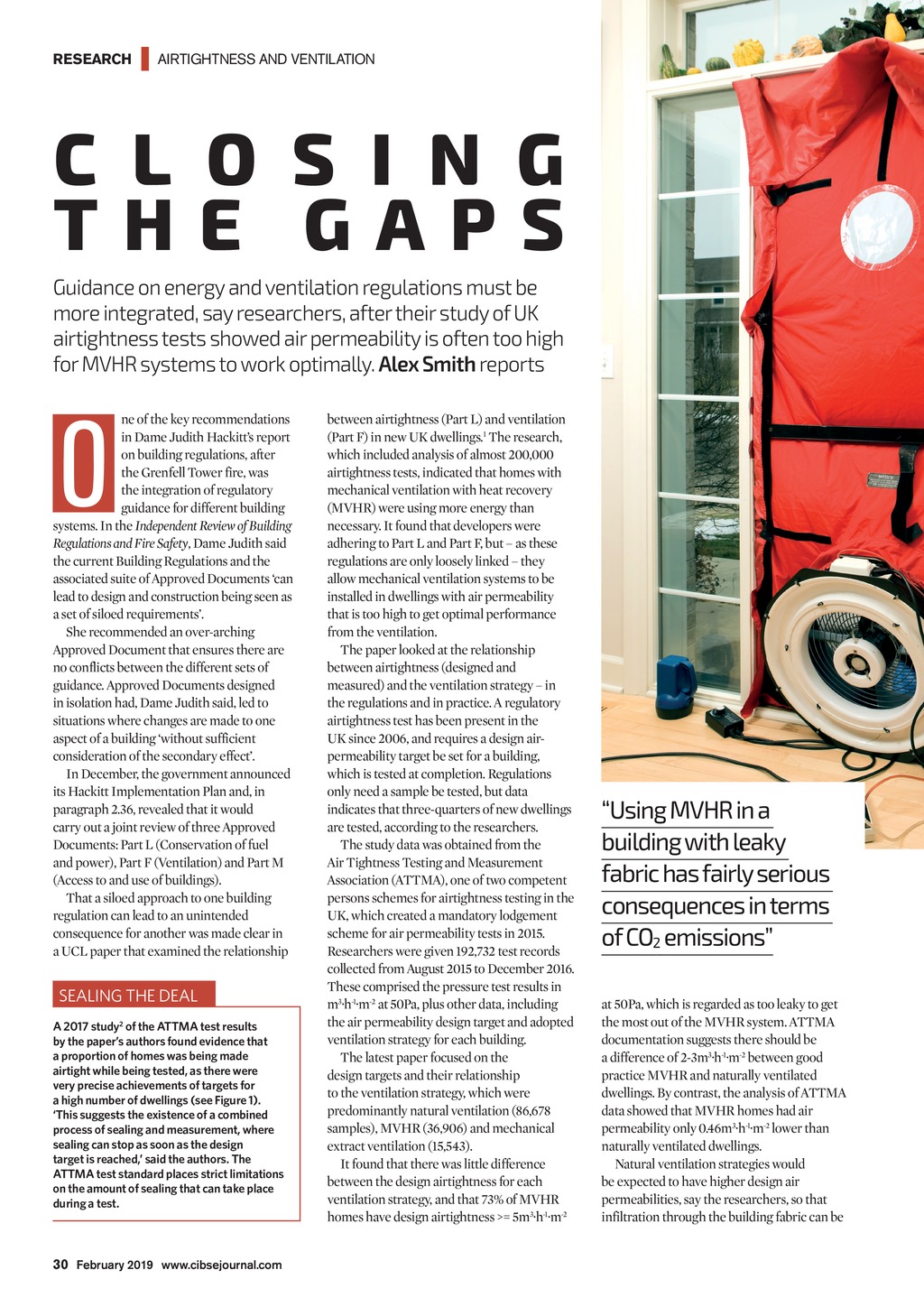


RESEARCH | AIRTIGHTNESS AND VENTILATION C L O S I N G THE GAPS Guidance on energy and ventilation regulations must be more integrated, say researchers, after their study of UK airtightness tests showed air permeability is often too high for MVHR systems to work optimally. Alex Smith reports O ne of the key recommendations in Dame Judith Hackitts report on building regulations, after the Grenfell Tower fire, was the integration of regulatory guidance for different building systems. In the Independent Review of Building Regulations and Fire Safety, Dame Judith said the current Building Regulations and the associated suite of Approved Documents can lead to design and construction being seen as a set of siloed requirements. She recommended an over-arching Approved Document that ensures there are no conflicts between the different sets of guidance. Approved Documents designed in isolation had, Dame Judith said, led to situations where changes are made to one aspect of a building without sufficient consideration of the secondary effect. In December, the government announced its Hackitt Implementation Plan and, in paragraph 2.36, revealed that it would carry out a joint review of three Approved Documents: Part L (Conservation of fuel and power), Part F (Ventilation) and Part M (Access to and use of buildings). That a siloed approach to one building regulation can lead to an unintended consequence for another was made clear in a UCL paper that examined the relationship SEALING THE DEAL A 2017 study2 of the ATTMA test results by the papers authors found evidence that a proportion of homes was being made airtight whilebeing tested, as there were very preciseachievements of targets for a high number of dwellings (see Figure 1). This suggests the existence of a combined processof sealing and measurement, where sealing can stop as soon as the design targetisreached, said the authors. The ATTMA test standard places strict limitations on the amount of sealing that can take place during a test. between airtightness (Part L) and ventilation (Part F) in new UK dwellings.1 The research, which included analysis of almost 200,000 airtightness tests, indicated that homes with mechanical ventilation with heat recovery (MVHR) were using more energy than necessary. It found that developers were adhering to Part L and Part F, but as these regulations are only loosely linked they allow mechanical ventilation systems to be installed in dwellings with air permeability that is too high to get optimal performance from the ventilation. The paper looked at the relationship between airtightness (designed and measured) and the ventilation strategy in the regulations and in practice. A regulatory airtightness test has been present in the UK since 2006, and requires a design airpermeability target be set for a building, which is tested at completion. Regulations only need a sample be tested, but data indicates that three-quarters of new dwellings are tested, according to the researchers. The study data was obtained from the Air Tightness Testing and Measurement Association (ATTMA), one of two competent persons schemes for airtightness testing in the UK, which created a mandatory lodgement scheme for air permeability tests in 2015. Researchers were given 192,732 test records collected from August 2015 to December 2016. These comprised the pressure test results in m3h-1m-2 at 50Pa, plus other data, including the air permeability design target and adopted ventilation strategy for each building. The latest paper focused on the design targets and their relationship to the ventilation strategy, which were predominantly natural ventilation (86,678 samples), MVHR (36,906) and mechanical extract ventilation (15,543). It found that there was little difference between the design airtightness for each ventilation strategy, and that 73% of MVHR homes have design airtightness >= 5m3h-1m-2 Using MVHR in a building with leaky fabric has fairly serious consequences in terms ofCO2 emissions at 50Pa, which is regarded as too leaky to get the most out of the MVHR system. ATTMA documentation suggests there should be a difference of 2-3m3h-1m-2 between good practice MVHR and naturally ventilated dwellings. By contrast, the analysis of ATTMA data showed that MVHR homes had air permeability only 0.46m3h-1m-2 lower than naturally ventilated dwellings. Natural ventilation strategies would be expected to have higher design air permeabilities, say the researchers, so that infiltration through the building fabric can be 30 February 2019 www.cibsejournal.com CIBSE Feb19 pp30-31 Airtigtness Testing.indd 30 25/01/2019 18:29