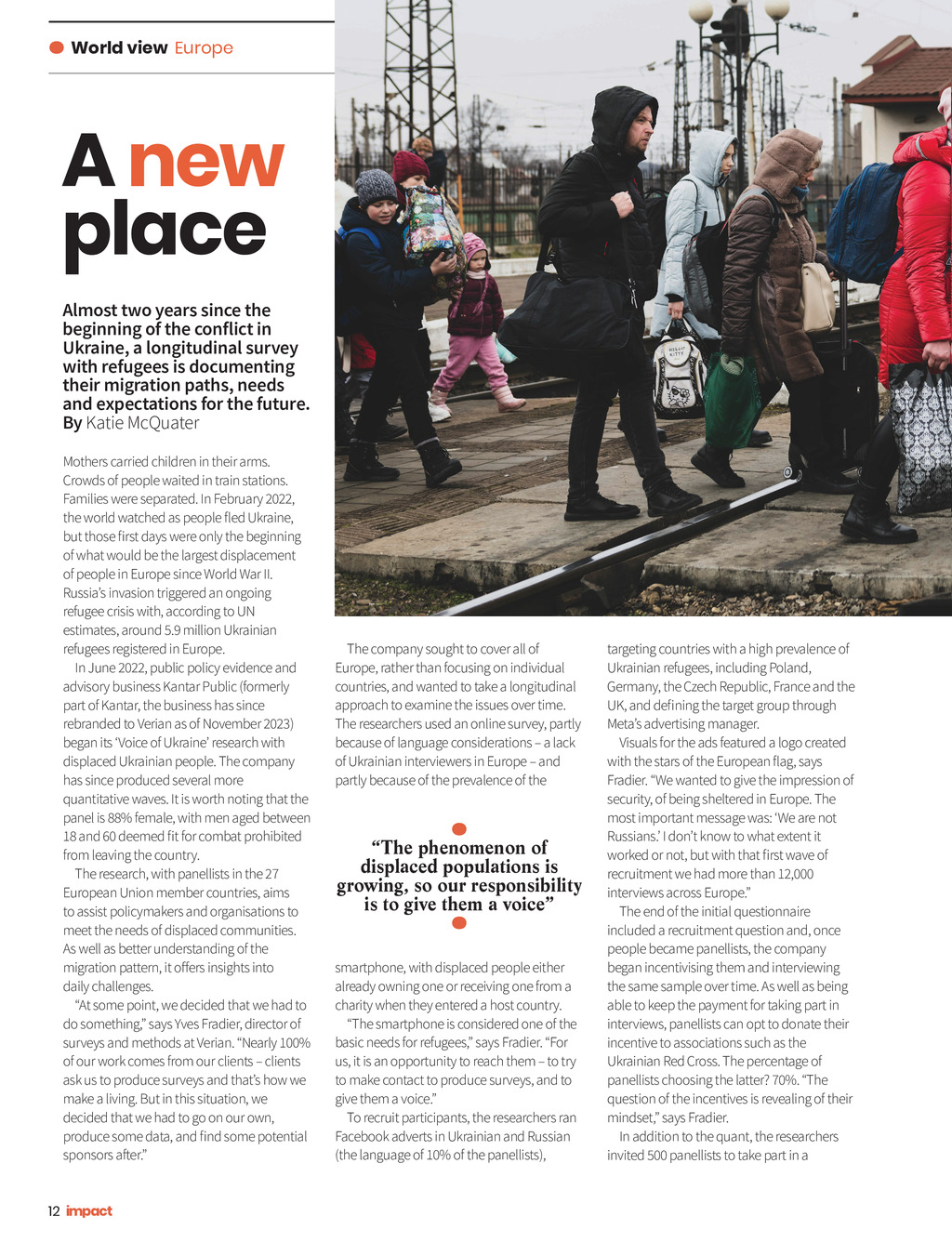
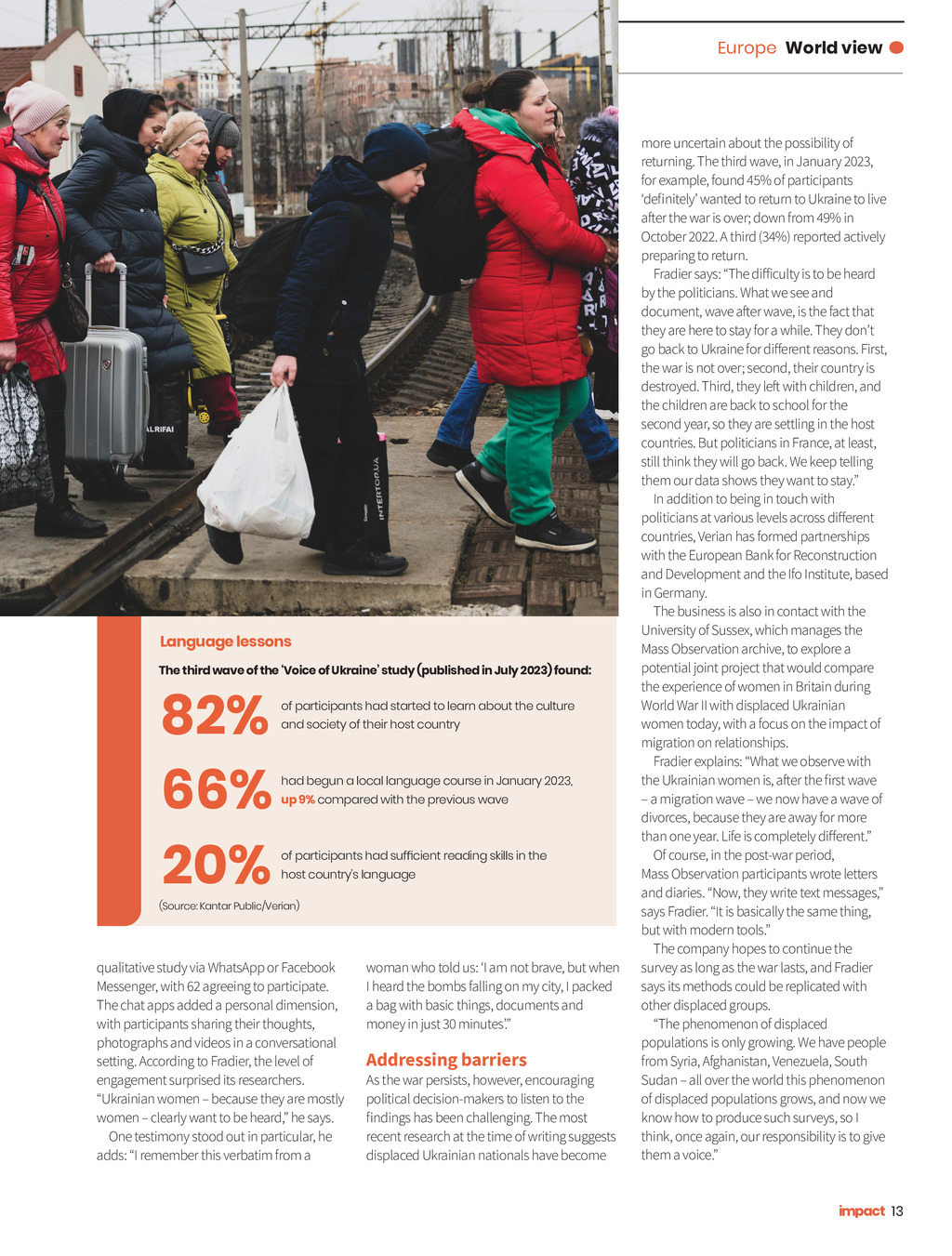
World view Europe A new place Almost two years since the beginning of the conflict in Ukraine, a longitudinal survey with refugees is documenting their migration paths, needs and expectations for the future. By Katie McQuater Mothers carried children in their arms. Crowds of people waited in train stations. Families were separated. In February 2022, the world watched as people fled Ukraine, but those first days were only the beginning of what would be the largest displacement of people in Europe since World War II. Russias invasion triggered an ongoing refugee crisis with, according to UN estimates, around 5.9 million Ukrainian refugees registered in Europe. In June 2022, public policy evidence and advisory business Kantar Public (formerly part of Kantar, the business has since rebranded to Verian as of November 2023) began its Voice of Ukraine research with displaced Ukrainian people. The company has since produced several more quantitative waves. It is worth noting that the panel is 88% female, with men aged between 18 and 60 deemed fit for combat prohibited from leaving the country. The research, with panellists in the 27 European Union member countries, aims to assist policymakers and organisations to meet the needs of displaced communities. As well as better understanding of the migration pattern, it offers insights into daily challenges. At some point, we decided that we had to do something, says Yves Fradier, director of surveys and methods at Verian. Nearly 100% of our work comes from our clients clients ask us to produce surveys and thats how we make a living. But in this situation, we decided that we had to go on our own, produce some data, and find some potential sponsors after. The company sought to cover all of Europe, rather than focusing on individual countries, and wanted to take a longitudinal approach to examine the issues over time. The researchers used an online survey, partly because of language considerations a lack of Ukrainian interviewers in Europe and partly because of the prevalence of the The phenomenon of displaced populations is growing, so our responsibility is to give them a voice smartphone, with displaced people either already owning one or receiving one from a charity when they entered a host country. The smartphone is considered one of the basic needs for refugees, says Fradier. For us, it is an opportunity to reach them to try to make contact to produce surveys, and to give them a voice. To recruit participants, the researchers ran Facebook adverts in Ukrainian and Russian (the language of 10% of the panellists), targeting countries with a high prevalence of Ukrainian refugees, including Poland, Germany, the Czech Republic, France and the UK, and defining the target group through Metas advertising manager. Visuals for the ads featured a logo created with the stars of the European flag, says Fradier. We wanted to give the impression of security, of being sheltered in Europe. The most important message was: We are not Russians. I dont know to what extent it worked or not, but with that first wave of recruitment we had more than 12,000 interviews across Europe. The end of the initial questionnaire included a recruitment question and, once people became panellists, the company began incentivising them and interviewing the same sample over time. As well as being able to keep the payment for taking part in interviews, panellists can opt to donate their incentive to associations such as the Ukrainian Red Cross. The percentage of panellists choosing the latter? 70%. The question of the incentives is revealing of their mindset, says Fradier. In addition to the quant, the researchers invited 500 panellists to take part in a 12 Impact ISSUE 44 2023_pp12-13 WV Europe.indd 12 05/12/2023 12:04