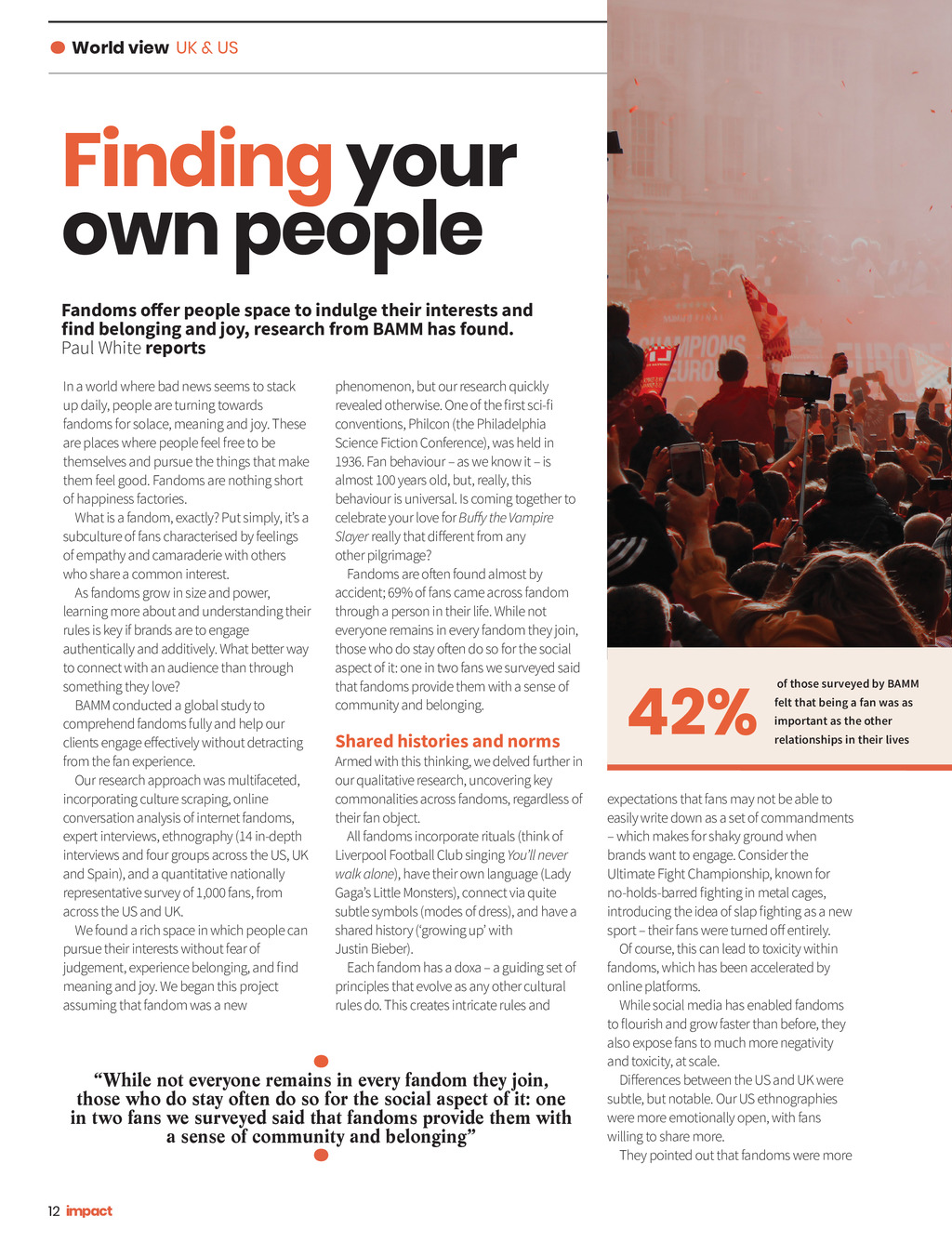
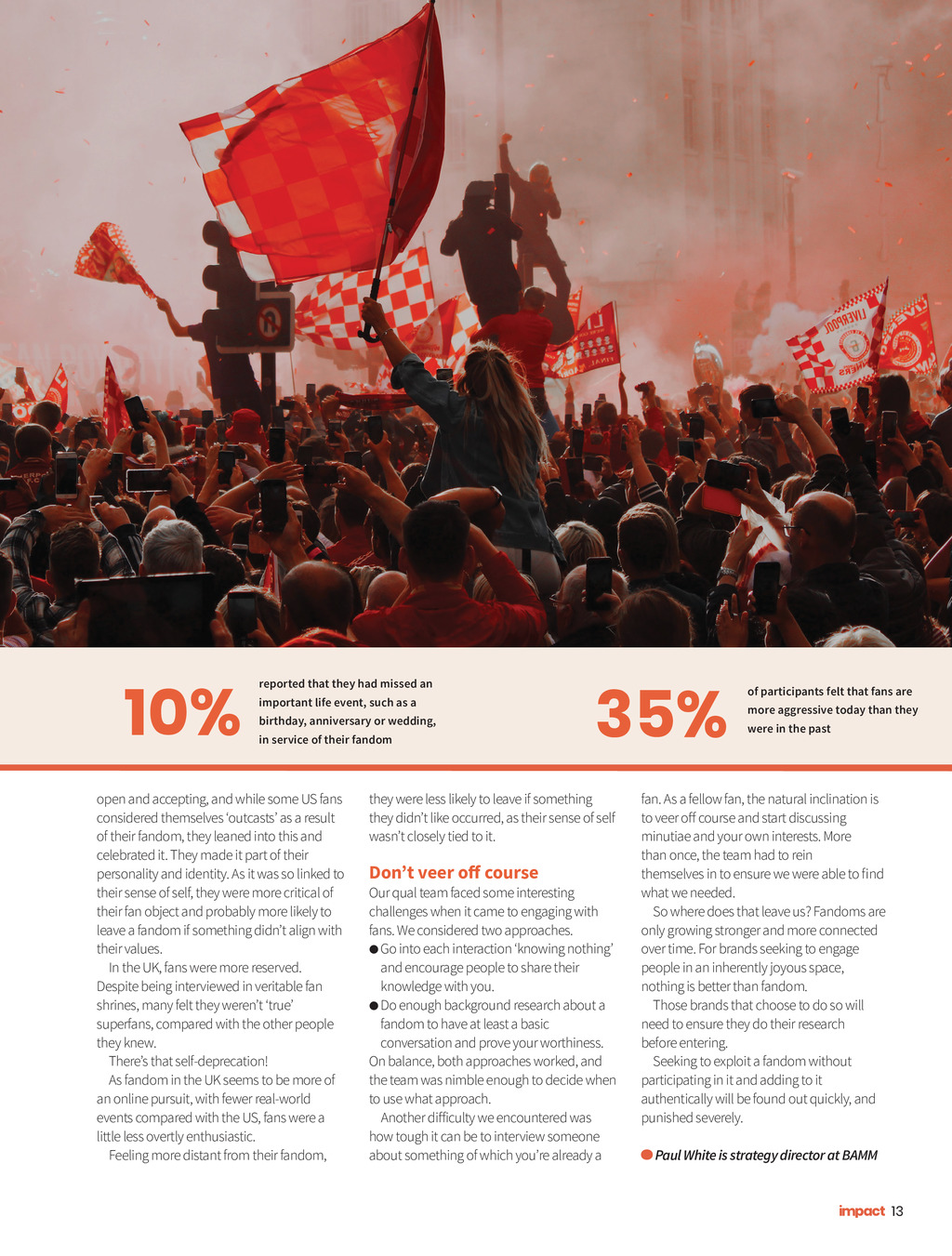
World view UK & US Finding your own people Fandoms offer people space to indulge their interests and find belonging and joy, research from BAMM has found. Paul White reports In a world where bad news seems to stack up daily, people are turning towards fandoms for solace, meaning and joy. These are places where people feel free to be themselves and pursue the things that make them feel good. Fandoms are nothing short of happiness factories. What is a fandom, exactly? Put simply, its a subculture of fans characterised by feelings of empathy and camaraderie with others who share a common interest. As fandoms grow in size and power, learning more about and understanding their rules is key if brands are to engage authentically and additively. What better way to connect with an audience than through something they love? BAMM conducted a global study to comprehend fandoms fully and help our clients engage effectively without detracting from the fan experience. Our research approach was multifaceted, incorporating culture scraping, online conversation analysis of internet fandoms, expert interviews, ethnography (14 in-depth interviews and four groups across the US, UK and Spain), and a quantitative nationally representative survey of 1,000 fans, from across the US and UK. We found a rich space in which people can pursue their interests without fear of judgement, experience belonging, and find meaning and joy. We began this project assuming that fandom was a new phenomenon, but our research quickly revealed otherwise. One of the first sci-fi conventions, Philcon (the Philadelphia Science Fiction Conference), was held in 1936. Fan behaviour as we know it is almost 100 years old, but, really, this behaviour is universal. Is coming together to celebrate your love for Buffy the Vampire Slayer really that different from any other pilgrimage? Fandoms are often found almost by accident; 69% of fans came across fandom through a person in their life. While not everyone remains in every fandom they join, those who do stay often do so for the social aspect of it: one in two fans we surveyed said that fandoms provide them with a sense of community and belonging. Shared histories and norms Armed with this thinking, we delved further in our qualitative research, uncovering key commonalities across fandoms, regardless of their fan object. All fandoms incorporate rituals (think of Liverpool Football Club singing Youll never walk alone), have their own language (Lady Gagas Little Monsters), connect via quite subtle symbols (modes of dress), and have a shared history (growing up with Justin Bieber). Each fandom has a doxa a guiding set of principles that evolve as any other cultural rules do. This creates intricate rules and While not everyone remains in every fandom they join, those who do stay often do so for the social aspect of it: one in two fans we surveyed said that fandoms provide them with a sense of community and belonging 42% of those surveyed by BAMM felt that being a fan was as important as the other relationships in their lives expectations that fans may not be able to easily write down as a set of commandments which makes for shaky ground when brands want to engage. Consider the Ultimate Fight Championship, known for no-holds-barred fighting in metal cages, introducing the idea of slap fighting as a new sport their fans were turned off entirely. Of course, this can lead to toxicity within fandoms, which has been accelerated by online platforms. While social media has enabled fandoms to flourish and grow faster than before, they also expose fans to much more negativity and toxicity, at scale. Differences between the US and UK were subtle, but notable. Our US ethnographies were more emotionally open, with fans willing to share more. They pointed out that fandoms were more 12 Impact ISSUE 43 2023_pp12-13 WV UK & US.indd 12 18/09/2023 18:43