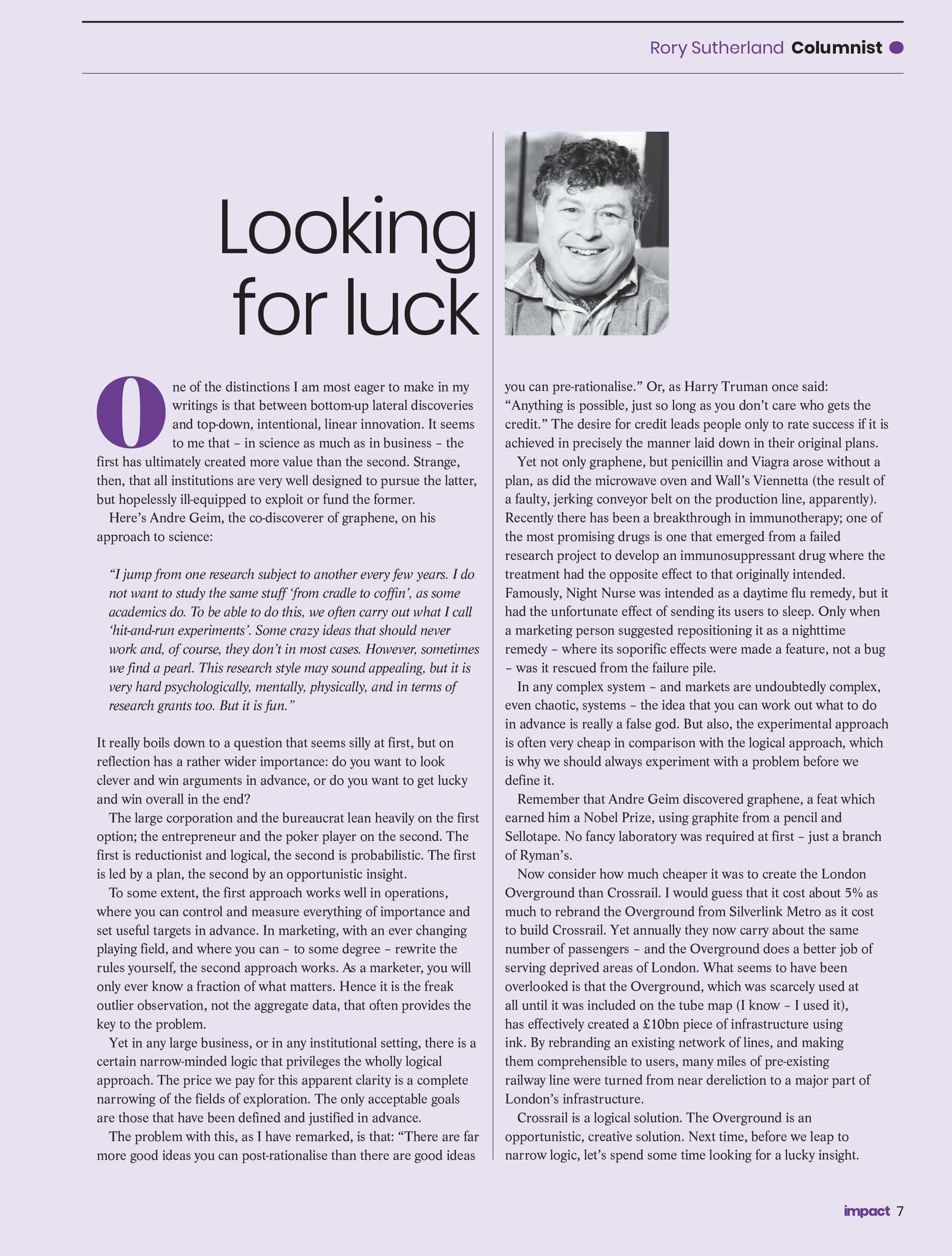
Rory Sutherland Columnist O Looking for luck ne of the distinctions I am most eager to make in my writings is that between bottom-up lateral discoveries and top-down, intentional, linear innovation. It seems to me that in science as much as in business the first has ultimately created more value than the second. Strange, then, that all institutions are very well designed to pursue the latter, but hopelessly ill-equipped to exploit or fund the former. Heres Andre Geim, the co-discoverer of graphene, on his approach to science: I jump from one research subject to another every few years. I do not want to study the same stu from cradle to con, as some academics do. To be able to do this, we often carry out what I call hit-and-run experiments. Some crazy ideas that should never work and, of course, they dont in most cases. However, sometimes we find a pearl. This research style may sound appealing, but it is very hard psychologically, mentally, physically, and in terms of research grants too. But it is fun. It really boils down to a question that seems silly at first, but on reflection has a rather wider importance: do you want to look clever and win arguments in advance, or do you want to get lucky and win overall in the end? The large corporation and the bureaucrat lean heavily on the first option; the entrepreneur and the poker player on the second. The first is reductionist and logical, the second is probabilistic. The first is led by a plan, the second by an opportunistic insight. To some extent, the first approach works well in operations, where you can control and measure everything of importance and set useful targets in advance. In marketing, with an ever changing playing field, and where you can to some degree rewrite the rules yourself, the second approach works. As a marketer, you will only ever know a fraction of what matters. Hence it is the freak outlier observation, not the aggregate data, that often provides the key to the problem. Yet in any large business, or in any institutional setting, there is a certain narrow-minded logic that privileges the wholly logical approach. The price we pay for this apparent clarity is a complete narrowing of the fields of exploration. The only acceptable goals are those that have been defined and justified in advance. The problem with this, as I have remarked, is that: There are far more good ideas you can post-rationalise than there are good ideas you can pre-rationalise. Or, as Harry Truman once said: Anything is possible, just so long as you dont care who gets the credit. The desire for credit leads people only to rate success if it is achieved in precisely the manner laid down in their original plans. Yet not only graphene, but penicillin and Viagra arose without a plan, as did the microwave oven and Walls Viennetta (the result of a faulty, jerking conveyor belt on the production line, apparently). Recently there has been a breakthrough in immunotherapy; one of the most promising drugs is one that emerged from a failed research project to develop an immunosuppressant drug where the treatment had the opposite eect to that originally intended. Famously, Night Nurse was intended as a daytime flu remedy, but it had the unfortunate eect of sending its users to sleep. Only when a marketing person suggested repositioning it as a nighttime remedy where its soporific eects were made a feature, not a bug was it rescued from the failure pile. In any complex system and markets are undoubtedly complex, even chaotic, systems the idea that you can work out what to do in advance is really a false god. But also, the experimental approach is often very cheap in comparison with the logical approach, which is why we should always experiment with a problem before we define it. Remember that Andre Geim discovered graphene, a feat which earned him a Nobel Prize, using graphite from a pencil and Sellotape. No fancy laboratory was required at first just a branch of Rymans. Now consider how much cheaper it was to create the London Overground than Crossrail. I would guess that it cost about 5% as much to rebrand the Overground from Silverlink Metro as it cost to build Crossrail. Yet annually they now carry about the same number of passengers and the Overground does a better job of serving deprived areas of London. What seems to have been overlooked is that the Overground, which was scarcely used at all until it was included on the tube map (I know I used it), has eectively created a 10bn piece of infrastructure using ink. By rebranding an existing network of lines, and making them comprehensible to users, many miles of pre-existing railway line were turned from near dereliction to a major part of Londons infrastructure. Crossrail is a logical solution. The Overground is an opportunistic, creative solution. Next time, before we leap to narrow logic, lets spend some time looking for a lucky insight. 7 Impact ISSUE 42 2023_pp6-7_Rory.indd 7 16/06/2023 16:50