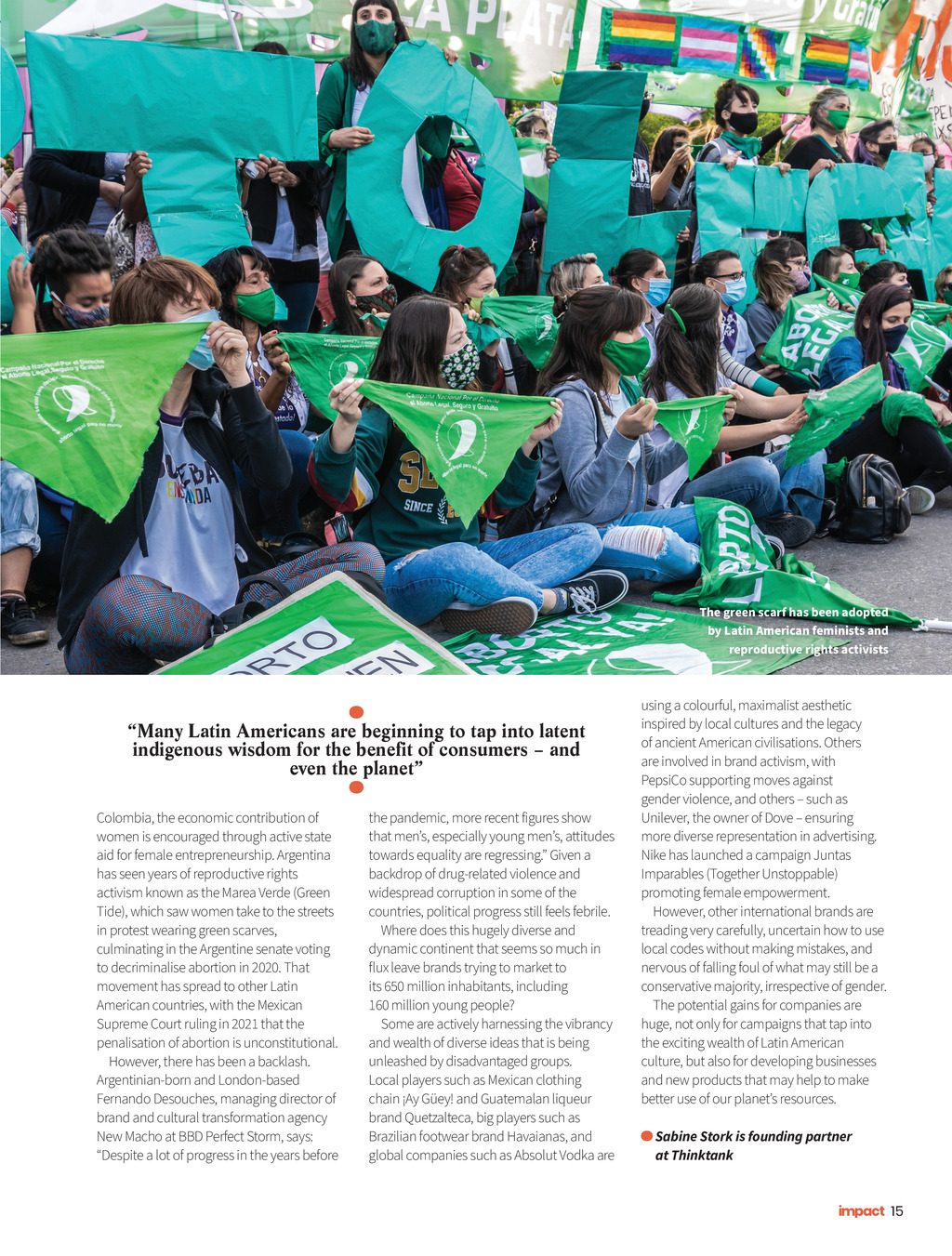
World view Latin America Rising confidence Marginalised groups are asserting themselves in Latin America, with diverse creative energy and an embrace of indigenous culture giving rise to vibrant brands and cultural scenes. By Sabine Stork After 214 years we have a government of the people... a government of the callused hands... a government of the nobodies of Colombia. So said Francia Mrquez, who, a little over six months ago, became Colombias first black vice-president. Mrquez comes from Yolomb, a small village in the remote western state of Cauca. She trained as an agricultural technician, got a law degree, and became an environmental activist who organised a 350km march of 80 Afro-Colombian women to the capital, Bogot, to protest against illegal mining. Mrquez could serve as a poster child for the rise of the marginalised across much of Latin America, which has been dominated by a male, white urban elite since the conquest of the continent by European colonists. These groups be they indigenous people, women, or inhabitants of far-flung regions such as the vice-presidents home state are increasingly finding their voice. A shift to the left in many countries and the election of a number of indginas such as Mrquez and the former president of Bolivia Evo Morales has led to more political representation and overt attempts to further inclusion, even if the results are yet to lead to measurable improvements in the lives of the underprivileged. Newly confident communities and demographics are asserting themselves through soft power, and are becoming more and more influential in setting trends and There are 160 million people aged 15 to 29 in Latin America and the Caribbean (OHCHR) The largest populations of young people are in Brazil, Mexico and Argentina (Policy.org) The population of 15- to 29-year-olds is the highest in the regions history (UN) reshaping how Latin Americans see themselves. The immense creative energy of diverse, previously suppressed voices is giving rise to new businesses, along with a vibrant cultural scene. Artesanos Don Bosco, based in the cool Barranco neighbourhood of Perus capital, Lima, sells highly contemporary furniture that incorporates Inca and Mesoamerican designs from Peruvian craftworkers using Amazon-sourced materials. The business is run as a charitable operation, with all profits going into educational and training programmes in the highlands. Fashion designer Amelia Toro splits her time between her stores in Bogot and New York. Her signature is the red embroidery she uses for white garments, which is influenced by indigenous Colombian needlework. Mexican film has been particularly successful in making indigenous people more visible from Oscar winner Yalitza Aparicio, who played the lead in Roma, a film told from the perspective of an indgena housemaid, to Tenoch Huerta, who plays the hero of Black Panther: Wakanda Forever and is an activist behind the Poder Prieto movement, which fights racism in the entertainment sector. In fact, many Latin Americans are beginning to tap into latent indigenous wisdom for the benefit of consumers and even the planet. On a macro level, Argentinas Ministry of Agriculture, Livestock and Fisheries has created a National Directorate of Agroecology to promote traditional farming methods, such as organic pest control, the conservation of natural predators, and the development of biological corridors to create self-sustaining ecosystems. In addition, spiritual tourism, including ayahuasca retreats, is on a steep growth curve, while there has been a re-evaluation of shamanism in Peru, Colombia and Mexico. In the Colombian Amazon, local indigenous groups, supported by the World Wide Fund for Nature, are developing so-called impact ventures, which protect the natural environment and offer life benefits to communities. One such venture is the firm Bioingredientes Amazonicos in the border state of Putumayo, which has developed a sustainable use for two Amazonian fruits with nutraceutical properties sacha inchi and cacay in cosmetic skin products. At the same time, making use of the huge diversity of local experiences and traditional practices can amount to a real challenge to the hegemony of white and US culture. As a result, young people are forging identities that are rooted in their own countries rather than aspiring to emigrate, or even travel. This does not mean that Western culture does not still play a role. Latin Americans are mixing US cultural references into native folklore, giving birth to local fusions both proudly asserting their own culture and challenging conservative expectations of women in their communities. In the Bolivian city of Cochabamba, a group of young skateboarding women have formed ImillaSkate. They sport the usual white Vans trainers but pair them with polleras voluminous, colourful skirts, traditionally worn by the Aymara and Quechua indigenous women. Wearing this attire, while also styling their hair in the traditional way, the skaters make strong statements of pride in their origins and promote further acceptance of their often-discriminated-against ethnic culture. This confluence of ethnic inclusivity on the one hand, and female (and gender) emancipation on the other, is particularly striking on a continent strongly influenced by conservative values and subject to polarisations between progressive ideas and regression. In some countries, such as 14 Impact ISSUE 42 2023_pp14-15 WV Latin America.indd 14 16/06/2023 16:56