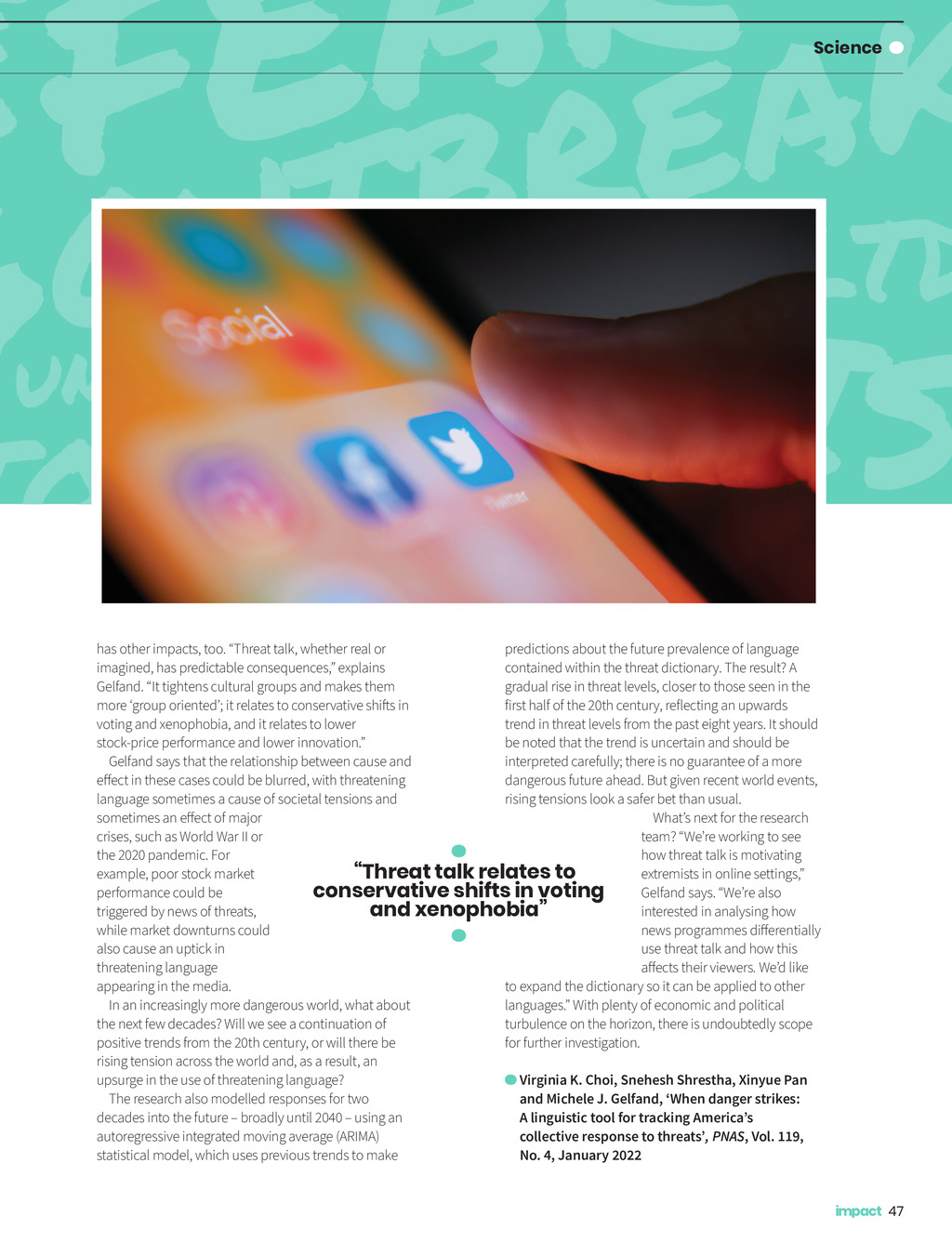
Science Fear and loathing Threatening language is prevalent across the internet, so researchers have developed a threat dictionary to track its impact on those exposed to it. By Liam Kay T he world feels increasingly unstable as the years roll by. A pandemic, the war in Ukraine and an increasingly toxic political environment are just some of the factors that have raised anxiety levels and decreased optimism across large swathes of the population. Portents of doom abound online, decrying the latest supposed threat to humanity. What is the cumulative impact of this torrent of bad news? Does it change peoples outlook on life, society, their fellow human beings and country? One recent study by researchers at the University of Maryland and Stanford University looked to understand the implications of threats broadcast through mass communication channels in the media and online. They used a computational linguistic tool to index threat levels from text, allowing the researchers to examine how the prevalence of threatening language in the media over the past century has impacted cultural, political and economic shifts. Michele Gelfand, professor in cross-cultural management and of organisational behaviour at Stanford University, and one of four lead researchers on the project, says that the study came about because of a dearth of available tools and evidence on the subject. We have been studying the impact of threat on human psychology for some years, but we realised there were few methods developed to track threat in real time in public media and its impact on human groups, she explains. We wanted to also develop this tool so that people can use it in their own lives for example, to see how much threat talk one is exposed to when online or when listening to speeches or reading the newspaper. The research team created a threat dictionary to help develop a semantic measure that tracks the form, frequency, and magnitude of communicated threats. This involved scanning documents for the presence of select keywords, identified through a technique to determine how words related to the concept of threat cluster together across different platforms, such as Twitter, Wikipedia and raw webpage data website Common Crawl. The researchers identified 240 words, including: attack, crisis, destroy, disaster, fear, meltdown, outbreak, suffer, tension, toxic, unrest, unstable, and violent. Developing a threat dictionary can help us detect threats in many settings in real time and track it across many years, Gelfand explains. It can be used in a variety of settings, from analysing the impact of threat on the stock market and examining how leaders use threat to motivate, to understanding how threat spreads across platforms online, among many other uses. In this study, researchers used the dictionary to examine trends across US newspapers over the past 100 years, and found a general reduction in the prevalence of threatening language over time, with spikes for various major events, such as wars, pandemics and global catastrophes. For example, World War I and II both caused a significant spike in the model, and similar trends were seen for events such as the terrorist attack on the World Trade Center in New York in 2001. But even with these three events, threatening language did not rise above that seen at the turn of the 20th century, reflecting a broader march towards a more peaceable existence. The prevalence of threatening language in the media 46 Impact ISSUE 40 2022_pp46-47_Science.indd 46 13/12/2022 11:58