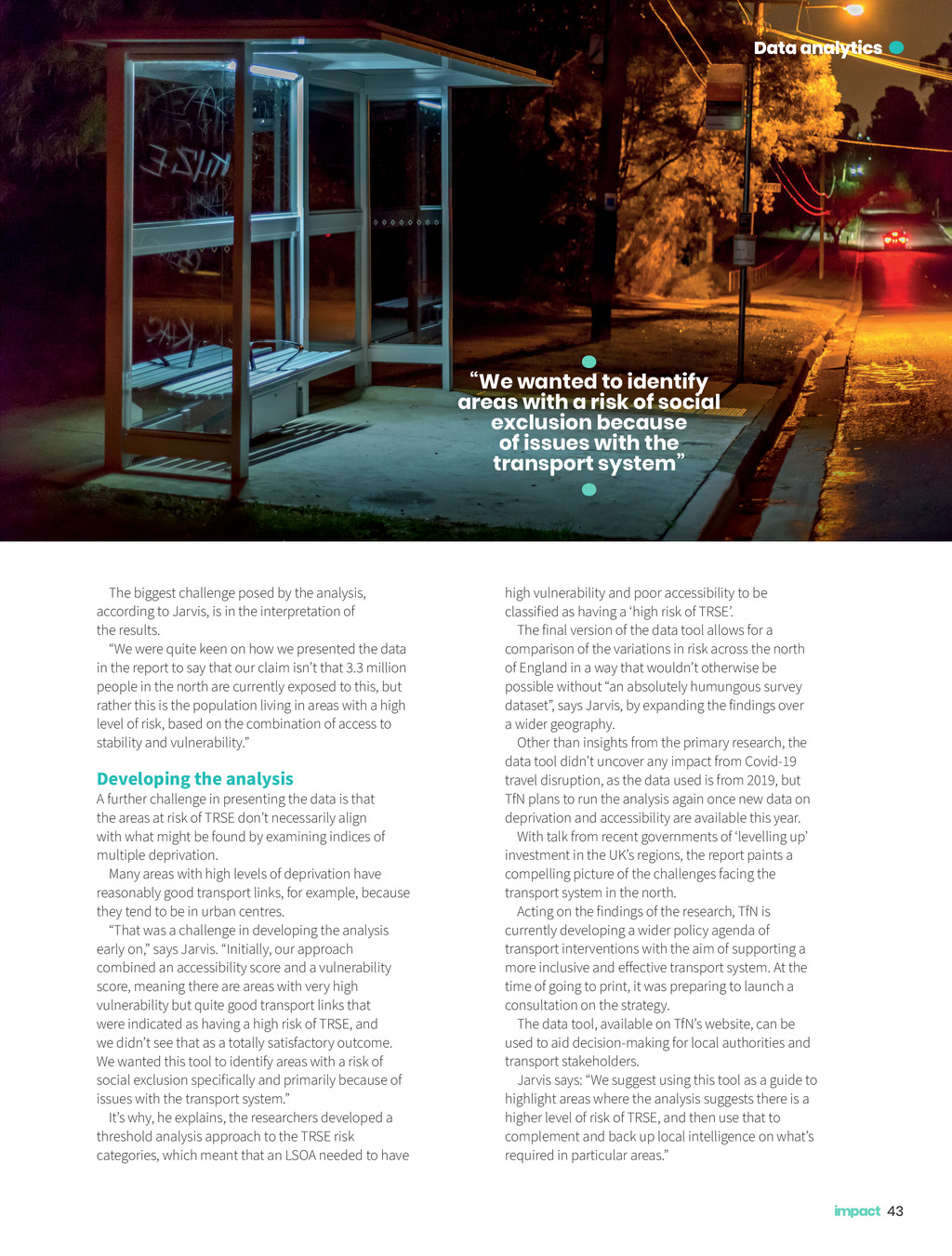
Data analytics Out in the cold Transport-related social exclusion prevents people from fully participating in their communities, and new data analysis has shed light on the scale of the problem in England. Katie McQuater reports A n estimated 3.3 million people in the north of England live in areas where there is a relatively high risk of social exclusion as a result of limitations in transport equating to a fifth of the regions population. That stark figure is the result of data analysis from Transport for the North (TfN), the body responsible for making the case for strategic transport improvements across the north. In its report, Transport-related social exclusion in the north of England, TfN defines transport-related social exclusion (TRSE) as being unable to access opportunities, key services and community life as much as needed, and facing major obstacles in everyday life through the wider impacts of having to travel to access key destinations. The impacts of TRSE can contribute to a cycle of poverty, isolation and poor access to basic services. Furthermore, the issue disproportionately affects people with disabilities and long-term health conditions, people with caring responsibilities, and those on low incomes and in insecure work, reinforcing wider patterns of social and economic inequality. TRSE is caused by a number of factors: fragmentation, unreliability and high costs of public transport; poor conditions for walking and cycling in car-dominated environments; and a resulting high level of car dependency. However, a lack of evidence means it has historically been difficult for authorities to accurately measure the scale of the problem. Tom Jarvis, senior evidence and analysis officer at TfN, says: There was a large evidence gap when it came to precisely assessing what an inclusive transport system looked like in the north of England. To better understand the issue and establish which areas of England are at a higher risk of TRSE, TfN carried out primary research, working with Social Research Associates and Temple, and developed a data tool combining accessibility analysis with a range of socio-economic and demographic indicators. Identifying causes and consequences Initially, TfN began by looking at its data on access to employment and then combined that with socioeconomic and demographic datasets to create a score of vulnerability to social exclusion. We knew the focus on employment was relatively narrow, but a key purpose of that first data analysis was to identify a set of areas in which to conduct primary research, explains Jarvis. Following the initial analysis, primary research involving a quantitative survey of 3,000 people, 300 qualitative interviews and 11 focus groups sought to examine how TRSE manifests in specific place and population contexts, and the lived experience of those affected. Jarvis says: That gave us a really clear idea of the causes and consequences of transport-related social exclusion in the north. The data analysis guided the development of the primary research, allowing TfN to get an insight into the types of areas that might be at higher risk of TRSE and focus their research on those areas. Jarvis then conducted further work on the findings to develop the second version of the data tool, which reflects a broader accessibility analysis, factoring in access to healthcare services, education and other services, as well as employment. The tool measures the risk of TRSE at the layer super output area (LSOA) level, a geographical unit for small area statistical analysis, and can be used to estimate the size of the population living in the areas indicated to have a higher level of risk. The data published in TfNs report covers all LSOAs in England, including regional comparisons of the overall risk of TRSE and of the accessibility and vulnerability elements that comprise it. Jarvis says: One of our key findings is that there are very large variations between the regions of England, and the north east really stands out as having a very high level of risk of TRSE 31.5% of the population of the north east live in areas with a high risk, compared with 21.3% of the population of the north and 16% of the population of the rest of England. 42 Impact ISSUE 40 2022_pp42-43_Data Analytics.indd 42 13/12/2022 11:52