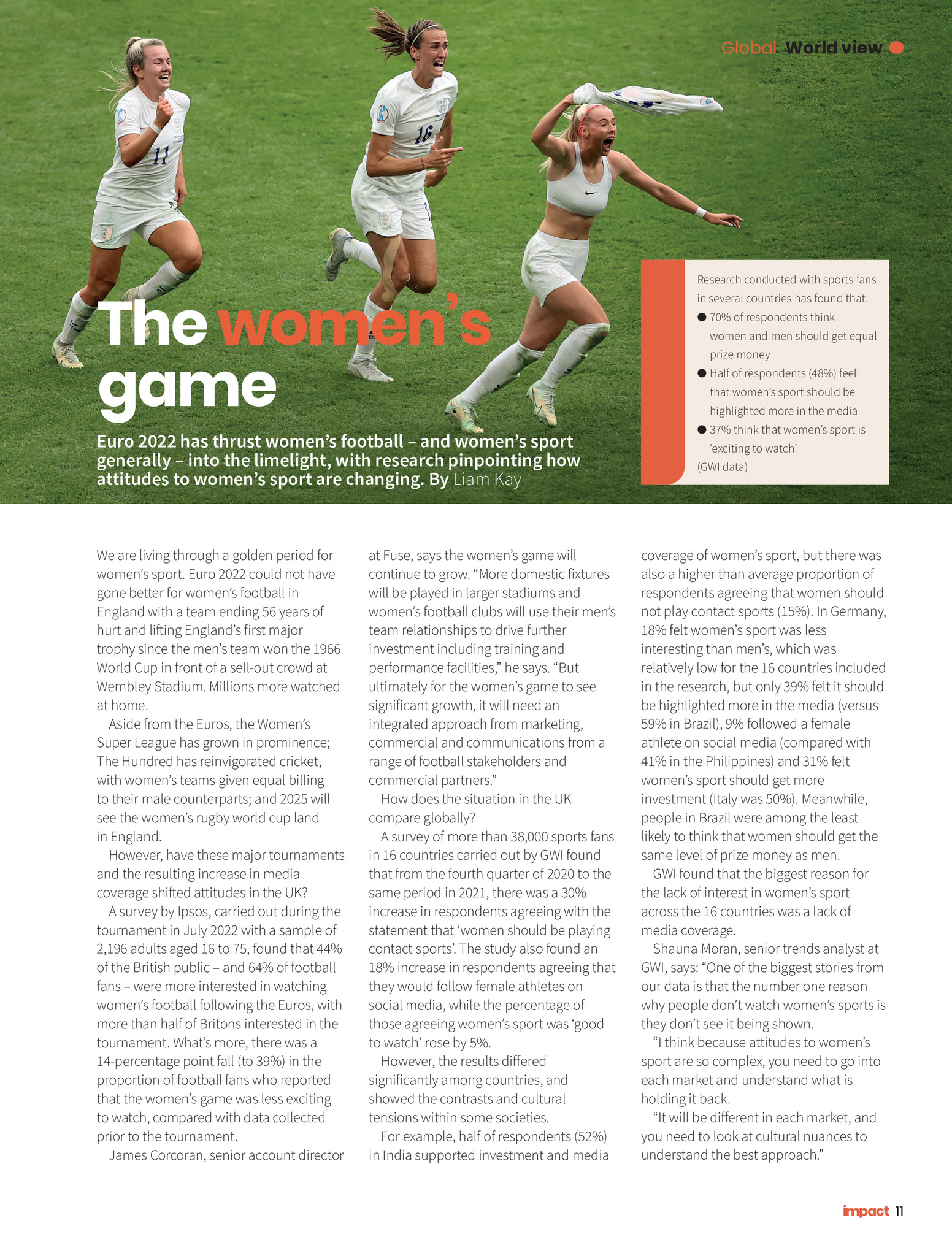
Global World view The womens game Euro 2022 has thrust womens football and womens sport generally into the limelight, with research pinpointing how attitudes to womens sport are changing. By Liam Kay We are living through a golden period for womens sport. Euro 2022 could not have gone better for womens football in England with a team ending 56 years of hurt and lifting Englands first major trophy since the mens team won the 1966 World Cup in front of a sell-out crowd at Wembley Stadium. Millions more watched at home. Aside from the Euros, the Womens Super League has grown in prominence; The Hundred has reinvigorated cricket, with womens teams given equal billing to their male counterparts; and 2025 will see the womens rugby world cup land in England. However, have these major tournaments and the resulting increase in media coverage shifted attitudes in the UK? A survey by Ipsos, carried out during the tournament in July 2022 with a sample of 2,196 adults aged 16 to 75, found that 44% of the British public and 64% of football fans were more interested in watching womens football following the Euros, with more than half of Britons interested in the tournament. Whats more, there was a 14-percentage point fall (to 39%) in the proportion of football fans who reported that the womens game was less exciting to watch, compared with data collected prior to the tournament. James Corcoran, senior account director at Fuse, says the womens game will continue to grow. More domestic fixtures will be played in larger stadiums and womens football clubs will use their mens team relationships to drive further investment including training and performance facilities, he says. But ultimately for the womens game to see significant growth, it will need an integrated approach from marketing, commercial and communications from a range of football stakeholders and commercial partners. How does the situation in the UK compare globally? A survey of more than 38,000 sports fans in 16 countries carried out by GWI found that from the fourth quarter of 2020 to the same period in 2021, there was a 30% increase in respondents agreeing with the statement that women should be playing contact sports. The study also found an 18% increase in respondents agreeing that they would follow female athletes on social media, while the percentage of those agreeing womens sport was good to watch rose by 5%. However, the results differed significantly among countries, and showed the contrasts and cultural tensions within some societies. For example, half of respondents (52%) in India supported investment and media Research conducted with sports fans in several countries has found that: 70% of respondents think women and men should get equal prize money Half of respondents (48%) feel that womens sport should be highlighted more in the media 37% think that womens sport is exciting to watch (GWI data) coverage of womens sport, but there was also a higher than average proportion of respondents agreeing that women should not play contact sports (15%). In Germany, 18% felt womens sport was less interesting than mens, which was relatively low for the 16 countries included in the research, but only 39% felt it should be highlighted more in the media (versus 59% in Brazil), 9% followed a female athlete on social media (compared with 41% in the Philippines) and 31% felt womens sport should get more investment (Italy was 50%). Meanwhile, people in Brazil were among the least likely to think that women should get the same level of prize money as men. GWI found that the biggest reason for the lack of interest in womens sport across the 16 countries was a lack of media coverage. Shauna Moran, senior trends analyst at GWI, says: One of the biggest stories from our data is that the number one reason why people dont watch womens sports is they dont see it being shown. I think because attitudes to womens sport are so complex, you need to go into each market and understand what is holding it back. It will be different in each market, and you need to look at cultural nuances to understand the best approach. 11 Impact ISSUE 39 2022_pp11 WV Global.indd 11 23/09/2022 13:11