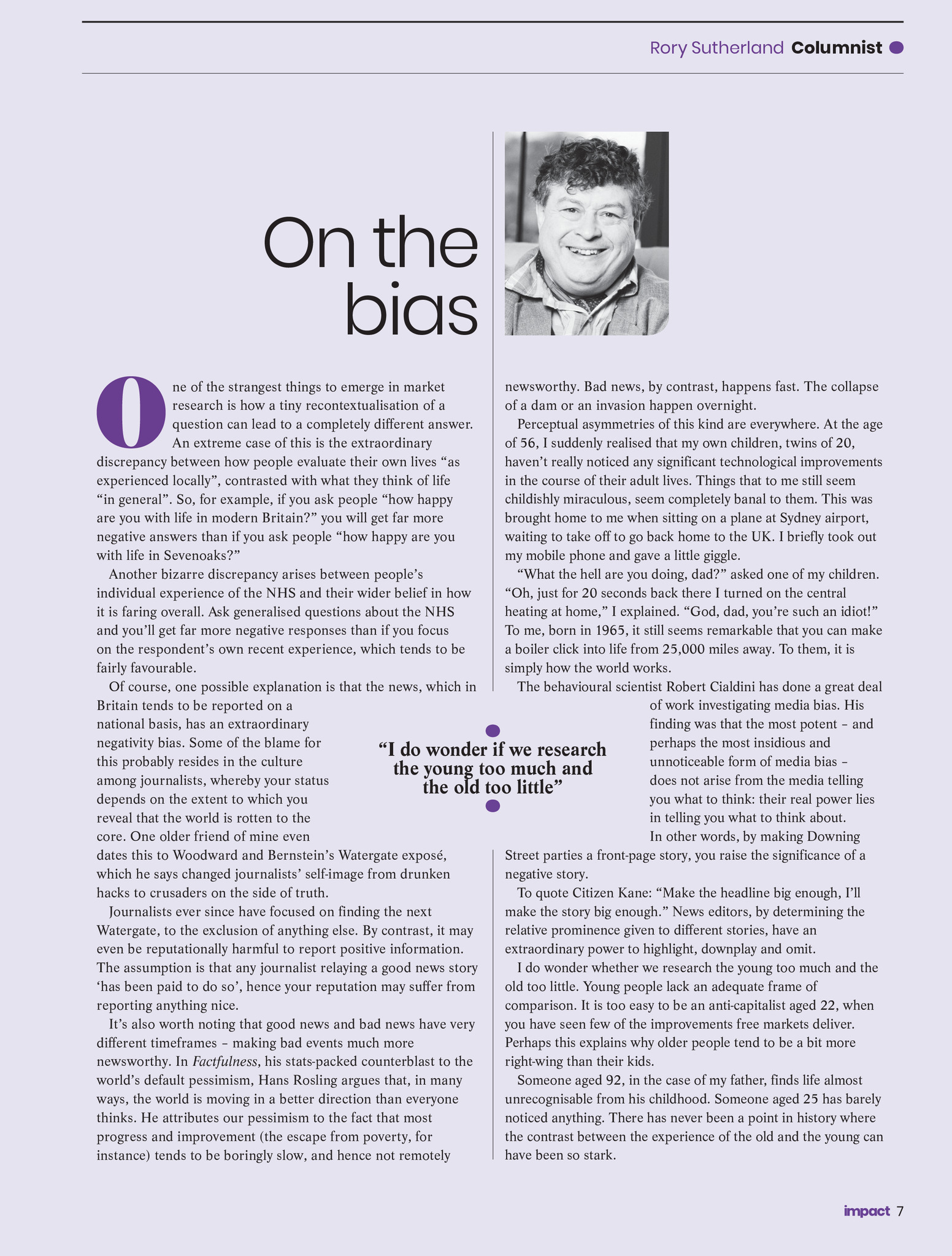

Rory Sutherland Columnist O On the bias newsworthy. Bad news, by contrast, happens fast. The collapse ne of the strangest things to emerge in market of a dam or an invasion happen overnight. research is how a tiny recontextualisation of a Perceptual asymmetries of this kind are everywhere. At the age question can lead to a completely dierent answer. of 56, I suddenly realised that my own children, twins of 20, An extreme case of this is the extraordinary havent really noticed any significant technological improvements discrepancy between how people evaluate their own lives as in the course of their adult lives. Things that to me still seem experienced locally, contrasted with what they think of life childishly miraculous, seem completely banal to them. This was in general. So, for example, if you ask people how happy brought home to me when sitting on a plane at Sydney airport, are you with life in modern Britain? you will get far more waiting to take o to go back home to the UK. I briefly took out negative answers than if you ask people how happy are you my mobile phone and gave a little giggle. with life in Sevenoaks? What the hell are you doing, dad? asked one of my children. Another bizarre discrepancy arises between peoples Oh, just for 20 seconds back there I turned on the central individual experience of the NHS and their wider belief in how heating at home, I explained. God, dad, youre such an idiot! it is faring overall. Ask generalised questions about the NHS To me, born in 1965, it still seems remarkable that you can make and youll get far more negative responses than if you focus a boiler click into life from 25,000 miles away. To them, it is on the respondents own recent experience, which tends to be simply how the world works. fairly favourable. The behavioural scientist Robert Cialdini has done a great deal Of course, one possible explanation is that the news, which in of work investigating media bias. His Britain tends to be reported on a finding was that the most potent and national basis, has an extraordinary perhaps the most insidious and negativity bias. Some of the blame for I do wonder if we research unnoticeable form of media bias this probably resides in the culture the young too much and does not arise from the media telling among journalists, whereby your status the old too little you what to think: their real power lies depends on the extent to which you in telling you what to think about. reveal that the world is rotten to the In other words, by making Downing core. One older friend of mine even Street parties a front-page story, you raise the significance of a dates this to Woodward and Bernsteins Watergate expos, negative story. which he says changed journalists self-image from drunken To quote Citizen Kane: Make the headline big enough, Ill hacks to crusaders on the side of truth. make the story big enough. News editors, by determining the Journalists ever since have focused on finding the next relative prominence given to dierent stories, have an Watergate, to the exclusion of anything else. By contrast, it may extraordinary power to highlight, downplay and omit. even be reputationally harmful to report positive information. I do wonder whether we research the young too much and the The assumption is that any journalist relaying a good news story old too little. Young people lack an adequate frame of has been paid to do so, hence your reputation may suer from comparison. It is too easy to be an anti-capitalist aged 22, when reporting anything nice. you have seen few of the improvements free markets deliver. Its also worth noting that good news and bad news have very Perhaps this explains why older people tend to be a bit more dierent timeframes making bad events much more right-wing than their kids. newsworthy. In Factfulness, his stats-packed counterblast to the Someone aged 92, in the case of my father, finds life almost worlds default pessimism, Hans Rosling argues that, in many unrecognisable from his childhood. Someone aged 25 has barely ways, the world is moving in a better direction than everyone noticed anything. There has never been a point in history where thinks. He attributes our pessimism to the fact that most the contrast between the experience of the old and the young can progress and improvement (the escape from poverty, for have been so stark. instance) tends to be boringly slow, and hence not remotely 7 Impact ISSUE 37 2022_pp6-7_Rory.indd 7 28/03/2022 14:30