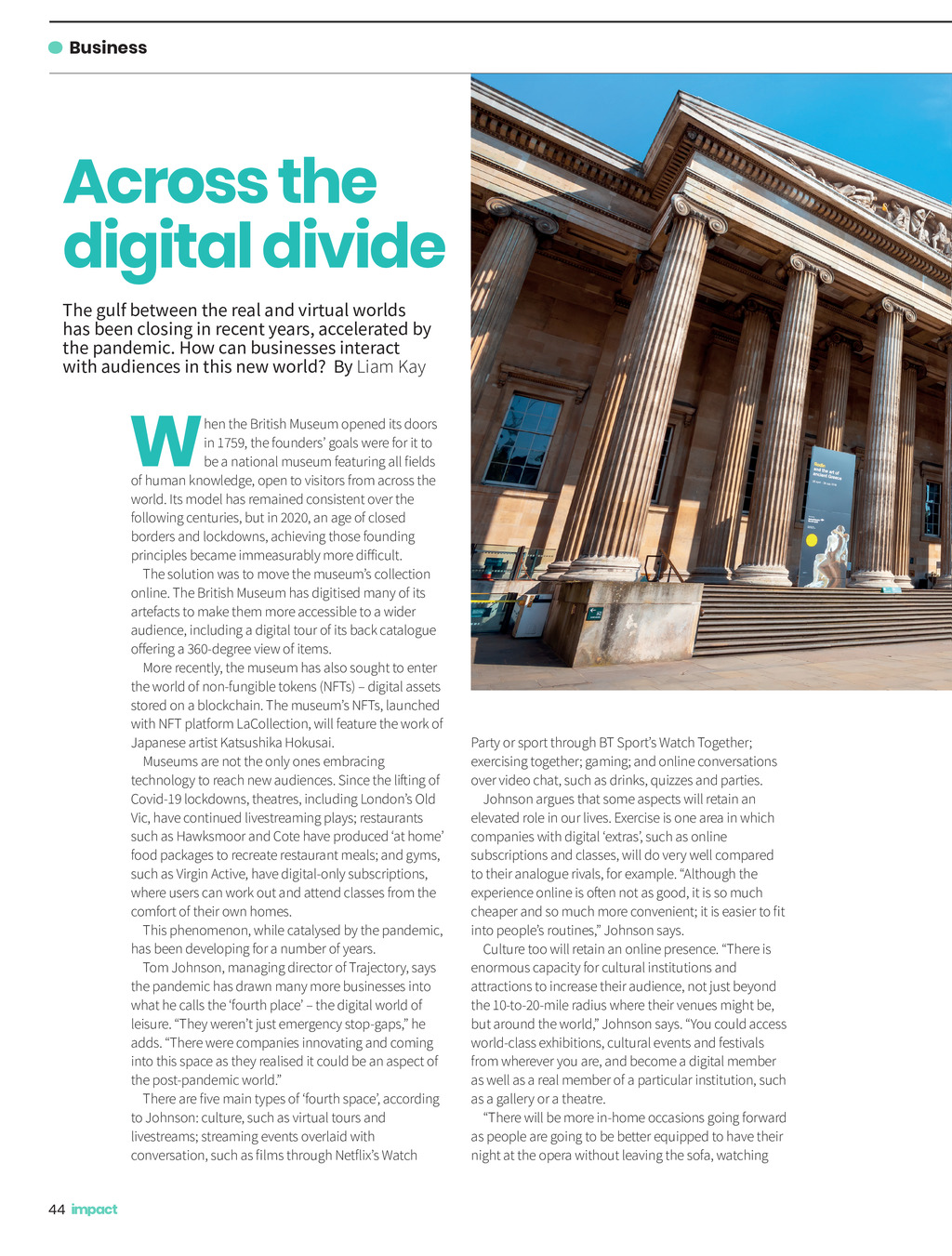
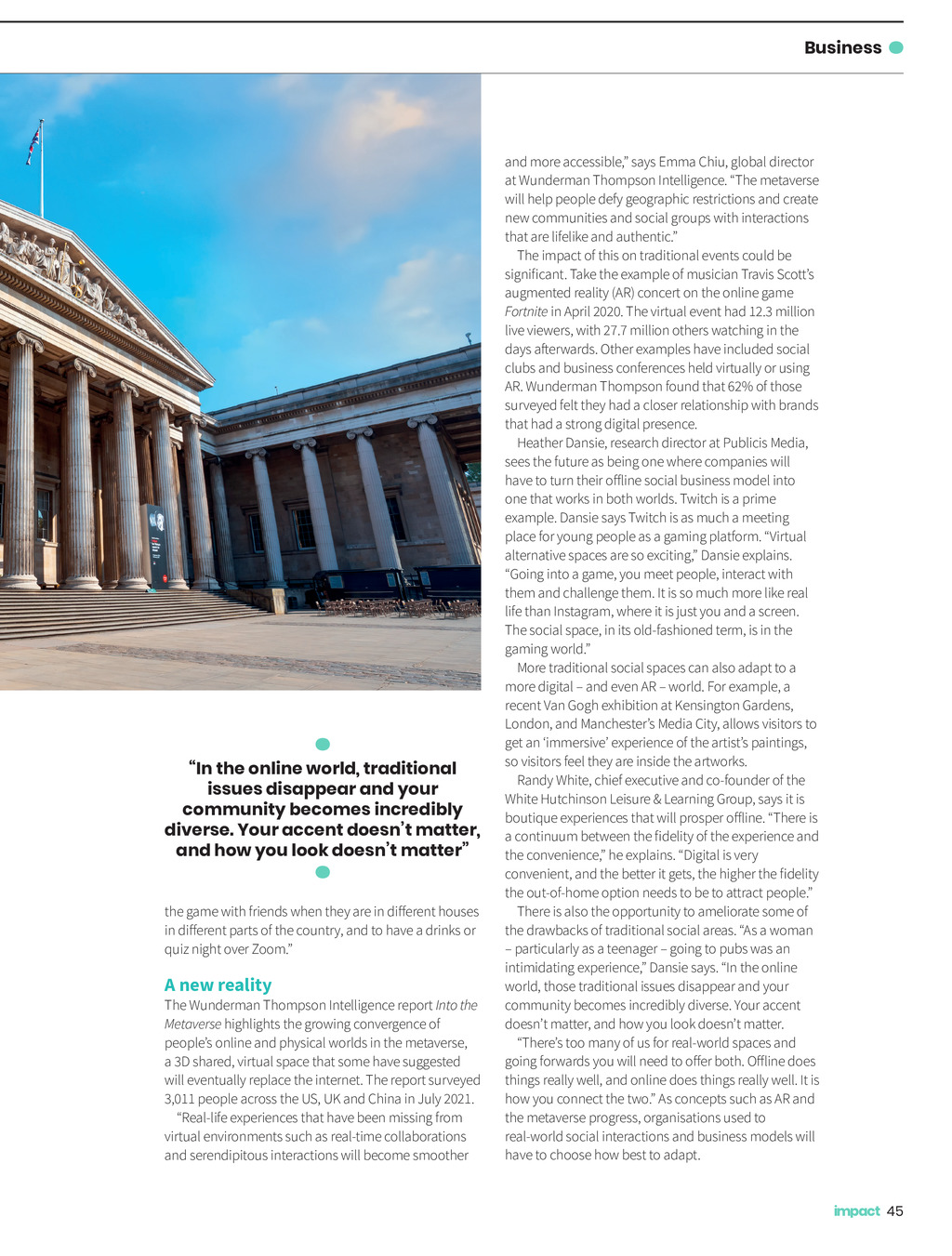
Business Across the digital divide The gulf between the real and virtual worlds has been closing in recent years, accelerated by the pandemic. How can businesses interact with audiences in this new world? By Liam Kay W hen the British Museum opened its doors in 1759, the founders goals were for it to be a national museum featuring all fields of human knowledge, open to visitors from across the world. Its model has remained consistent over the following centuries, but in 2020, an age of closed borders and lockdowns, achieving those founding principles became immeasurably more difficult. The solution was to move the museums collection online. The British Museum has digitised many of its artefacts to make them more accessible to a wider audience, including a digital tour of its back catalogue offering a 360-degree view of items. More recently, the museum has also sought to enter the world of non-fungible tokens (NFTs) digital assets stored on a blockchain. The museums NFTs, launched with NFT platform LaCollection, will feature the work of Japanese artist Katsushika Hokusai. Museums are not the only ones embracing technology to reach new audiences. Since the lifting of Covid-19 lockdowns, theatres, including Londons Old Vic, have continued livestreaming plays; restaurants such as Hawksmoor and Cote have produced at home food packages to recreate restaurant meals; and gyms, such as Virgin Active, have digital-only subscriptions, where users can work out and attend classes from the comfort of their own homes. This phenomenon, while catalysed by the pandemic, has been developing for a number of years. Tom Johnson, managing director of Trajectory, says the pandemic has drawn many more businesses into what he calls the fourth place the digital world of leisure. They werent just emergency stop-gaps, he adds. There were companies innovating and coming into this space as they realised it could be an aspect of the post-pandemic world. There are five main types of fourth space, according to Johnson: culture, such as virtual tours and livestreams; streaming events overlaid with conversation, such as films through Netflixs Watch Party or sport through BT Sports Watch Together; exercising together; gaming; and online conversations over video chat, such as drinks, quizzes and parties. Johnson argues that some aspects will retain an elevated role in our lives. Exercise is one area in which companies with digital extras, such as online subscriptions and classes, will do very well compared to their analogue rivals, for example. Although the experience online is often not as good, it is so much cheaper and so much more convenient; it is easier to fit into peoples routines, Johnson says. Culture too will retain an online presence. There is enormous capacity for cultural institutions and attractions to increase their audience, not just beyond the 10-to-20-mile radius where their venues might be, but around the world, Johnson says. You could access world-class exhibitions, cultural events and festivals from wherever you are, and become a digital member as well as a real member of a particular institution, such as a gallery or a theatre. There will be more in-home occasions going forward as people are going to be better equipped to have their night at the opera without leaving the sofa, watching 44 Impact ISSUE 36 2022_pp44-45 Subscription Services.indd 44 08/12/2021 10:14