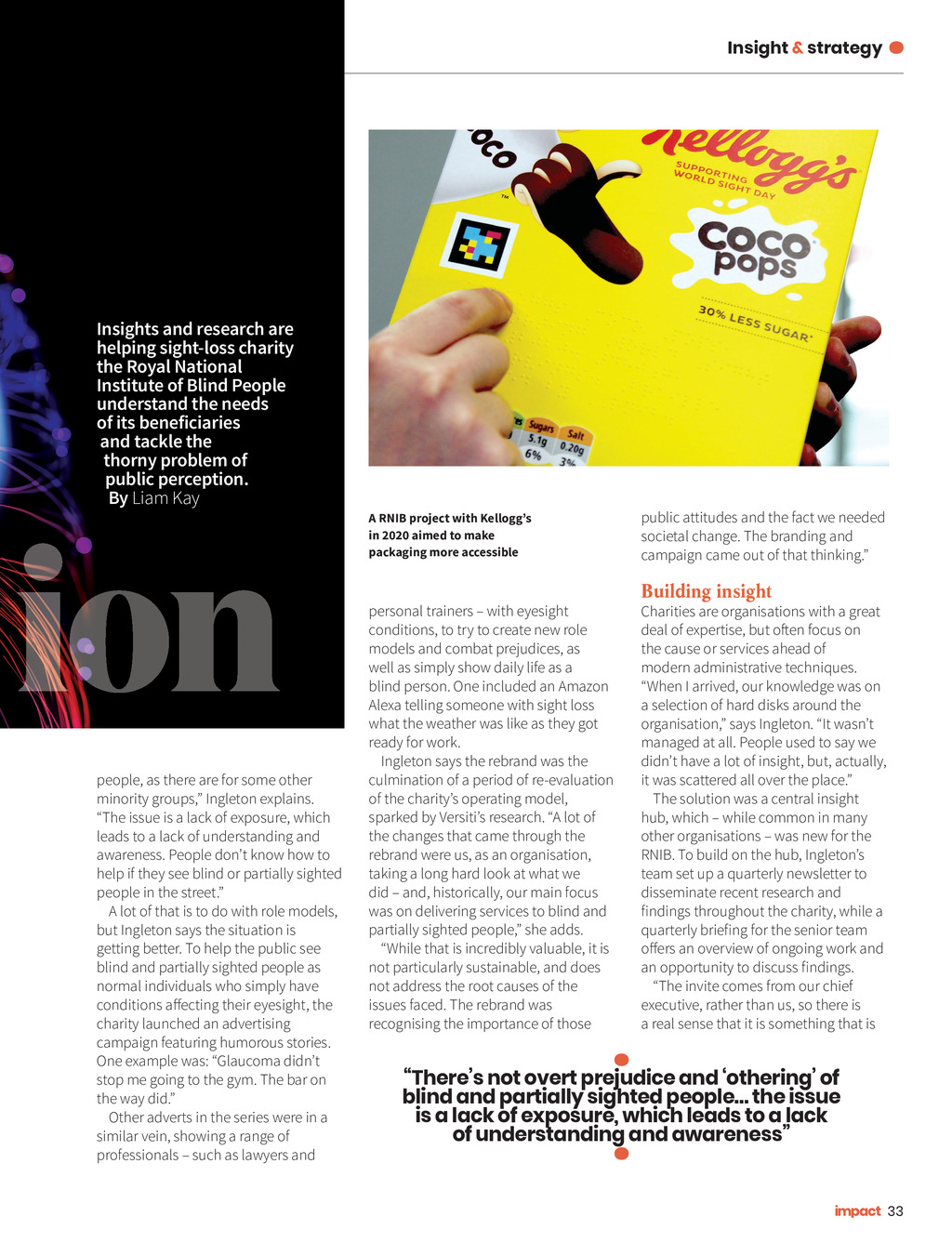
A clear vis i W hat comes to mind when you think of a blind person? There are countless stereotypes many people have, most of which do not represent the reality of living with sight loss. Campaigning organisations have sought to address this issue and combat misguided views of life as a blind or partially sighted person. For more than 150 years, the Royal National Institute of Blind People (RNIB) has sought to help blind and partially sighted people lead as full a life as possible, and aims to counteract false perceptions of what life is like with sight loss. The charity has embraced the second part of its purpose fully in recent years, embarking on a rebrand and shift in focus in 2018, with a resulting emphasis on ghting misconceptions and stereotypes of blind and partially sighted people. It dropped some of its services as it looked at how it could make the biggest dierence to people with sight loss across the country. A lot of our work is around making the world a more accessible place for blind and partially sighted people, and that stems a lot from how businesses oer their services and making sure that diversity, inclusion and accessibility are embedded in service providers, says Hilary Ingleton, head of research and insight at RNIB. It is a huge and broad remit, and the breadth of what we cover is quite mind-blowing sometimes. Ingleton has worked for the charity since 2019 and leads its 11-strong research team. She joined in the wake of the charitys rebrand, which included a new tagline Seeing dierently and a logo that uses a font resembling an eye test. The rebrand cost 70,000 and included work with creative agency The&Partnership. Public perception has continued to be tracked by ICM Unlimited, following on from a research project by Versiti. Misconceptions The rebrand was partially the result of Versitis project (see boxout), which sought to understand some of the views held by the public about the sight-loss community. It found a number of stereotypes, particularly around the kinds of jobs that blind and partially sighted people could take on. Theres not overt prejudice and othering of blind and partially sighted 32 Impact ISSUE 36 2022_pp32-35 I&S RNIB.indd 32 08/12/2021 10:08