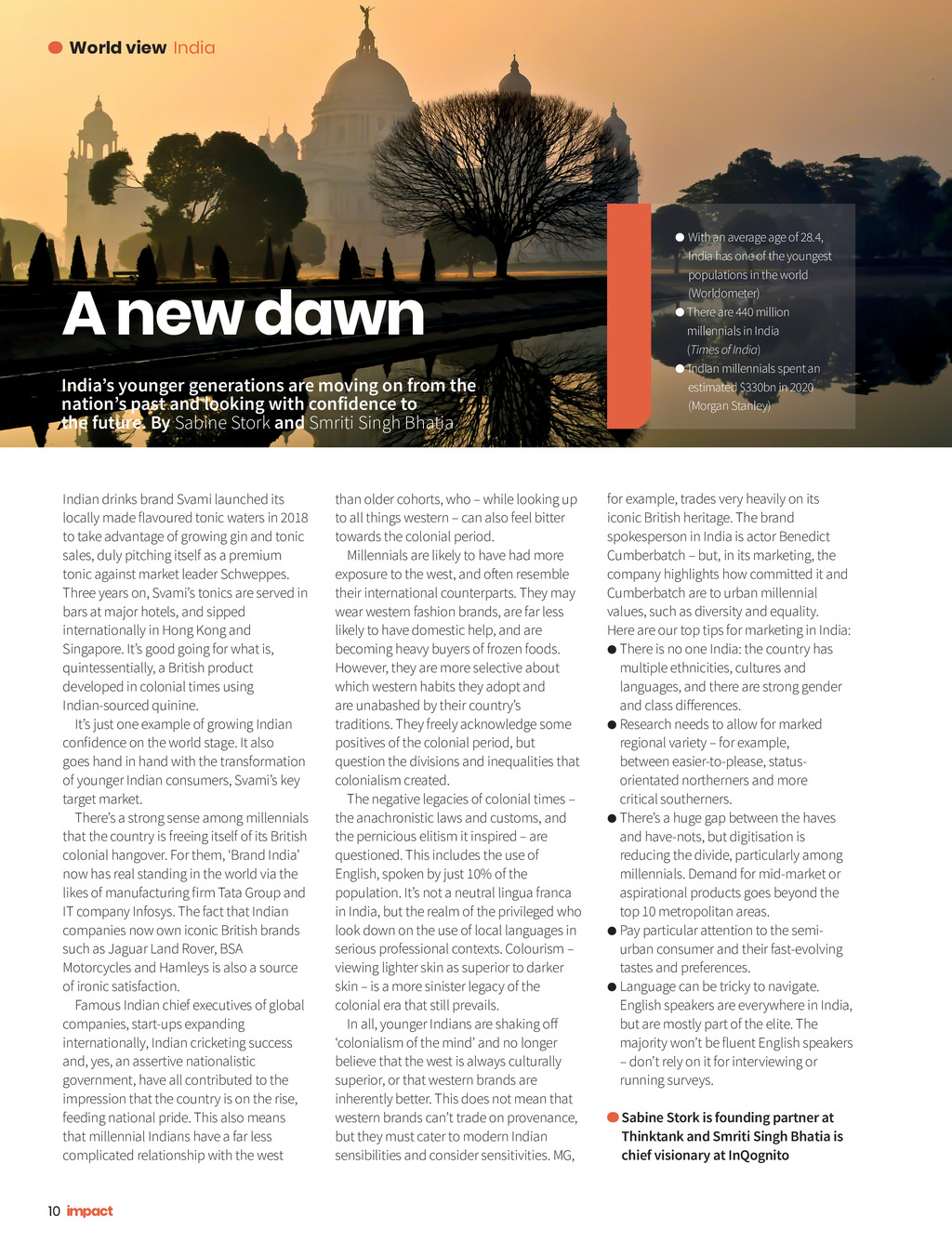

World view India With an average age of 28.4, A new dawn Indias younger generations are moving on from the nations past and looking with confidence to the future. By Sabine Stork and Smriti Singh Bhatia Indian drinks brand Svami launched its locally made avoured tonic waters in 2018 to take advantage of growing gin and tonic sales, duly pitching itself as a premium tonic against market leader Schweppes. Three years on, Svamis tonics are served in bars at major hotels, and sipped internationally in Hong Kong and Singapore. Its good going for what is, quintessentially, a British product developed in colonial times using Indian-sourced quinine. Its just one example of growing Indian condence on the world stage. It also goes hand in hand with the transformation of younger Indian consumers, Svamis key target market. Theres a strong sense among millennials that the country is freeing itself of its British colonial hangover. For them, Brand India now has real standing in the world via the likes of manufacturing rm Tata Group and IT company Infosys. The fact that Indian companies now own iconic British brands such as Jaguar Land Rover, BSA Motorcycles and Hamleys is also a source of ironic satisfaction. Famous Indian chief executives of global companies, start-ups expanding internationally, Indian cricketing success and, yes, an assertive nationalistic government, have all contributed to the impression that the country is on the rise, feeding national pride. This also means that millennial Indians have a far less complicated relationship with the west than older cohorts, who while looking up to all things western can also feel bitter towards the colonial period. Millennials are likely to have had more exposure to the west, and often resemble their international counterparts. They may wear western fashion brands, are far less likely to have domestic help, and are becoming heavy buyers of frozen foods. However, they are more selective about which western habits they adopt and are unabashed by their countrys traditions. They freely acknowledge some positives of the colonial period, but question the divisions and inequalities that colonialism created. The negative legacies of colonial times the anachronistic laws and customs, and the pernicious elitism it inspired are questioned. This includes the use of English, spoken by just 10% of the population. Its not a neutral lingua franca in India, but the realm of the privileged who look down on the use of local languages in serious professional contexts. Colourism viewing lighter skin as superior to darker skin is a more sinister legacy of the colonial era that still prevails. In all, younger Indians are shaking o colonialism of the mind and no longer believe that the west is always culturally superior, or that western brands are inherently better. This does not mean that western brands cant trade on provenance, but they must cater to modern Indian sensibilities and consider sensitivities. MG, India has one of the youngest populations in the world (Worldometer) There are 440 million millennials in India (Times of India) Indian millennials spent an estimated $330bn in 2020 (Morgan Stanley) for example, trades very heavily on its iconic British heritage. The brand spokesperson in India is actor Benedict Cumberbatch but, in its marketing, the company highlights how committed it and Cumberbatch are to urban millennial values, such as diversity and equality. Here are our top tips for marketing in India: There is no one India: the country has multiple ethnicities, cultures and languages, and there are strong gender and class dierences. Research needs to allow for marked regional variety for example, between easier-to-please, statusorientated northerners and more critical southerners. Theres a huge gap between the haves and have-nots, but digitisation is reducing the divide, particularly among millennials. Demand for mid-market or aspirational products goes beyond the top 10 metropolitan areas. Pay particular attention to the semiurban consumer and their fast-evolving tastes and preferences. Language can be tricky to navigate. English speakers are everywhere in India, but are mostly part of the elite. The majority wont be uent English speakers dont rely on it for interviewing or running surveys. Sabine Stork is founding partner at Thinktank and Smriti Singh Bhatia is chief visionary at InQognito 10 Impact ISSUE 36 2022_pp10 WV India.indd 10 08/12/2021 09:34