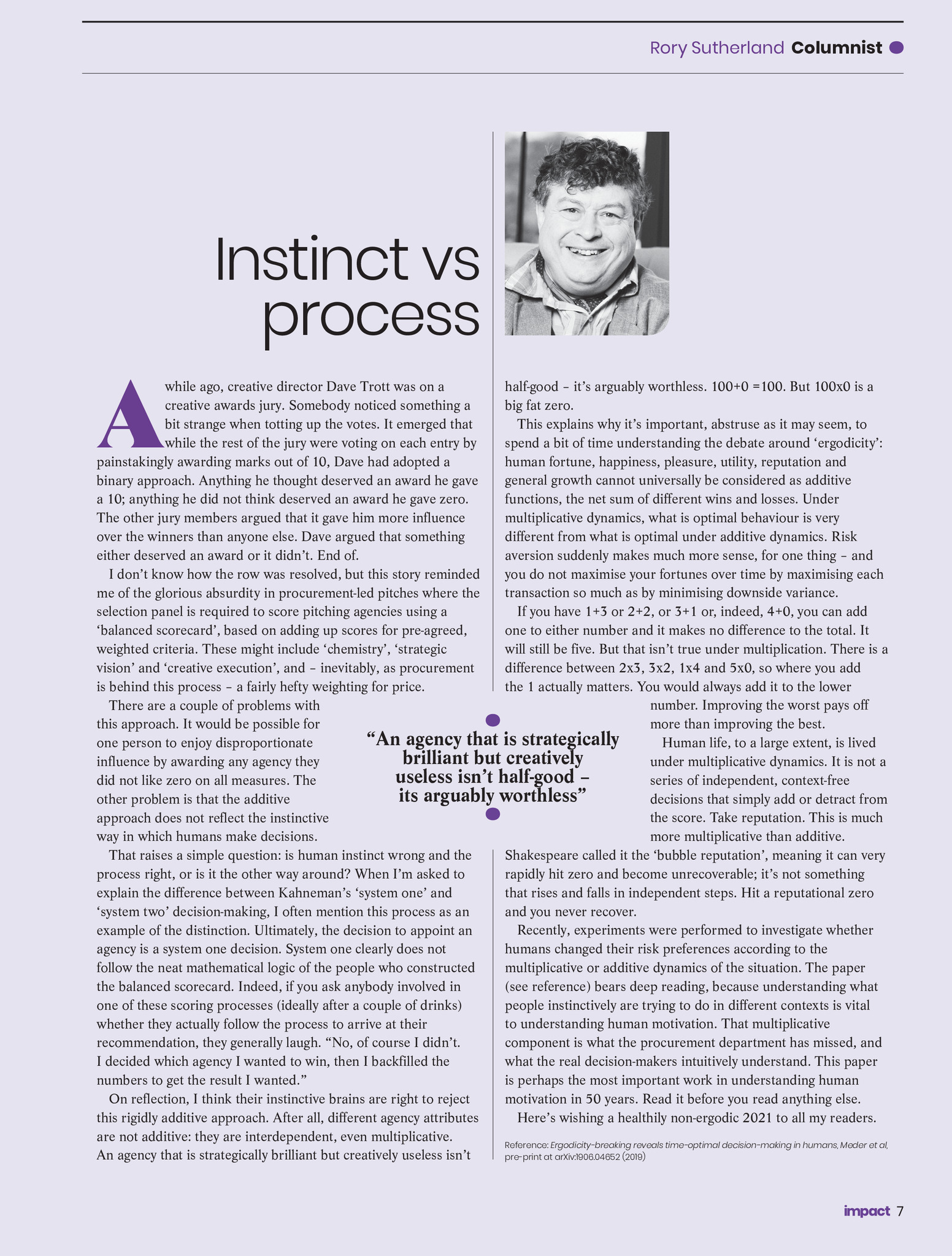
Rory Sutherland Columnist A Instinct vs process half-good its arguably worthless. 100+0 =100. But 100x0 is a while ago, creative director Dave Trott was on a big fat zero. creative awards jury. Somebody noticed something a This explains why its important, abstruse as it may seem, to bit strange when totting up the votes. It emerged that spend a bit of time understanding the debate around ergodicity: while the rest of the jury were voting on each entry by human fortune, happiness, pleasure, utility, reputation and painstakingly awarding marks out of 10, Dave had adopted a general growth cannot universally be considered as additive binary approach. Anything he thought deserved an award he gave functions, the net sum of different wins and losses. Under a 10; anything he did not think deserved an award he gave zero. multiplicative dynamics, what is optimal behaviour is very The other jury members argued that it gave him more influence different from what is optimal under additive dynamics. Risk over the winners than anyone else. Dave argued that something aversion suddenly makes much more sense, for one thing and either deserved an award or it didnt. End of. you do not maximise your fortunes over time by maximising each I dont know how the row was resolved, but this story reminded transaction so much as by minimising downside variance. me of the glorious absurdity in procurement-led pitches where the If you have 1+3 or 2+2, or 3+1 or, indeed, 4+0, you can add selection panel is required to score pitching agencies using a one to either number and it makes no difference to the total. It balanced scorecard, based on adding up scores for pre-agreed, will still be five. But that isnt true under multiplication. There is a weighted criteria. These might include chemistry, strategic difference between 2x3, 3x2, 1x4 and 5x0, so where you add vision and creative execution, and inevitably, as procurement the 1 actually matters. You would always add it to the lower is behind this process a fairly hefty weighting for price. number. Improving the worst pays off There are a couple of problems with more than improving the best. this approach. It would be possible for An agency that is strategically Human life, to a large extent, is lived one person to enjoy disproportionate brilliant but creatively under multiplicative dynamics. It is not a influence by awarding any agency they useless isnt half-good series of independent, context-free did not like zero on all measures. The its arguably worthless decisions that simply add or detract from other problem is that the additive the score. Take reputation. This is much approach does not reflect the instinctive more multiplicative than additive. way in which humans make decisions. Shakespeare called it the bubble reputation, meaning it can very That raises a simple question: is human instinct wrong and the rapidly hit zero and become unrecoverable; its not something process right, or is it the other way around? When Im asked to that rises and falls in independent steps. Hit a reputational zero explain the difference between Kahnemans system one and and you never recover. system two decision-making, I often mention this process as an Recently, experiments were performed to investigate whether example of the distinction. Ultimately, the decision to appoint an humans changed their risk preferences according to the agency is a system one decision. System one clearly does not multiplicative or additive dynamics of the situation. The paper follow the neat mathematical logic of the people who constructed (see reference) bears deep reading, because understanding what the balanced scorecard. Indeed, if you ask anybody involved in people instinctively are trying to do in different contexts is vital one of these scoring processes (ideally after a couple of drinks) to understanding human motivation. That multiplicative whether they actually follow the process to arrive at their component is what the procurement department has missed, and recommendation, they generally laugh. No, of course I didnt. what the real decision-makers intuitively understand. This paper I decided which agency I wanted to win, then I backfilled the is perhaps the most important work in understanding human numbers to get the result I wanted. motivation in 50 years. Read it before you read anything else. On reflection, I think their instinctive brains are right to reject Heres wishing a healthily non-ergodic 2021 to all my readers. this rigidly additive approach. After all, different agency attributes are not additive: they are interdependent, even multiplicative. Reference: Ergodicity-breaking reveals time-optimal decision-making in humans, Meder et al, An agency that is strategically brilliant but creatively useless isnt pre-print at arXiv:1906.04652 (2019) 7