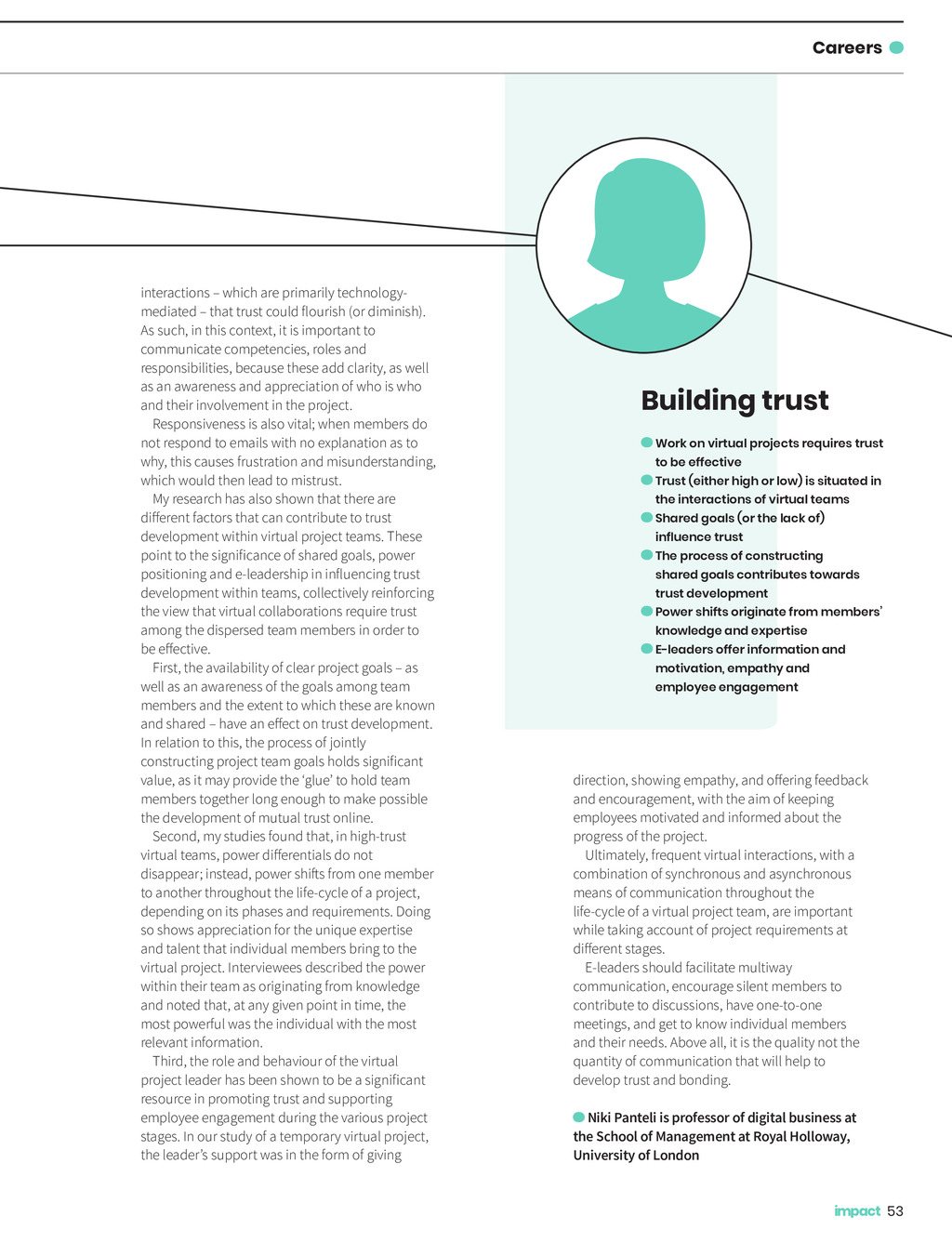
Careers Team bonding Organisations and individuals can take a few key steps to develop trust in virtual teams, including setting clear project goals, says Niki Panteli T rust is an important ingredient for working effectively and successfully online. Nevertheless, it is often reported as one of the key challenges of virtual work. With virtual teams, work can take place anywhere, anytime, while the use of different communication technologies enables dispersed employees to work on joint projects. This form of work is not new, but up until recently it was a choice. For organisations, it was a way to bring talented individuals together, regardless of their location, to collaborate on joint projects; for individuals, it was a preference to work flexibly, both in time and space. With Covid-19, and because of the ongoing lockdowns, virtual project teams have become a necessity an enforced way of organising and, often, the only form of work arrangement for many professionals and organisations. Trust has been found by several scholars to be crucial for the success of virtual project teams. It has been specifically stated that virtuality requires 52 trust to make it work. As Charles Handy, a management author, said in 1995, it is unwise to trust people you do not know, whose work you have not seen, and who you do not know are committed to a project. Yet he also said if we are to enjoy the benefits of virtual teams, we have to trust more. For Handy, a way to develop trust online was by promoting face-to-face meetings among the dispersed team members. However, this may not always be possible because of budget, time and current travel restrictions, for example. So, the question that I have been asking in my own investigations is: how does trust develop within virtual project teams? After a series of qualitative case studies and interviews with virtual team members in organisations across different sectors and of varied sizes including small firms and large multinationals I have come across teams that experienced high trust and others that experienced low trust. Unsurprisingly, members talked enthusiastically about the former, but shared their frustration at being part of the latter. Based on my research in this area, I argue that trust, whether high or low, is situated in the interactions between virtual team members. So, my position is that it is within these virtual team