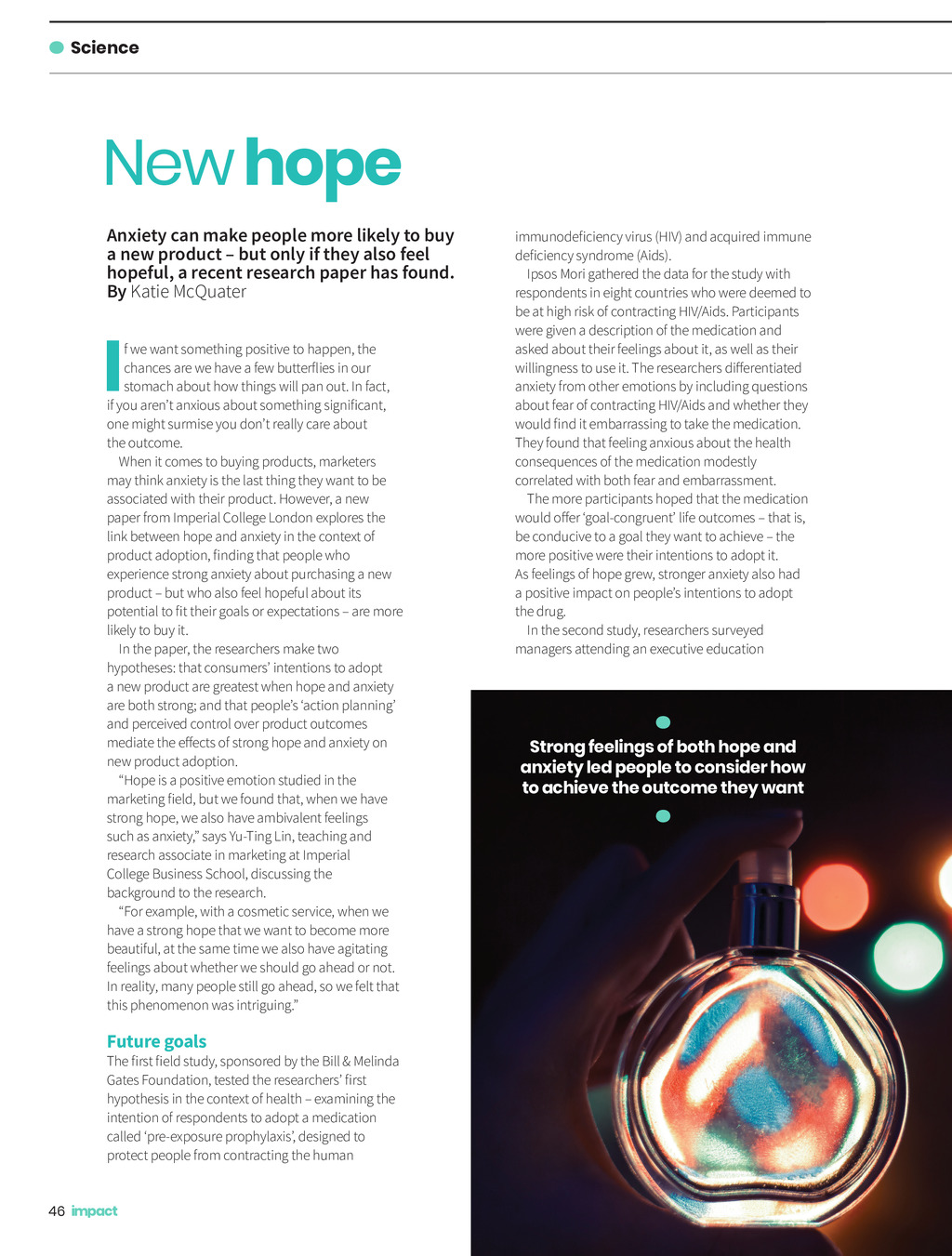
Science New hope Anxiety can make people more likely to buy a new product but only if they also feel hopeful, a recent research paper has found. By Katie McQuater I f we want something positive to happen, the chances are we have a few butterflies in our stomach about how things will pan out. In fact, if you arent anxious about something significant, one might surmise you dont really care about the outcome. When it comes to buying products, marketers may think anxiety is the last thing they want to be associated with their product. However, a new paper from Imperial College London explores the link between hope and anxiety in the context of product adoption, finding that people who experience strong anxiety about purchasing a new product but who also feel hopeful about its potential to fit their goals or expectations are more likely to buy it. In the paper, the researchers make two hypotheses: that consumers intentions to adopt a new product are greatest when hope and anxiety are both strong; and that peoples action planning and perceived control over product outcomes mediate the effects of strong hope and anxiety on new product adoption. Hope is a positive emotion studied in the marketing field, but we found that, when we have strong hope, we also have ambivalent feelings such as anxiety, says Yu-Ting Lin, teaching and research associate in marketing at Imperial College Business School, discussing the background to the research. For example, with a cosmetic service, when we have a strong hope that we want to become more beautiful, at the same time we also have agitating feelings about whether we should go ahead or not. In reality, many people still go ahead, so we felt that this phenomenon was intriguing. Future goals The first field study, sponsored by the Bill & Melinda Gates Foundation, tested the researchers first hypothesis in the context of health examining the intention of respondents to adopt a medication called pre-exposure prophylaxis, designed to protect people from contracting the human 46 immunodeficiency virus (HIV) and acquired immune deficiency syndrome (Aids). Ipsos Mori gathered the data for the study with respondents in eight countries who were deemed to be at high risk of contracting HIV/Aids. Participants were given a description of the medication and asked about their feelings about it, as well as their willingness to use it. The researchers differentiated anxiety from other emotions by including questions about fear of contracting HIV/Aids and whether they would find it embarrassing to take the medication. They found that feeling anxious about the health consequences of the medication modestly correlated with both fear and embarrassment. The more participants hoped that the medication would offer goal-congruent life outcomes that is, be conducive to a goal they want to achieve the more positive were their intentions to adopt it. As feelings of hope grew, stronger anxiety also had a positive impact on peoples intentions to adopt the drug. In the second study, researchers surveyed managers attending an executive education Strong feelings of both hope and anxiety led people to consider how to achieve the outcome they want