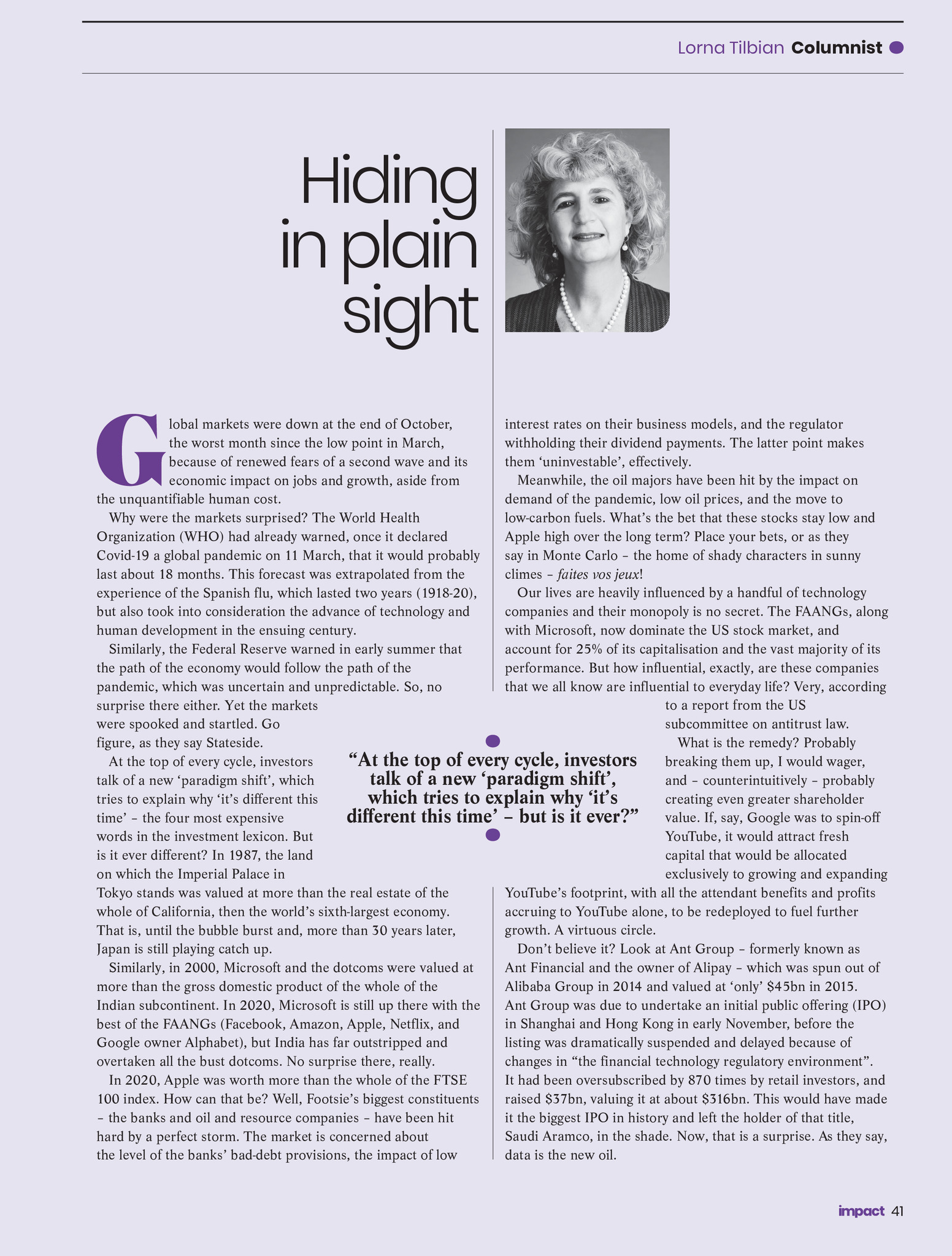
Lorna Tilbian Columnist Hiding in plain sight G interest rates on their business models, and the regulator lobal markets were down at the end of October, withholding their dividend payments. The latter point makes the worst month since the low point in March, them uninvestable, effectively. because of renewed fears of a second wave and its Meanwhile, the oil majors have been hit by the impact on economic impact on jobs and growth, aside from demand of the pandemic, low oil prices, and the move to the unquantifiable human cost. low-carbon fuels. Whats the bet that these stocks stay low and Why were the markets surprised? The World Health Apple high over the long term? Place your bets, or as they Organization (WHO) had already warned, once it declared say in Monte Carlo the home of shady characters in sunny Covid-19 a global pandemic on 11 March, that it would probably climes faites vos jeux! last about 18 months. This forecast was extrapolated from the Our lives are heavily influenced by a handful of technology experience of the Spanish flu, which lasted two years (1918-20), companies and their monopoly is no secret. The FAANGs, along but also took into consideration the advance of technology and with Microsoft, now dominate the US stock market, and human development in the ensuing century. account for 25% of its capitalisation and the vast majority of its Similarly, the Federal Reserve warned in early summer that performance. But how influential, exactly, are these companies the path of the economy would follow the path of the that we all know are influential to everyday life? Very, according pandemic, which was uncertain and unpredictable. So, no to a report from the US surprise there either. Yet the markets subcommittee on antitrust law. were spooked and startled. Go What is the remedy? Probably figure, as they say Stateside. At the top of every cycle, investors At the top of every cycle, investors breaking them up, I would wager, and counterintuitively probably talk of a new paradigm shift, which talk of a new paradigm shift, creating even greater shareholder tries to explain why its different this which tries to explain why its time the four most expensive different this time but is it ever? value. If, say, Google was to spin-off YouTube, it would attract fresh words in the investment lexicon. But capital that would be allocated is it ever different? In 1987, the land exclusively to growing and expanding on which the Imperial Palace in YouTubes footprint, with all the attendant benefits and profits Tokyo stands was valued at more than the real estate of the accruing to YouTube alone, to be redeployed to fuel further whole of California, then the worlds sixth-largest economy. growth. A virtuous circle. That is, until the bubble burst and, more than 30 years later, Dont believe it? Look at Ant Group formerly known as Japan is still playing catch up. Ant Financial and the owner of Alipay which was spun out of Similarly, in 2000, Microsoft and the dotcoms were valued at Alibaba Group in 2014 and valued at only $45bn in 2015. more than the gross domestic product of the whole of the Ant Group was due to undertake an initial public offering (IPO) Indian subcontinent. In 2020, Microsoft is still up there with the in Shanghai and Hong Kong in early November, before the best of the FAANGs (Facebook, Amazon, Apple, Netflix, and listing was dramatically suspended and delayed because of Google owner Alphabet), but India has far outstripped and changes in the financial technology regulatory environment. overtaken all the bust dotcoms. No surprise there, really. It had been oversubscribed by 870 times by retail investors, and In 2020, Apple was worth more than the whole of the FTSE raised $37bn, valuing it at about $316bn. This would have made 100 index. How can that be? Well, Footsies biggest constituents it the biggest IPO in history and left the holder of that title, the banks and oil and resource companies have been hit Saudi Aramco, in the shade. Now, that is a surprise. As they say, hard by a perfect storm. The market is concerned about data is the new oil. the level of the banks bad-debt provisions, the impact of low 41