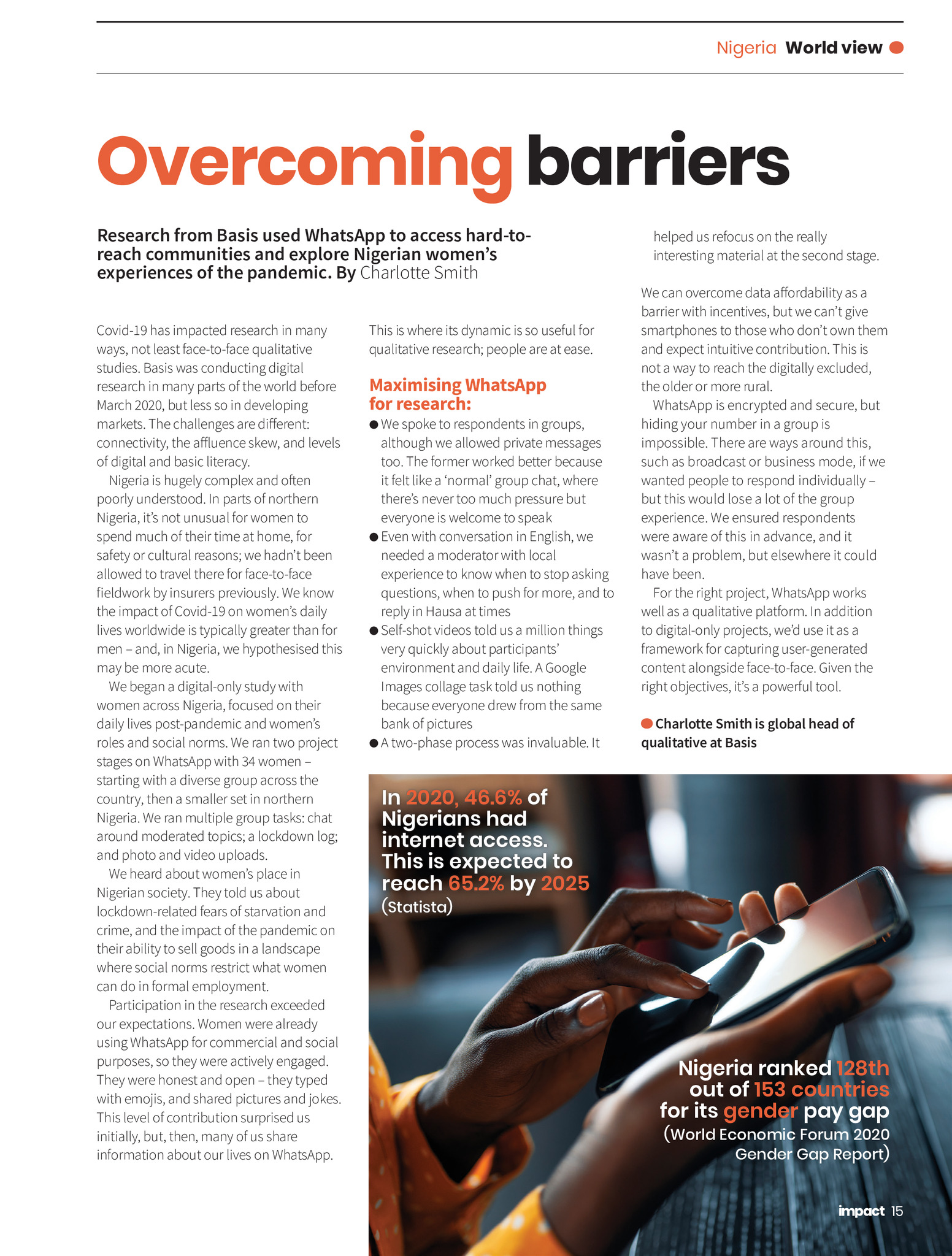
Nigeria World view Overcoming barriers Research from Basis used WhatsApp to access hard-toreach communities and explore Nigerian womens experiences of the pandemic. By Charlotte Smith Covid-19 has impacted research in many ways, not least face-to-face qualitative studies. Basis was conducting digital research in many parts of the world before March 2020, but less so in developing markets. The challenges are different: connectivity, the affluence skew, and levels of digital and basic literacy. Nigeria is hugely complex and often poorly understood. In parts of northern Nigeria, its not unusual for women to spend much of their time at home, for safety or cultural reasons; we hadnt been allowed to travel there for face-to-face fieldwork by insurers previously. We know the impact of Covid-19 on womens daily lives worldwide is typically greater than for men and, in Nigeria, we hypothesised this may be more acute. We began a digital-only study with women across Nigeria, focused on their daily lives post-pandemic and womens roles and social norms. We ran two project stages on WhatsApp with 34 women starting with a diverse group across the country, then a smaller set in northern Nigeria. We ran multiple group tasks: chat around moderated topics; a lockdown log; and photo and video uploads. We heard about womens place in Nigerian society. They told us about lockdown-related fears of starvation and crime, and the impact of the pandemic on their ability to sell goods in a landscape where social norms restrict what women can do in formal employment. Participation in the research exceeded our expectations. Women were already using WhatsApp for commercial and social purposes, so they were actively engaged. They were honest and open they typed with emojis, and shared pictures and jokes. This level of contribution surprised us initially, but, then, many of us share information about our lives on WhatsApp. This is where its dynamic is so useful for qualitative research; people are at ease. Maximising WhatsApp for research: We spoke to respondents in groups, although we allowed private messages too. The former worked better because it felt like a normal group chat, where theres never too much pressure but everyone is welcome to speak Even with conversation in English, we needed a moderator with local experience to know when to stop asking questions, when to push for more, and to reply in Hausa at times Self-shot videos told us a million things very quickly about participants environment and daily life. A Google Images collage task told us nothing because everyone drew from the same bank of pictures A two-phase process was invaluable. It helped us refocus on the really interesting material at the second stage. We can overcome data affordability as a barrier with incentives, but we cant give smartphones to those who dont own them and expect intuitive contribution. This is not a way to reach the digitally excluded, the older or more rural. WhatsApp is encrypted and secure, but hiding your number in a group is impossible. There are ways around this, such as broadcast or business mode, if we wanted people to respond individually but this would lose a lot of the group experience. We ensured respondents were aware of this in advance, and it wasnt a problem, but elsewhere it could have been. For the right project, WhatsApp works well as a qualitative platform. In addition to digital-only projects, wed use it as a framework for capturing user-generated content alongside face-to-face. Given the right objectives, its a powerful tool. Charlotte Smith is global head of qualitative at Basis In 2020, 46.6% of Nigerians had internet access. This is expected to reach 65.2% by 2025 (Statista) Nigeria ranked 128th out of 153 countries for its gender pay gap (World Economic Forum 2020 Gender Gap Report) 15