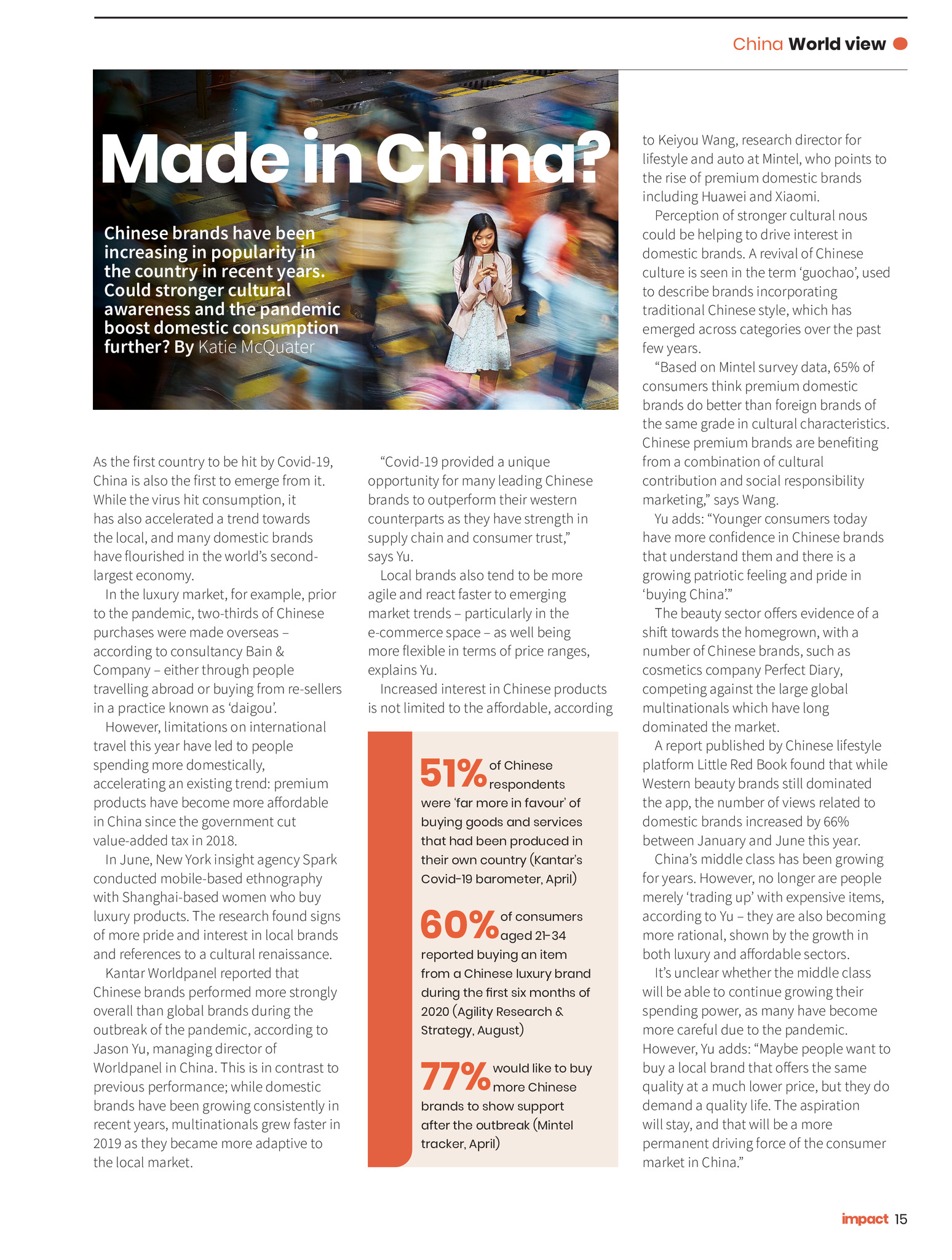
China World view Made in China? Chinese brands have been increasing in popularity in the country in recent years. Could stronger cultural awareness and the pandemic boost domestic consumption further? By atie c uater s the first country to be hit by ovid , hina is also the first to emerge from it. hile the virus hit consumption, it has also accelerated a trend towards the local, and many domestic brands have flourished in the worlds second largest economy. n the luxury market, for example, prior to the pandemic, two thirds of hinese purchases were made overseas according to consultancy ain ompany either through people travelling abroad or buying from re sellers in a practice known as daigou. owever, limitations on international travel this year have led to people spending more domestically, accelerating an existing trend premium products have become more affordable in hina since the government cut value added tax in . n une, ew ork insight agency park conducted mobile based ethnography with hanghai based women who buy luxury products. The research found signs of more pride and interest in local brands and references to a cultural renaissance. antar orldpanel reported that hinese brands performed more strongly overall than global brands during the outbreak of the pandemic, according to ason u, managing director of orldpanel in hina. This is in contrast to previous performance; while domestic brands have been growing consistently in recent years, multinationals grew faster in as they became more adaptive to the local market. ovid provided a uni ue opportunity for many leading hinese brands to outperform their western counterparts as they have strength in supply chain and consumer trust, says u. ocal brands also tend to be more agile and react faster to emerging market trends particularly in the e commerce space as well being more flexible in terms of price ranges, explains u. ncreased interest in hinese products is not limited to the affordable, according 51% of Chinese respondents were far more in favour of buying goods and services that had been produced in their own country (Kantars Covid-19 barometer, April) 60% of consumers aged 21-34 reported buying an item from a Chinese luxury brand durin the first si onths o 2020 (Agility Research & Strategy, August) 77% would like to buy more Chinese brands to show support after the outbreak (Mintel tracker, April) to eiyou ang, research director for lifestyle and auto at intel, who points to the rise of premium domestic brands including uawei and iaomi. Perception of stronger cultural nous could be helping to drive interest in domestic brands. revival of hinese culture is seen in the term guochao, used to describe brands incorporating traditional hinese style, which has emerged across categories over the past few years. ased on intel survey data, of consumers think premium domestic brands do better than foreign brands of the same grade in cultural characteristics. hinese premium brands are benefiting from a combination of cultural contribution and social responsibility marketing, says ang. u adds ounger consumers today have more confidence in hinese brands that understand them and there is a growing patriotic feeling and pride in buying hina. The beauty sector offers evidence of a shi towards the homegrown, with a number of hinese brands, such as cosmetics company Perfect iary, competing against the large global multinationals which have long dominated the market. report published by hinese lifestyle platform ittle ed ook found that while estern beauty brands still dominated the app, the number of views related to domestic brands increased by between anuary and une this year. hinas middle class has been growing for years. owever, no longer are people merely trading up with expensive items, according to u they are also becoming more rational, shown by the growth in both luxury and affordable sectors. ts unclear whether the middle class will be able to continue growing their spending power, as many have become more careful due to the pandemic. owever, u adds aybe people want to buy a local brand that offers the same uality at a much lower price, but they do demand a uality life. The aspiration will stay, and that will be a more permanent driving force of the consumer market in hina. 15 Impact ISSUE 31 20_pp15 China.indd 15 18/09/2020 10:21