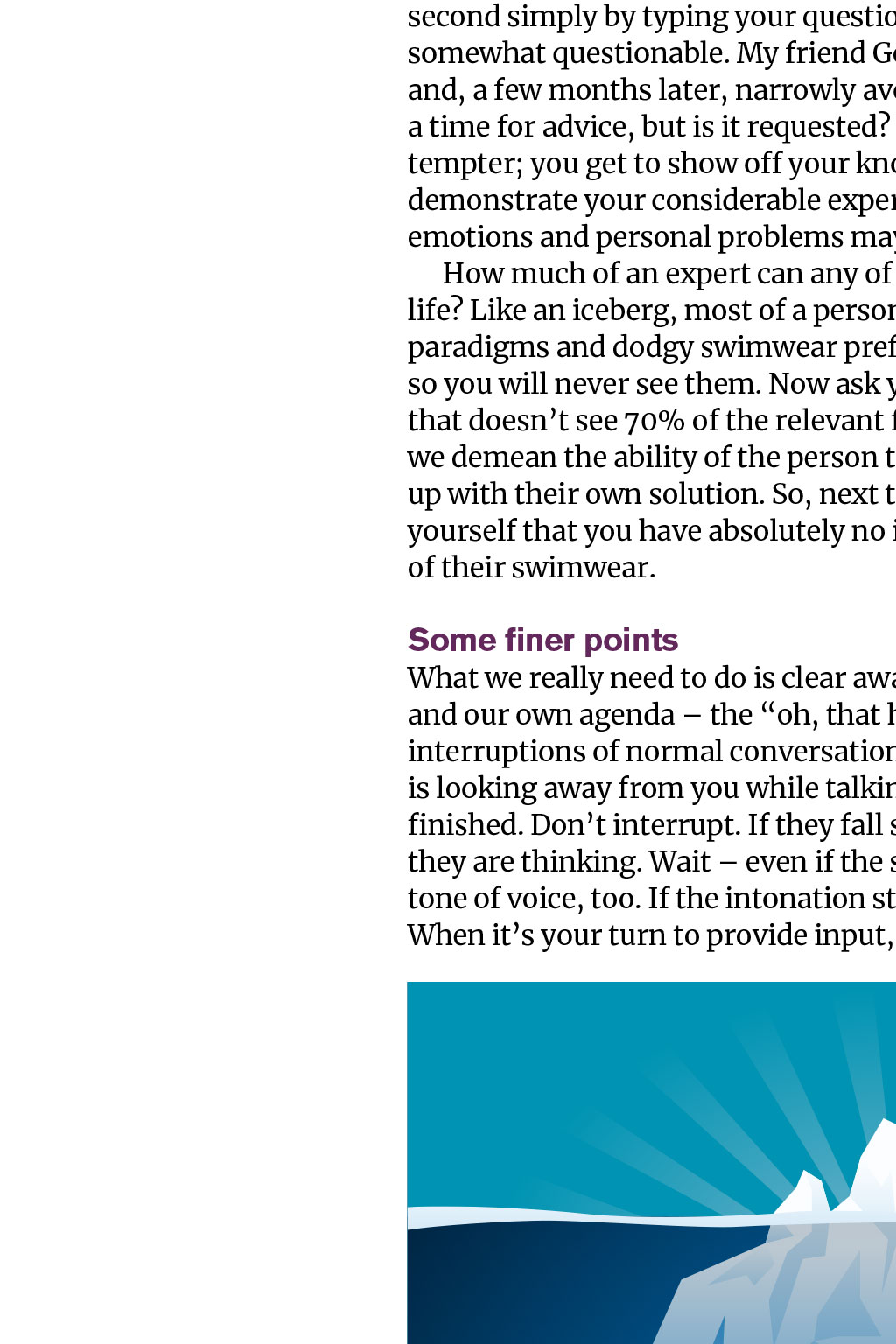
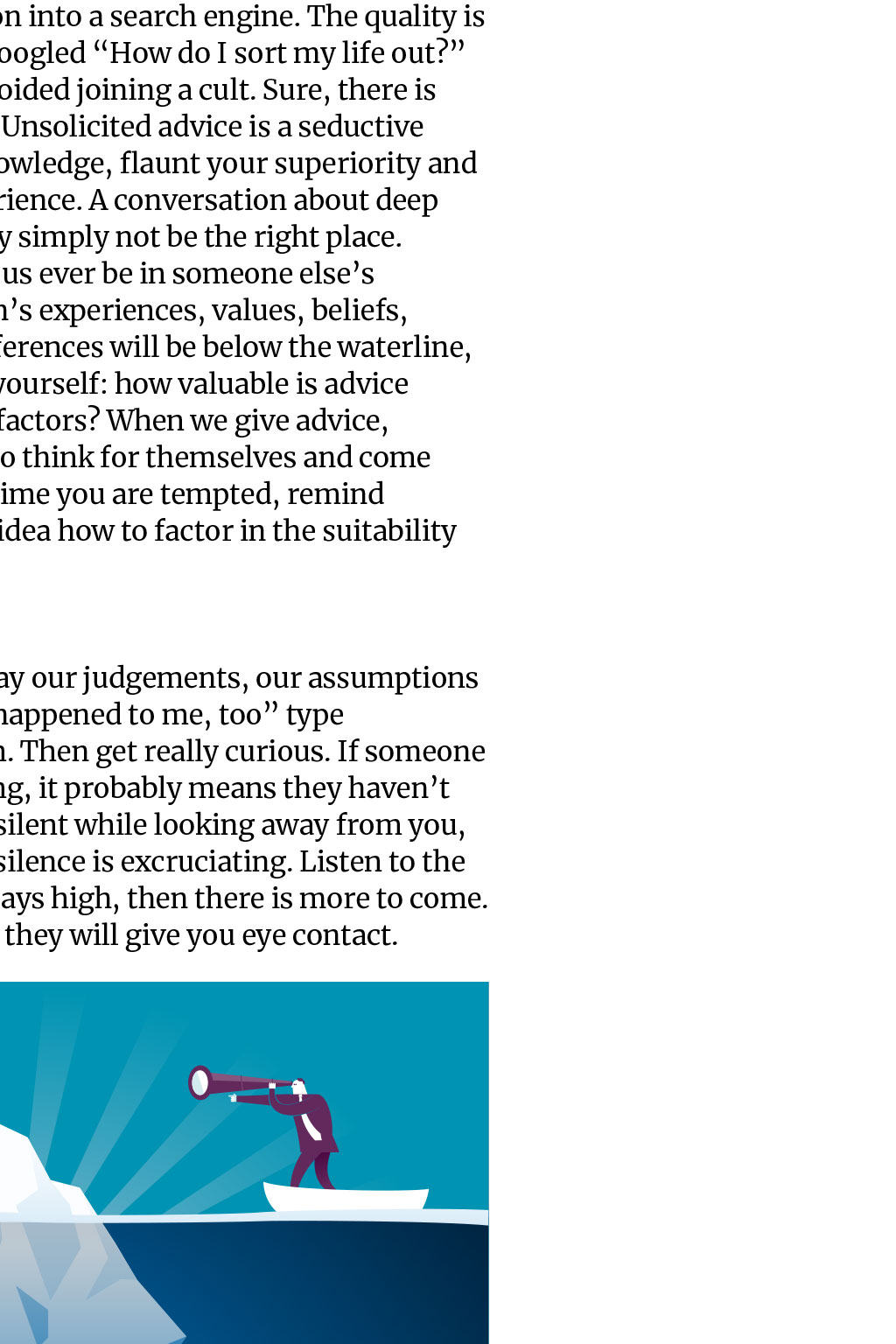

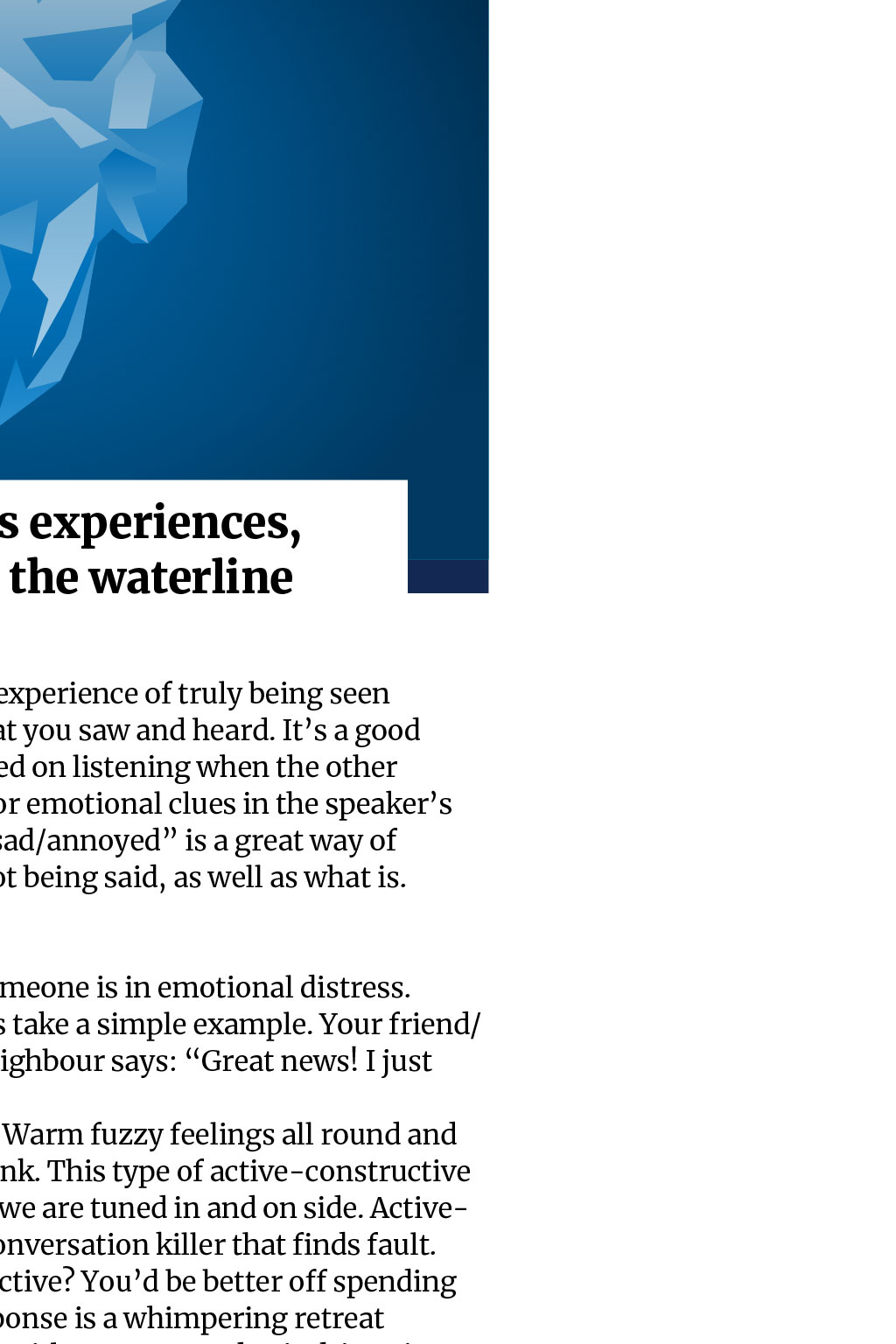


LISTENING Im going to give you a right good listening to How to be a good listener By Captain Karen Speight, Log Board member magine a world where these delightful words were the norm, rather than the more popular threat of a right good talking to. With the latter, Im still struggling to understand what, exactly, is the good bit. When was the last time you truly enjoyed a listening to? Mine was probably yesterday evening, when my teddy bear got the full brunt. In fact, when Im wondering whether Ive listened well enough, I think of Dylan and how cathartic our one-way chats can be. He doesnt have to do an awful lot, except look at me and not interrupt. There is true power in letting people finish their thoughts. If we count up the number of interrupted thoughts stored up in the average persons head, it is probably too much for the spine muscles to bear. No wonder we end up with stiff necks and imps whizzing round in our minds causing mayhem, playing with things they shouldnt be touching. Its very easy to hide from the loopholes in our thinking behind the fraying sofa, but when the words behind those thoughts are out there, blatantly sitting on tatty cushions in the open, we spot inconsistencies all by ourselves. When people get beyond their initial brain dump to actually finish their thoughts, they make links themselves, they see patterns, they come to their own conclusions. In this article, Im not talking about casual listening to idle chat, but times we want to be deeply receptive to anothers feelings. No more you NEVER listen to me! and, if you role model it, you might just get it back! The problem with advice These days, you can get 206,000 differing pieces of advice in a tenth of a second simply by typing your question into a search engine. The quality is somewhat questionable. My friend Googled How do I sort my life out? and, a few months later, narrowly avoided joining a cult. Sure, there is a time for advice, but is it requested? Unsolicited advice is a seductive tempter; you get to show off your knowledge, flaunt your superiority and demonstrate your considerable experience. A conversation about deep emotions and personal problems may simply not be the right place. How much of an expert can any of us ever be in someone elses life? Like an iceberg, most of a persons experiences, values, beliefs, paradigms and dodgy swimwear preferences will be below the waterline, so you will never see them. Now ask yourself: how valuable is advice that doesnt see 70% of the relevant factors? When we give advice, we demean the ability of the person to think for themselves and come up with their own solution. So, next time you are tempted, remind yourself that you have absolutely no idea how to factor in the suitability of their swimwear. Some finer points What we really need to do is clear away our judgements, our assumptions and our own agenda the oh, that happened to me, too type interruptions of normal conversation. Then get really curious. If someone is looking away from you while talking, it probably means they havent finished. Dont interrupt. If they fall silent while looking away from you, they are thinking. Wait even if the silence is excruciating. Listen to the tone of voice, too. If the intonation stays high, then there is more to come. When its your turn to provide input, they will give you eye contact. Like an iceberg, most of a persons experiences, values and beliefs ... will be below the waterline If you want to offer the person an experience of truly being seen and heard, then summarise back what you saw and heard. Its a good technique for keeping yourself focused on listening when the other person is speaking. Look and listen for emotional clues in the speakers face and voice. You sound anxious/sad/annoyed is a great way of showing that youve heard what is not being said, as well as what is. What about the good news? Deep listening is very useful when someone is in emotional distress. What about sharing good news? Lets take a simple example. Your friend/ lover/spouse/partner/accountant/neighbour says: Great news! I just published my new article. Amazing! I cant wait to read it. Warm fuzzy feelings all round and a deposit in the relationship piggy bank. This type of active-constructive reply sends a powerful message that we are tuned in and on side. Activedestructive, on the other hand, is a conversation killer that finds fault. Isnt all this writing counter-productive? Youd be better off spending your time elsewhere. The likely response is a whimpering retreat with tail between legs, or all-out war. Either way, a wedge is driven into the relationship. Passive-constructive is the distracted thats nice dear, which shows you arent listening and conveys the distinct message that you dont find the person interesting or valuable enough to bother about. Finally, passive-destructive is the conversation hog. Thats nothing. I just published my third book! steals the limelight, gives a distinct message of being more important, and takes the wind out of the speakers sails. So, having pulled the rug out from under the luscious feelings of superiority you get when giving advice, the power trip of being destructive, and energy-saving passivity, what is left to promote the seemingly unfulfilling role of listener? When you are receptive to anothers emotions, they feel noticed. Hearing someone out means you might learn something new and interesting. The relationship will be strengthened because they feel your respect and compassion for their thinking. They might even offer the same favour in return, and then you get to be the one feeling loved. Why do we value being listened to so much? To be fully seen as a person, even by a teddy bear, is to be held as worthy. That is surely a gift worth giving. A longer version of this article can be found on my website at www.ajetlife.com