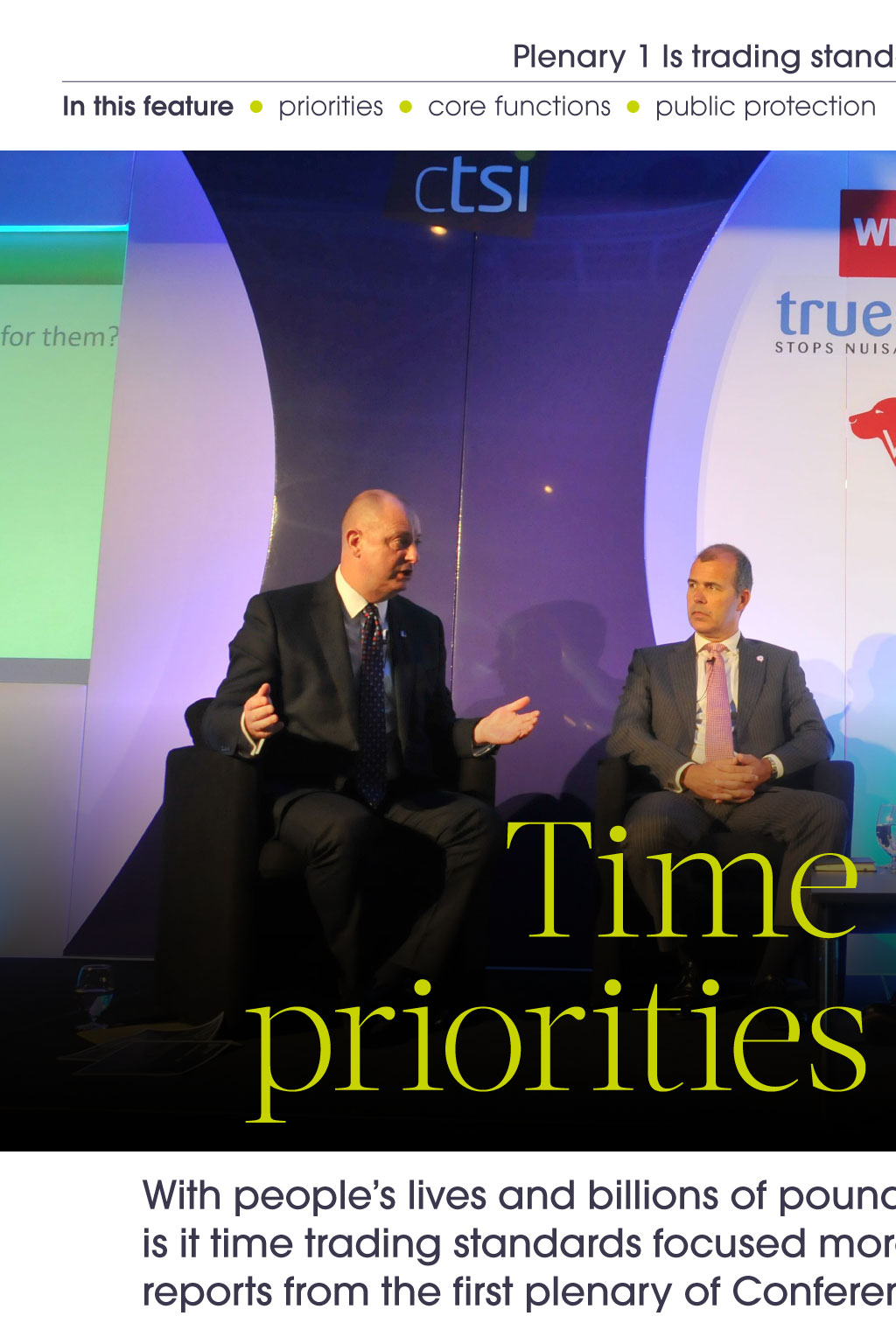


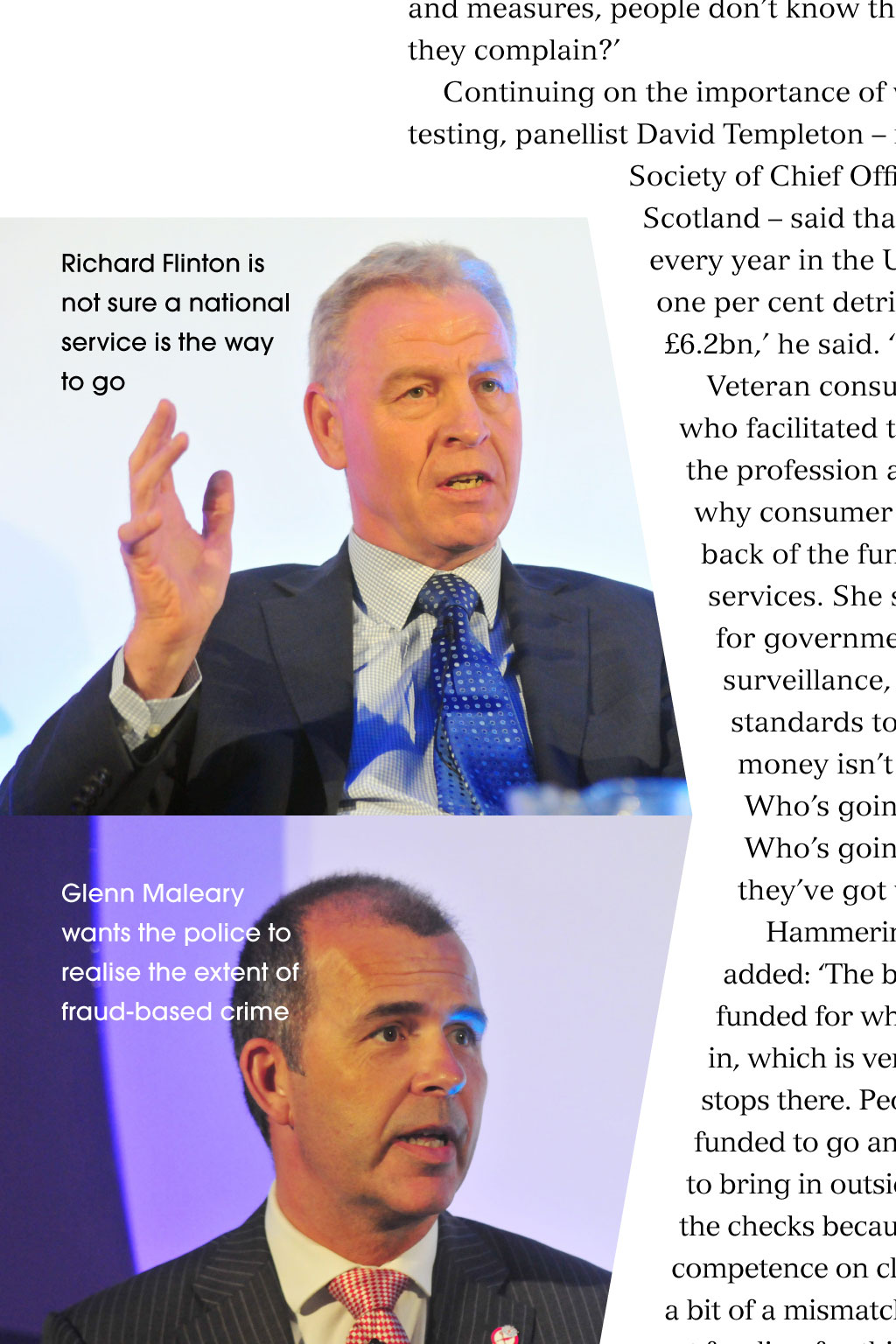







Plenary 1 Is trading standards performing other agencies’ roles? In this feature l priorities l core functions l public protection CONFERENCE 2017 Time to get our priorities straight? With people’s lives and billions of pounds from the UK economy at stake, is it time trading standards focused more on its core functions? Carina Bailey reports from the first plenary of Conference The dangers of operating a trading standards system that acts largely on complaints and intelligence-led priorities, rather than good old-fashioned inspection and compliance testing, led to a lively debate during the rst plenary session at CTSI Conference in Harrogate. Criticisms were voiced about the way trading standards currently creates its priorities, and there was discussion about whether the profession – which is now responsible for more than 260 pieces of legislation – is performing other agencies’ roles. Trading standards’ original core functions were legal metrology, product safety, food and fair trading. Panellist Richard Flinton – a former trading standards of cer (TSO) and now chief executive of North Yorkshire County Council – became a target for many questions from the oor about prioritisation, adequate funding and resourcing. In light of the Grenfell Tower re tragedy, product-safety expert Christine Heemskerk pointedly asked: ‘Can you explain why local authorities have basically ignored something called the Construction Products Regulation, which means trading standards should have been undertaking inspections of construction products for the past 10 years or so? ‘As far as I know, very little has been undertaken, yet there are re doors out there – there are panels out there – which we now are nding are non-compliant. I know you have to prioritise, but that particular area has really seen no action whatsoever. We do not get complaints about it, so how will you prioritise those sorts of issues?’ To almost rapturous applause, an of cer from Derby Trading Standards made a similar observation, but about weights and measures: ‘The point Richard [Flinton] made about resources being directed to areas where they receive the most complaints – well, with weights and measures, people don’t know they’re being ripped off, so how can they complain?’ Continuing on the importance of weights and measures compliance testing, panellist David Templeton – metrology lead of cer for the Society of Chief Of cers of Trading Standards in Scotland – said that the of cial value of goods traded every year in the UK is £622bn. ‘If there was just a one per cent detriment element in that gure, that’s £6.2bn,’ he said. ‘Why are we ignoring that?’ Veteran consumer champion Lynn Faulds Wood, who facilitated the debate, appeared to defend the profession a number of times, querying why consumer protection seemed to fall to the back of the funding queue compared to other services. She said: ‘When I was doing the review for government, and talking about market surveillance, councils often won’t pay for trading standards to make those solutions because the money isn’t around at the moment to do it. Who’s going to take on Whirlpool or Beko? Who’s going to prosecute them – because they’ve got very deep pockets.’ Hammering home her point, Faulds Wood added: ‘The building control people, they get funded for what they do, and they take the money in, which is very nice – but then their responsibility stops there. People like Christine, they don’t get funded to go and do the checks. Maybe they have to bring in outsiders – who they have to pay to do the checks because they don’t have that level of competence on cladding or whatever. So, there seems a bit of a mismatch going on here – health and safety get funding for things that trading standards don’t get at all. Market surveillance, when it comes to consumers’ safety and protection, seems to be done lower down the pile, and the funding’s harder to come by.’ Heemskerk suggested the Construction Products Regulation is a good example of where it is time to consider national and regional enforcement of regulations. Flinton admitted they were tough questions to answer because of the ‘sheer breadth’ of what trading standards has to cover, but he remained wary about creating a national service. ‘You don’t get protected by moving to another level,’ he said. ‘You’ve just got to understand that, I think, by looking at other public bodies and what’s happened there. There is clearly an issue about the overall level of resources against such a spectrum of responsibilities, so I’m not trying to defend the government or anything – or even individual councils’ choices. I would just be wary about wishing everything to be national in future.’ Flinton also suggested that trading standards ‘needs something’ to act as a ‘wake up to decision-makers within councils about how resources are allocated’, and he defended his earlier comments about the usefulness of lots of compliance testing that’s not backed up by intelligence or complaints. ‘I think it’s right that complaints are there to help with prioritisation, but I didn’t say we’d junk everything else,’ he said. ‘I talked about being able to do the market surveillance in accordance with that core work. I absolutely get that. You have to hang on to what’s good about the profession as well. Investigations are taking place, and prosecutions are happening now, that never ever happened 15 years ago.’ Another audience member questioned why trading standards had been burdened with enforcing the Construction Products Regulation at all: ‘What Christine’s said brings the debate back to the question: is trading standards performing other agencies’ roles for them? ‘Why was trading standards given the role of enforcing Construction Product Regulations... of enforcing the Recreation Craft Directive? Why have we done these things when it seems more apparent now that building regulation of cers perhaps ought to be assessing them? So are we actually doing other agencies roles? Is that fundamental, or do we surrender the responsibility that we’ve got?’ When Faulds Wood asked how many in the room felt the service had been overburdened without necessarily having the funding to follow through Can you explain why local authorities have basically ignored something called the Construction Products Regulation, which means trading standards should have been undertaking inspections of construction products for the past 10 years or so? Christine Heemskerk Richard Flinton is not sure a national service is the way to go Glenn Maleary wants the police to realise the extent of fraud-based crime Make it hurt Consumer champion and plenary facilitator Lynn Faulds Wood told trading standards officers to start using words that mean something to the public if they expect their work to have an impact. ‘Consumer detriment – when you use words like that it doesn’t hurt,’ she said. ‘This is pain in people’s pockets. I would love everybody to read a copy of The Sun and see what words get in there. If you don’t touch people, you don’t change behaviour.’ If you look at the investment made for economic- crimes specialists, it’s not even one per cent of that made in policing Glenn Maleary on responsibilities, practically everyone agreed. She added: ‘There’s a terrible mismatch going on here.’ Sara Barry, head of safer communities at Lincolnshire County Council, said trading standards had stepped into the fraud space because the police had left it, and she asked Glenn Maleary – detective chief superintendent and economic lead at City of London Police – whether he saw the police reclaiming it. ‘Sadly,’ Maleary answered, ‘I don’t think the police have ever been in that space, truth be told. I’ve spent 27 years in policing and an awful lot of it in fast-moving, “life at risk” kind of investigations – kidnaps, extortion, organised-crime groups. If I’d know when I started on that part of my career how I could attack the criminal by pursuing their money, I think I would have brought a few more to book along the way – and probably stopped a lot more harm.’ Maleary said it was his ambition – and that of his command – to ensure that every police force understands that more than half of all crime in the UK is fraud-based. However, when you look at the amount spent on the issue, it feels like the Met Police is still eons away from achieving that ambition. ‘If you look at the investment made in economic-crimes specialists, it’s not even one per cent of that made in policing,’ Maleary added. Templeton made the point that, when the intelligence-led priorities system was set up, metrology was too complex to include – so there was no mechanism for recording weights and measures issues. He added: ‘We don’t record it, it’s not a problem; it’s not a problem you don’t resource it; you don’t resource it and this spiral of decline continues – and that’s what the situation is.’ An advocate of reform, Templeton pointed to Australia, which made its outdated system t for purpose in 1997. ‘Our system of national policy delivered at local level – with more than 200 delivery mechanisms – was written in the last century. That does not take into account a modern, complex, global-chain environment. We need a t- for-purpose delivery mechanism and, to my mind, that means a fundamental structural review of how we deliver weights and measures.’ Impactful language is key, says Lynn Faulds Wood There is clearly an issue about the overall level of resources against such a spectrum of responsibilities... I would just be wary about wishing everything to be national in future Richard Flinton Credits David Templeton wants the system reformed Andy Wilson, from Bristol City Council, got an enthusiastic round of applause when he opened the Q&A debate by noting that each pint poured in the local pub the night before was about ve per cent short. ‘How much consumer detriment happened in that pub last night? Gross that up to every pub in the country – virtually every night – and that is trading standards work; it’s fundamental consumer protection and it’s a hell of a lot of consumer detriment that we’re not doing anything about.’ While Flinton maintained that trading standards should not sit at a national level, he did suggest that the way forward could be to tier the service and create coordination between the two. ‘When you re ect on some of the comments from the audience – whether it be about construction products or metrology issues – there is just a stronger role for, not national delivery, but national coordination of these issues, and understanding the tiers at which we should be looking at things to work,’ he said. ‘So there’s a national role, there’s a regional role, but there very much is that local role – and I think to get the tiering of the response right at a time of austerity, and the coordination between them, is probably the best way forward.’ To share this page, You might also like Credits: Carina Bailey is editor of TS Today. click on in the toolbar Question time – July 2016 Images: Sam Atkins Panel members Facilitator Lynn Faulds Wood – TV presenter and health campaigner Panellists David Templeton – metrology lead officer for the Society of Chief Officers of Trading Standards in Scotland Glenn Maleary – detective chief superintendent and economic lead at City of London Police Richard Flinton – chief executive at North Yorkshire County Council