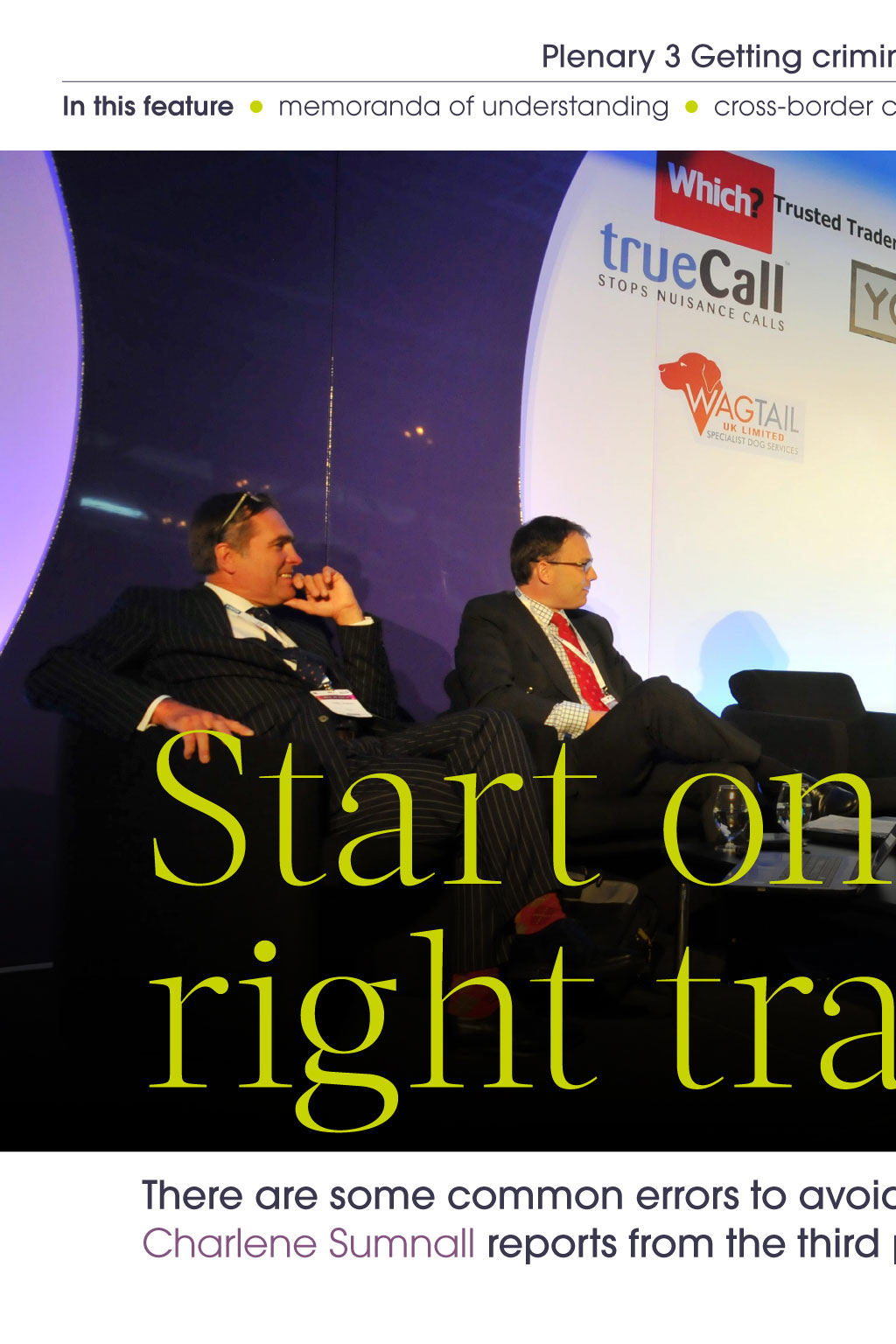
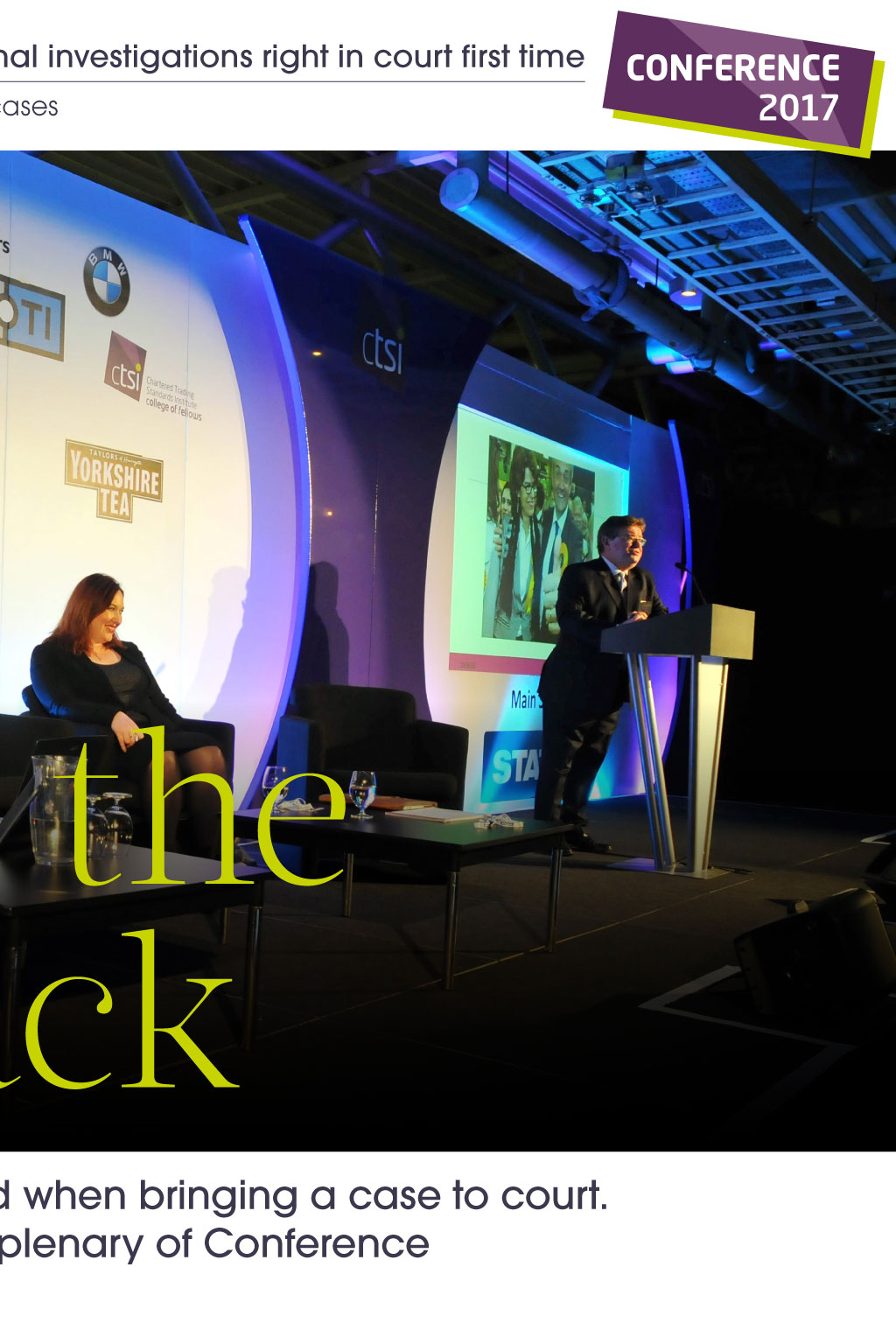
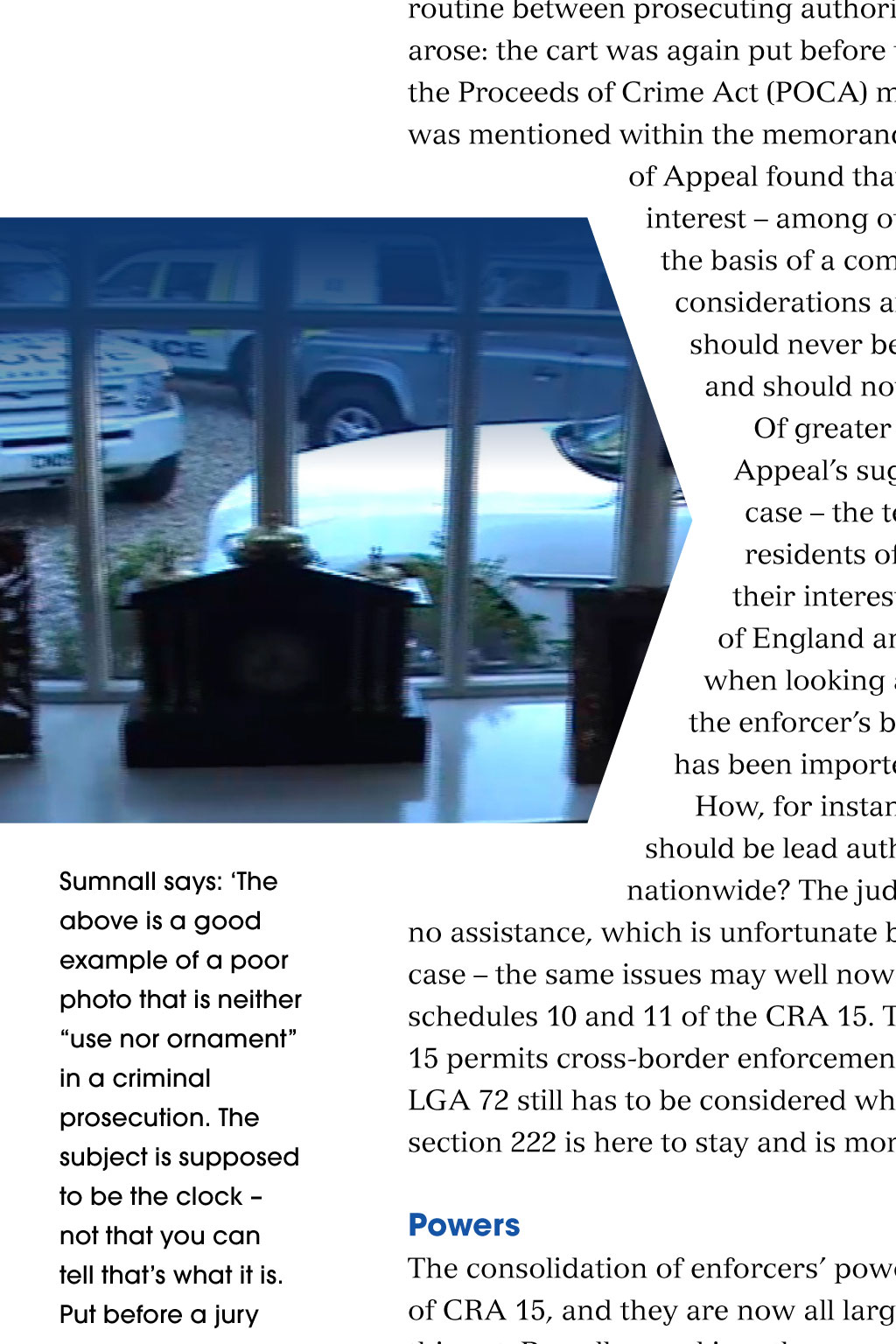
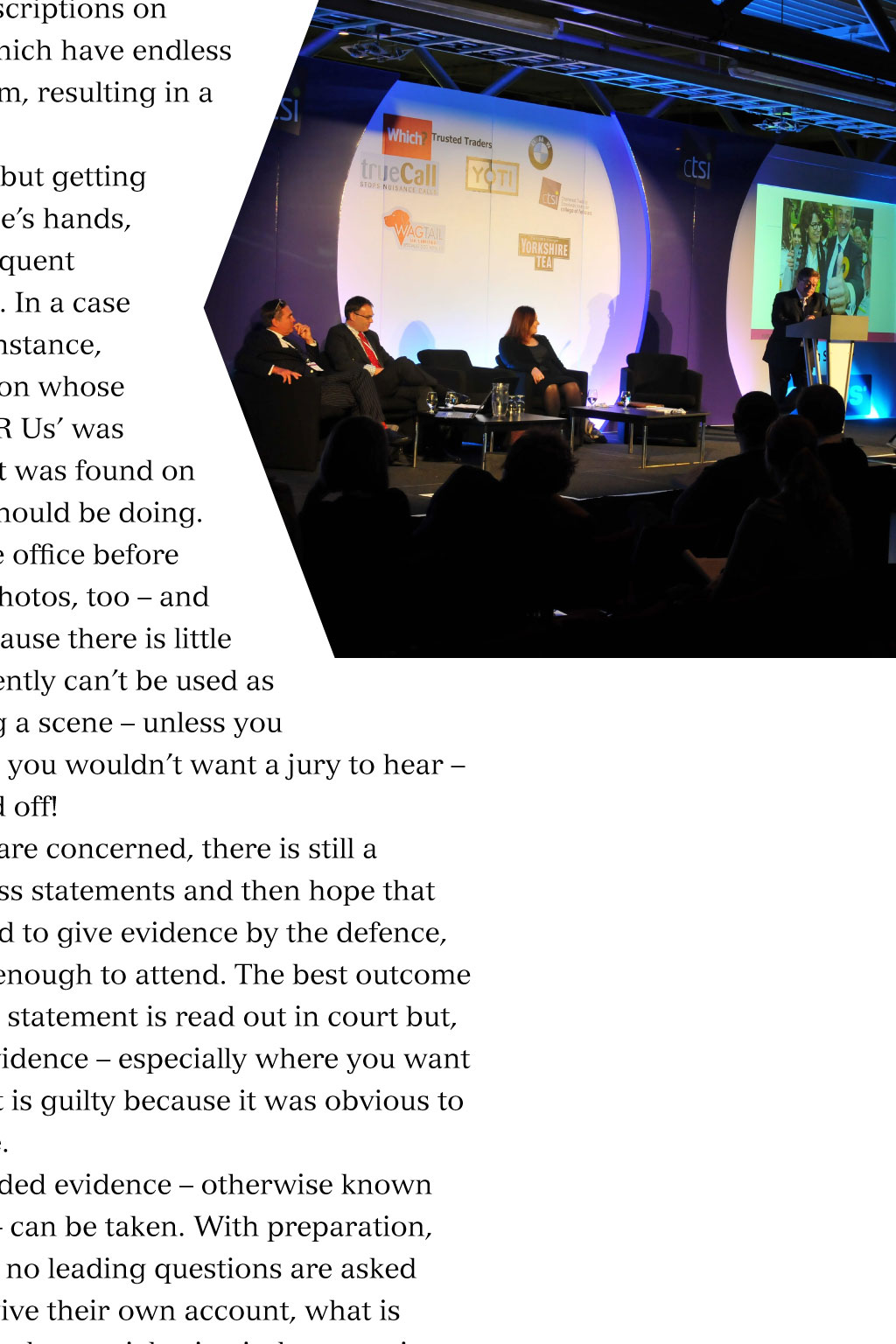

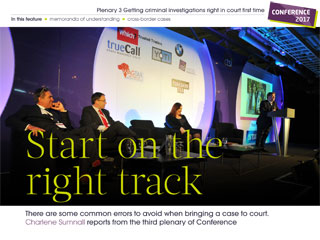
Plenary 3 Getting criminal investigations right in court first time In this feature l memoranda of understanding l cross-border cases CONFERENCE 2017 Start on the right track There are some common errors to avoid when bringing a case to court. Charlene Sumnall reports from the third plenary of Conference Now when looking at cases where activity falls outside the enforcer’s borders, a new ‘over and above’ test has been imported into section 222 Sumnall says: ‘The above is a good example of a poor photo that is neither “use nor ornament” in a criminal prosecution. The subject is supposed to be the clock – not that you can tell that’s what it is. Put before a jury or magistrate, it adds nothing to the prosecution’ Trading standards departments up and down the country are tasked with investigating and prosecuting all manner of offences on increasingly small budgets. As such, the pressure to ‘get it right’ – and get it right from the very start of an investigation – has never been greater. One of the rst things to consider is whether you have a right to bring the proceedings in the rst place. For years, the rst and last word on whether a council could bring enforcement proceedings for offences outside of their local boundaries started and ended with the provisions in section 222 of the Local Government Act 1972 (LGA 72) and the case law that owed from it. It was not always a straightforward issue, and getting it wrong could prove fatal to otherwise perfectly good and strong cases. However, hope was given by paragraph 46 of Schedule 5 of the Consumer Rights Act 2015 (CRA 15), which explicitly stated that ‘a weights and measures authority in England or Wales may bring proceedings for a consumer offence allegedly committed in a part of England or Wales which is outside that authority’s area’. But there was a catch: consumer offences are those explicitly listed in schedules 10 and 11 of the CRA 15, and that list has holes in it – probably the biggest being the lack of the Fraud Act 2006. Then along came the case of R v AB and others [2017] EWCA Crim 534, and headaches again abound. In short, Thurrock entered into an agreement with the Legal Aid Agency (LAA) to prosecute a large-scale fraud in which the LAA was the victim. The defendants – a solicitors’ rm specialising in immigration work – were not based in Thurrock, but in London. As this was a case concerning conspiracy to defraud, the CRA 15 – enabling proceedings to be brought outside of Thurrock’s area – could be of no assistance. The local authority correctly identi ed that it could only act if section 222 LGA 72 permitted such action. It entered into the normal memoranda of understanding that are routine between prosecuting authorities. However, a common problem arose: the cart was again put before the horse and the focus of ‘achieving the Proceeds of Crime Act (POCA) minimum criminal lifestyle criteria’ was mentioned within the memoranda of understanding. The Court of Appeal found that this may create a real con ict of interest – among other things – in prosecuting on the basis of a commercial interest. While POCA considerations are sensible, it is suggested that it should never be a reason for taking a prosecution, and should not be part of the section 222 test. Of greater concern, however, is the Court of Appeal’s suggestion that – for a cross-border case – the test to be established is not that the residents of Thurrock have an interest, but that their interest is greater than those of the citizens of England and Wales generally. As a result, when looking at cases where activity falls outside the enforcer’s borders, a new ‘over and above’ test has been imported into section 222. How, for instance, is it to be decided which council should be lead authority in a scam that is operating nationwide? The judgment of the court in AB provides no assistance, which is unfortunate because – even though this is a fraud case – the same issues may well now be live in those offences listed in schedules 10 and 11 of the CRA 15. The reason for this is that the CRA 15 permits cross-border enforcement, but offers no test, so section 222 LGA 72 still has to be considered when instituting proceedings. In short, section 222 is here to stay and is more complicated than ever. Powers The consolidation of enforcers’ powers came about with the start of CRA 15, and they are now all largely to be found in schedule 5 of this act. Broadly speaking, the powers are split into two distinct sets: those that require a warrant to enter premises and those that do not. In respect of those dependent on a warrant, enforcers should be in no doubt that the days of withholding information from those granting warrants are over. Where premises are used wholly or mainly as a dwelling, a warrant is required – even if that is the primary place from which a business is run. Where a warrant of entry into premises is not needed, the retention of the power to undertake test purchases is to be welcomed. Enforcers also have the power to request the provision of information, including the creation of some documentation. However, some caution should be exercised when using this power, as a person’s right not to incriminate themselves has been preserved and, as such, any information compelled in this fashion cannot be used as evidence. Once entry has been gained, items and documents can be seized as evidence. Enforcers can also break open containers – importantly, the de nition of a container includes electronic devices, so will cover USB and external hard drives. This should enable some form of preliminary check on the device itself, to see whether it needs seizing. No item can be seized and retained for longer than three months, unless there is reasonable justi cation for this. Enforcers should be mindful of this limit when progressing information, and should let those who are inspecting items know, too. It may reduce the lengthy delays that sometimes occur. Evidence gathering One of the most fundamental things to get right at the start of any investigation is the collation of evidence. Get that wrong and you are doomed. Most issues stem from the lack of a clear, coherent plan at the start of an investigation, especially those that are likely to be sizeable. Common problems include: failure to plan who is doing what, and making sure the necessary equipment is available; and poor descriptions on search records and exhibit labels, which have endless initials and numbers attached to them, resulting in a continuity nightmare. These may sound like silly gripes, but getting them wrong can play into the defence’s hands, and makes presentation of the subsequent prosecution that much more dif cult. In a case dealing with counterfeit goods, for instance, it might be quite important to know on whose desk the invoice from ‘Snide Goods R Us’ was found – so recording exactly where it was found on a plan should be the minimum you should be doing. It would be even better to lm the of ce before anything has been seized; take still photos, too – and make sure they are good quality, because there is little point in taking them if they subsequently can’t be used as intended. To that end, when videoing a scene – unless you can be sure no-one will say anything you wouldn’t want a jury to hear – it may be best to do it with the sound off! Where crimes against the elderly are concerned, there is still a tendency to rely on traditional witness statements and then hope that your vulnerable victim is not required to give evidence by the defence, and – if they are – that they are well enough to attend. The best outcome in those scenarios is that the witness statement is read out in court but, often, that is weakening your best evidence – especially where you want to make the point that this defendant is guilty because it was obvious to all that your victim is/was vulnerable. The answer is simple; video-recorded evidence – otherwise known as Achieving Best Evidence (ABEs) – can be taken. With preparation, it’s not a dif cult process. As long as no leading questions are asked of the witness, and they are able to give their own account, what is the harm in videoing it? It doesn’t need a special suite; it does require time, preparation and a video camera. But it is powerful evidence for the court, which gets to see the witness regardless of whether they are required to give live evidence or not. The above are just a few examples of how to prevent perfectly good cases from being lost – which we can all agree is in no-one’s interest. While POCA considerations are sensible, it is suggested that it should never be a reason for taking a prosecution, and should not be part of the section 222 test Credits To share this page, You might also like Credits: Charlene Sumnall is a barrister at click on in the toolbar Horizon Scanning – July 2016 5 Paper Buildings. Images: Sam Atkins Panel members Miles Bennett, Robin Shellard, Ben Douglas-Jones, and Charlene Sumnall – all barristers at 5 Paper Buildings