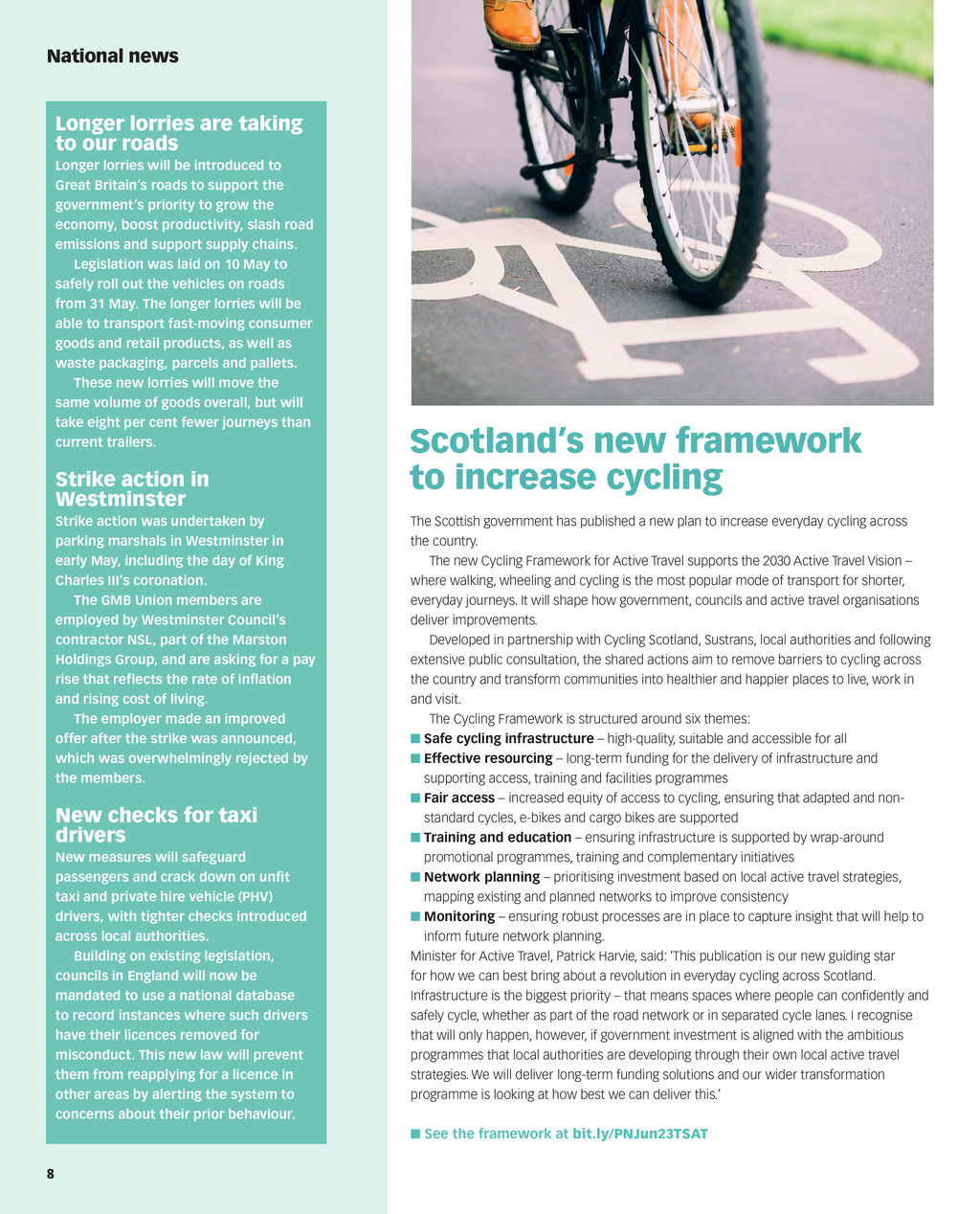

National news Longer lorries are taking to our roads Longer lorries will be introduced to Great Britains roads to support the governments priority to grow the economy, boost productivity, slash road emissions and support supply chains. Legislation was laid on 10 May to safely roll out the vehicles on roads from 31 May. The longer lorries will be able to transport fast-moving consumer goods and retail products, as well as waste packaging, parcels and pallets. These new lorries will move the same volume of goods overall, but will take eight per cent fewer journeys than current trailers. Strike action in Westminster Strike action was undertaken by parking marshals in Westminster in early May, including the day of King Charles IIIs coronation. The GMB Union members are employed by Westminster Councils contractor NSL, part of the Marston Holdings Group, and are asking for a pay rise that reflects the rate of inflation and rising cost of living. The employer made an improved offer after the strike was announced, which was overwhelmingly rejected by the members. New checks for taxi drivers New measures will safeguard passengers and crack down on unfit taxi and private hire vehicle (PHV) drivers, with tighter checks introduced across local authorities. Building on existing legislation, councils in England will now be mandated to use a national database to record instances where such drivers have their licences removed for misconduct. This new law will prevent them from reapplying for a licence in other areas by alerting the system to concerns about their prior behaviour. Scotlands new framework to increase cycling The Scottish government has published a new plan to increase everyday cycling across the country. The new Cycling Framework for Active Travel supports the 2030 Active Travel Vision where walking, wheeling and cycling is the most popular mode of transport for shorter, everyday journeys. It will shape how government, councils and active travel organisations deliver improvements. Developed in partnership with Cycling Scotland, Sustrans, local authorities and following extensive public consultation, the shared actions aim to remove barriers to cycling across the country and transform communities into healthier and happier places to live, work in and visit. The Cycling Framework is structured around six themes: Safe cycling infrastructure high-quality, suitable and accessible for all Effective resourcing long-term funding for the delivery of infrastructure and supporting access, training and facilities programmes Fair access increased equity of access to cycling, ensuring that adapted and nonstandard cycles, e-bikes and cargo bikes are supported Training and education ensuring infrastructure is supported by wrap-around promotional programmes, training and complementary initiatives Network planning prioritising investment based on local active travel strategies, mapping existing and planned networks to improve consistency Monitoring ensuring robust processes are in place to capture insight that will help to inform future network planning. Minister for Active Travel, Patrick Harvie, said: This publication is our new guiding star for how we can best bring about a revolution in everyday cycling across Scotland. Infrastructure is the biggest priority that means spaces where people can confidently and safely cycle, whether as part of the road network or in separated cycle lanes. I recognise that will only happen, however, if government investment is aligned with the ambitious programmes that local authorities are developing through their own local active travel strategies. We will deliver long-term funding solutions and our wider transformation programme is looking at how best we can deliver this. See the framework at bit.ly/PNJun23TSAT 8 PN June 2023 pp08-09 National News.indd 8 23/05/2023 11:40