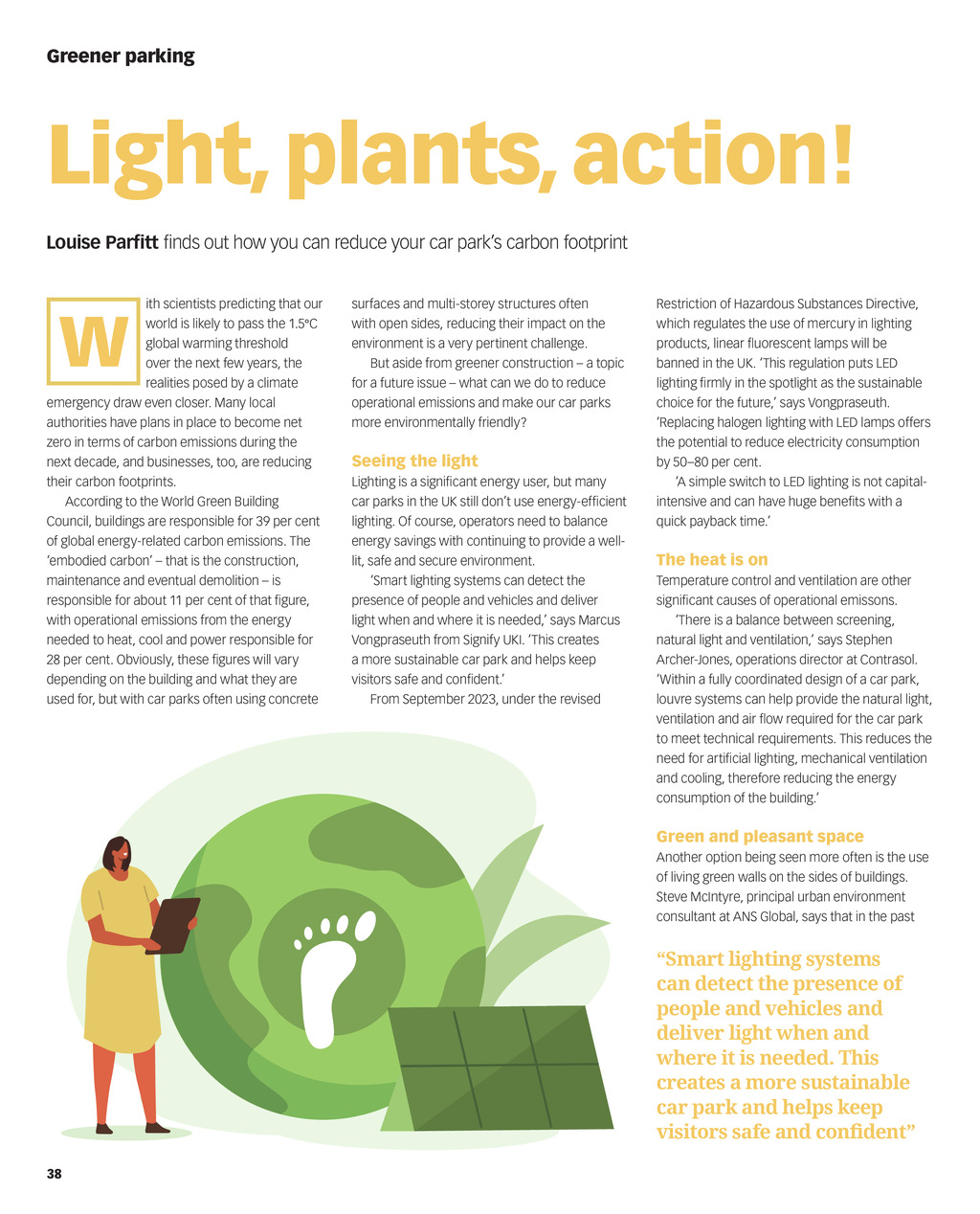

Greener parking Light, plants, action! Louise Parfitt finds out how you can reduce your car parks carbon footprint ith scientists predicting that our world is likely to pass the 1.5C global warming threshold over the next few years, the realities posed by a climate emergency draw even closer. Many local authorities have plans in place to become net zero in terms of carbon emissions during the next decade, and businesses, too, are reducing their carbon footprints. According to the World Green Building Council, buildings are responsible for 39 per cent of global energy-related carbon emissions. The embodied carbon that is the construction, maintenance and eventual demolition is responsible for about 11 per cent of that figure, with operational emissions from the energy needed to heat, cool and power responsible for 28 per cent. Obviously, these figures will vary depending on the building and what they are used for, but with car parks often using concrete W surfaces and multi-storey structures often with open sides, reducing their impact on the environment is a very pertinent challenge. But aside from greener construction a topic for a future issue what can we do to reduce operational emissions and make our car parks more environmentally friendly? Seeing the light Lighting is a significant energy user, but many car parks in the UK still dont use energy-efficient lighting. Of course, operators need to balance energy savings with continuing to provide a welllit, safe and secure environment. Smart lighting systems can detect the presence of people and vehicles and deliver light when and where it is needed, says Marcus Vongpraseuth from Signify UKI. This creates a more sustainable car park and helps keep visitors safe and confident. From September 2023, under the revised Restriction of Hazardous Substances Directive, which regulates the use of mercury in lighting products, linear fluorescent lamps will be banned in the UK. This regulation puts LED lighting firmly in the spotlight as the sustainable choice for the future, says Vongpraseuth. Replacing halogen lighting with LED lamps offers the potential to reduce electricity consumption by 5080 per cent. A simple switch to LED lighting is not capitalintensive and can have huge benefits with a quick payback time. The heat is on Temperature control and ventilation are other significant causes of operational emissons. There is a balance between screening, natural light and ventilation, says Stephen Archer-Jones, operations director at Contrasol. Within a fully coordinated design of a car park, louvre systems can help provide the natural light, ventilation and air flow required for the car park to meet technical requirements. This reduces the need for artificial lighting, mechanical ventilation and cooling, therefore reducing the energy consumption of the building. Green and pleasant space Another option being seen more often is the use of living green walls on the sides of buildings. Steve McIntyre, principal urban environment consultant at ANS Global, says that in the past Smart lighting systems can detect the presence of people and vehicles and deliver light when and where it is needed. This creates a more sustainable car park and helps keep visitors safe and confident 38 PN June 2023 pp38-39 Carbon Neutral.indd 30 23/05/2023 11:59