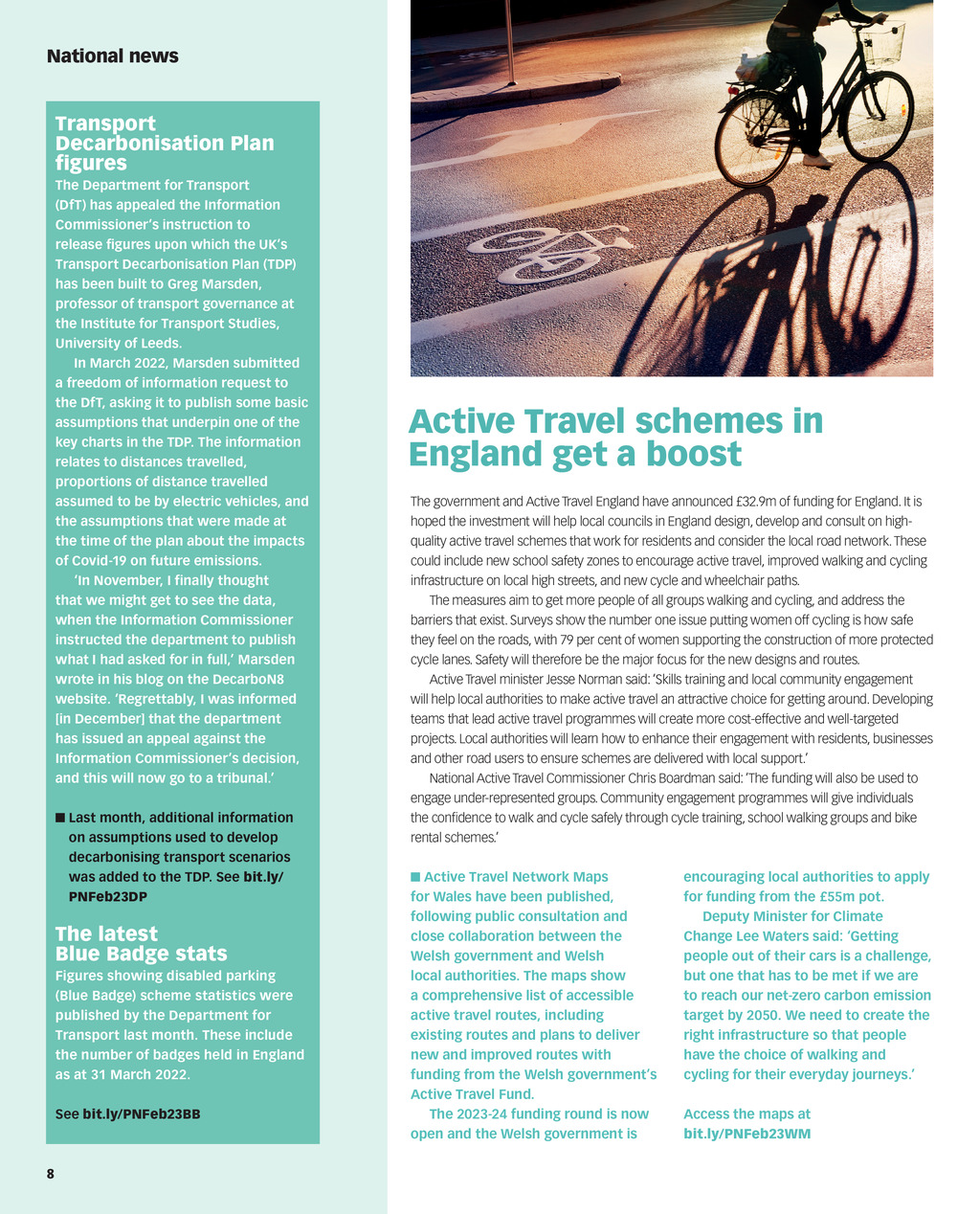


National news Transport Decarbonisation Plan figures The Department for Transport (DfT) has appealed the Information Commissioners instruction to release figures upon which the UKs Transport Decarbonisation Plan (TDP) has been built to Greg Marsden, professor of transport governance at the Institute for Transport Studies, University of Leeds. In March 2022, Marsden submitted a freedom of information request to the DfT, asking it to publish some basic assumptions that underpin one of the key charts in the TDP. The information relates to distances travelled, proportions of distance travelled assumed to be by electric vehicles, and the assumptions that were made at the time of the plan about the impacts of Covid-19 on future emissions. In November, I finally thought that we might get to see the data, when the Information Commissioner instructed the department to publish what I had asked for in full, Marsden wrote in his blog on the DecarboN8 website. Regrettably, I was informed [in December] that the department has issued an appeal against the Information Commissioners decision, and this will now go to a tribunal. Last month, additional information on assumptions used to develop decarbonising transport scenarios was added to the TDP. See bit.ly/ PNFeb23DP The latest Blue Badge stats Figures showing disabled parking (Blue Badge) scheme statistics were published by the Department for Transport last month. These include the number of badges held in England as at 31 March 2022. See bit.ly/PNFeb23BB 8 Active Travel schemes in England get a boost The government and Active Travel England have announced 32.9m of funding for England. It is hoped the investment will help local councils in England design, develop and consult on highquality active travel schemes that work for residents and consider the local road network. These could include new school safety zones to encourage active travel, improved walking and cycling infrastructure on local high streets, and new cycle and wheelchair paths. The measures aim to get more people of all groups walking and cycling, and address the barriers that exist. Surveys show the number one issue putting women off cycling is how safe they feel on the roads, with 79 per cent of women supporting the construction of more protected cycle lanes. Safety will therefore be the major focus for the new designs and routes. Active Travel minister Jesse Norman said: Skills training and local community engagement will help local authorities to make active travel an attractive choice for getting around. Developing teams that lead active travel programmes will create more cost-effective and well-targeted projects. Local authorities will learn how to enhance their engagement with residents, businesses and other road users to ensure schemes are delivered with local support. National Active Travel Commissioner Chris Boardman said: The funding will also be used to engage under-represented groups. Community engagement programmes will give individuals the confidence to walk and cycle safely through cycle training, school walking groups and bike rental schemes. Active Travel Network Maps for Wales have been published, following public consultation and close collaboration between the Welsh government and Welsh local authorities. The maps show a comprehensive list of accessible active travel routes, including existing routes and plans to deliver new and improved routes with funding from the Welsh governments Active Travel Fund. The 2023-24 funding round is now open and the Welsh government is encouraging local authorities to apply for funding from the 55m pot. Deputy Minister for Climate Change Lee Waters said: Getting people out of their cars is a challenge, but one that has to be met if we are to reach our net-zero carbon emission target by 2050. We need to create the right infrastructure so that people have the choice of walking and cycling for their everyday journeys. Access the maps at bit.ly/PNFeb23WM