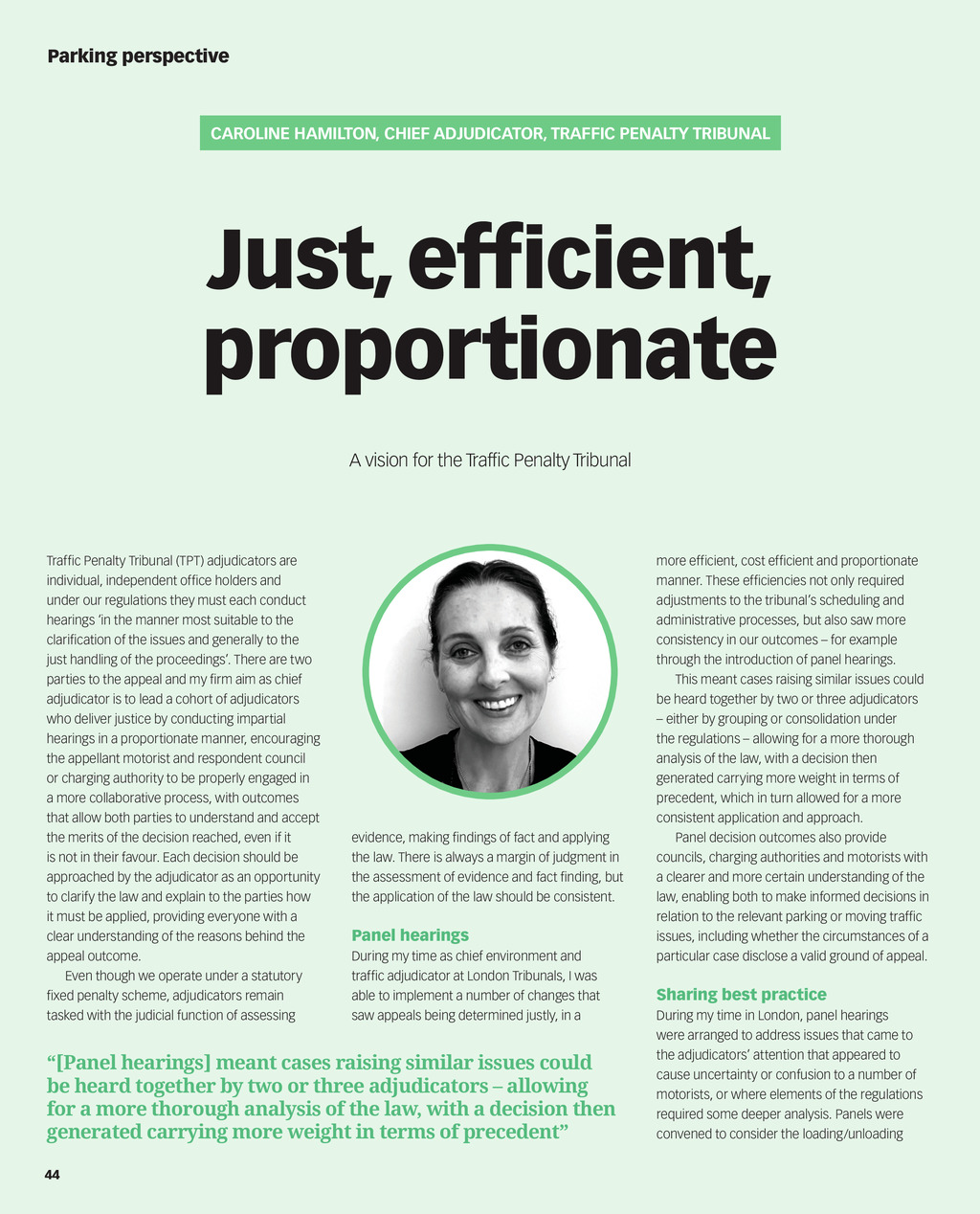
Parking perspective CAROLINE HAMILTON, CHIEF ADJUDICATOR, TRAFFIC PENALTY TRIBUNAL Just, efficient, proportionate A vision for the Traffic Penalty Tribunal Traffic Penalty Tribunal (TPT) adjudicators are individual, independent office holders and under our regulations they must each conduct hearings in the manner most suitable to the clarification of the issues and generally to the just handling of the proceedings. There are two parties to the appeal and my firm aim as chief adjudicator is to lead a cohort of adjudicators who deliver justice by conducting impartial hearings in a proportionate manner, encouraging the appellant motorist and respondent council or charging authority to be properly engaged in a more collaborative process, with outcomes that allow both parties to understand and accept the merits of the decision reached, even if it is not in their favour. Each decision should be approached by the adjudicator as an opportunity to clarify the law and explain to the parties how it must be applied, providing everyone with a clear understanding of the reasons behind the appeal outcome. Even though we operate under a statutory fixed penalty scheme, adjudicators remain tasked with the judicial function of assessing evidence, making findings of fact and applying the law. There is always a margin of judgment in the assessment of evidence and fact finding, but the application of the law should be consistent. Panel hearings During my time as chief environment and traffic adjudicator at London Tribunals, I was able to implement a number of changes that saw appeals being determined justly, in a [Panel hearings] meant cases raising similar issues could be heard together by two or three adjudicators allowing for a more thorough analysis of the law, with a decision then generated carrying more weight in terms of precedent more efficient, cost efficient and proportionate manner. These efficiencies not only required adjustments to the tribunals scheduling and administrative processes, but also saw more consistency in our outcomes for example through the introduction of panel hearings. This meant cases raising similar issues could be heard together by two or three adjudicators either by grouping or consolidation under the regulations allowing for a more thorough analysis of the law, with a decision then generated carrying more weight in terms of precedent, which in turn allowed for a more consistent application and approach. Panel decision outcomes also provide councils, charging authorities and motorists with a clearer and more certain understanding of the law, enabling both to make informed decisions in relation to the relevant parking or moving traffic issues, including whether the circumstances of a particular case disclose a valid ground of appeal. Sharing best practice During my time in London, panel hearings were arranged to address issues that came to the adjudicators attention that appeared to cause uncertainty or confusion to a number of motorists, or where elements of the regulations required some deeper analysis. Panels were convened to consider the loading/unloading 44 PN Nov 2022 pp44-45 Parking Perspective.indd 44 27/10/2022 13:59