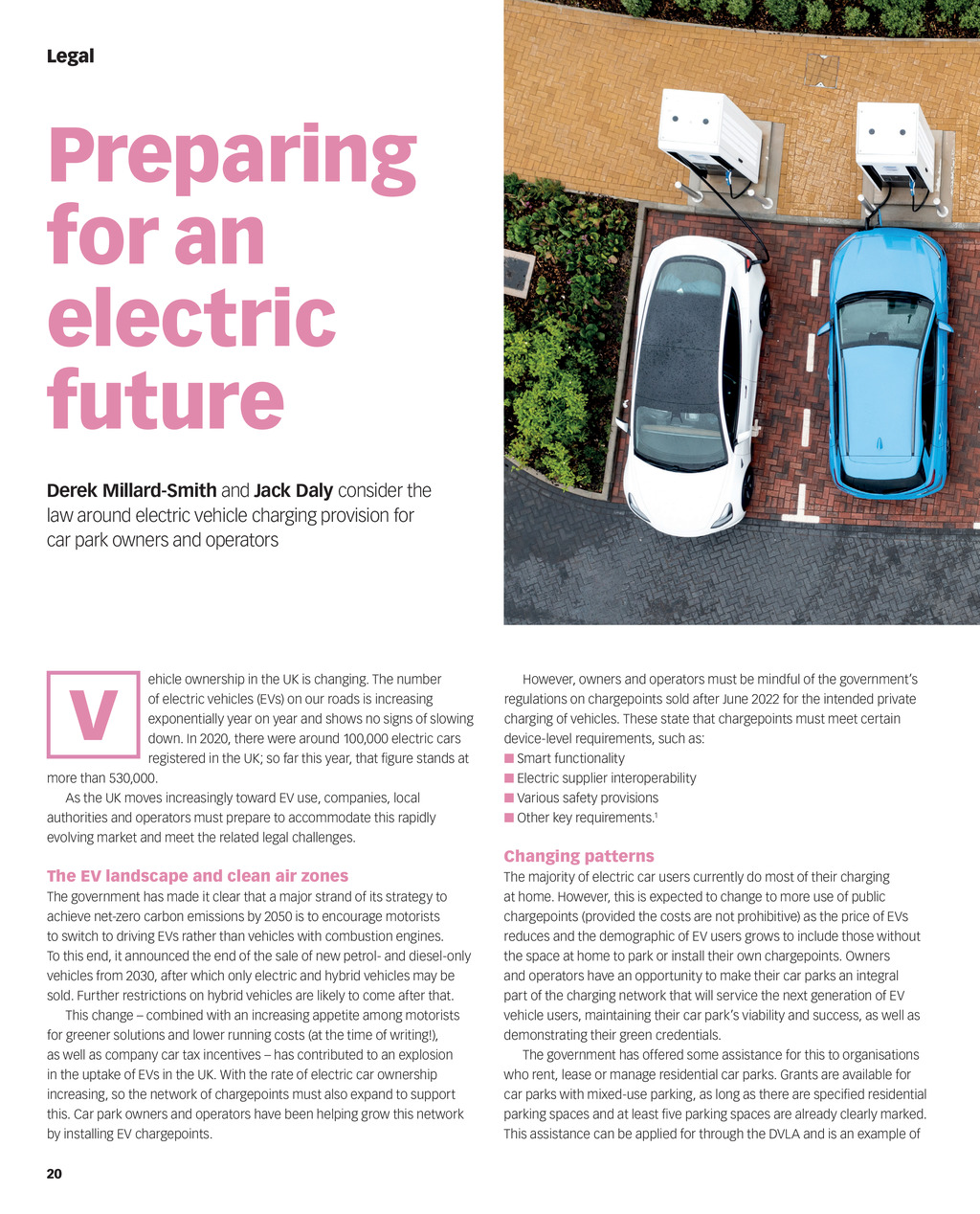
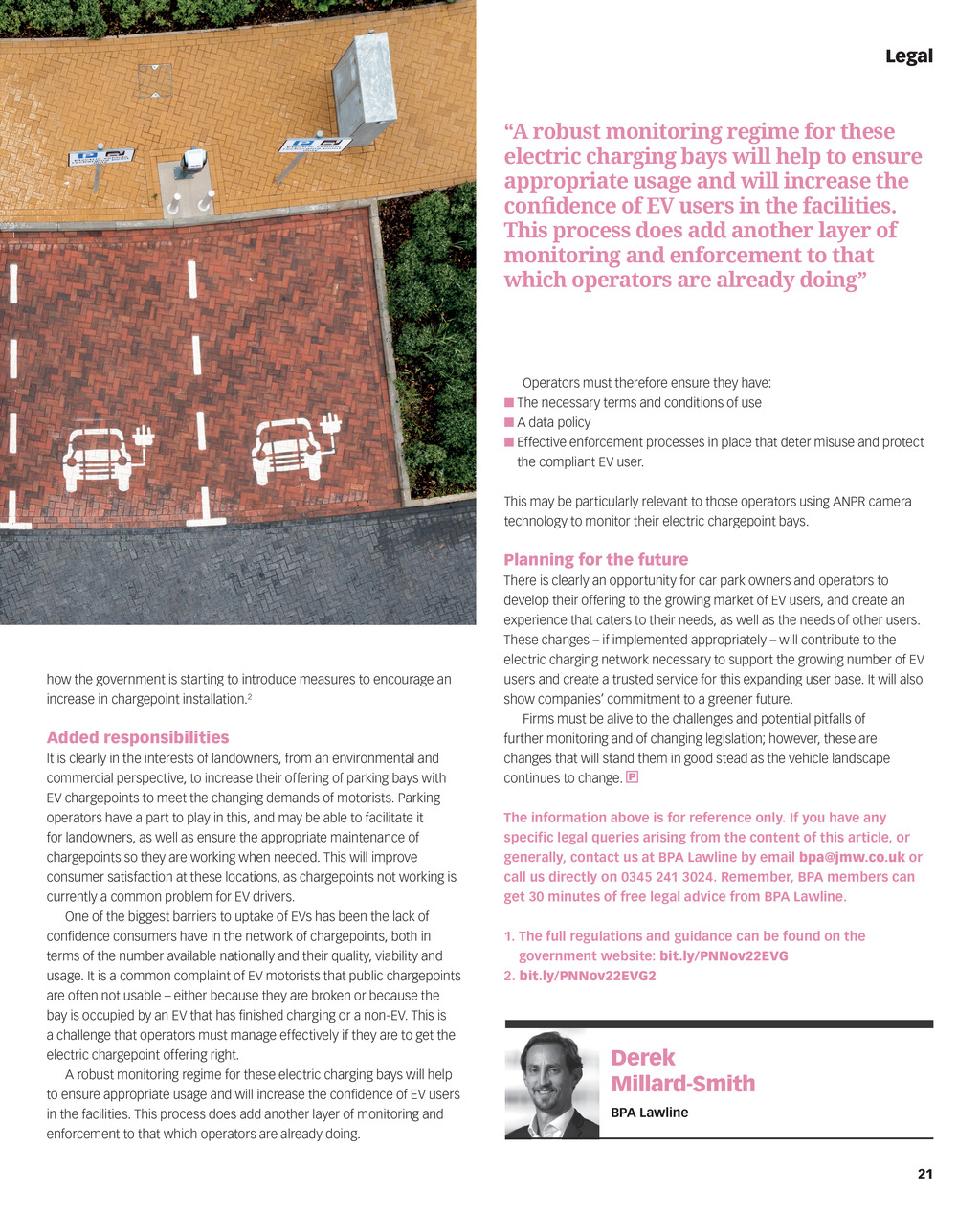

Legal Preparing for an electric future Derek Millard-Smith and Jack Daly consider the law around electric vehicle charging provision for car park owners and operators V ehicle ownership in the UK is changing. The number of electric vehicles (EVs) on our roads is increasing exponentially year on year and shows no signs of slowing down. In 2020, there were around 100,000 electric cars registered in the UK; so far this year, that figure stands at more than 530,000. As the UK moves increasingly toward EV use, companies, local authorities and operators must prepare to accommodate this rapidly evolving market and meet the related legal challenges. However, owners and operators must be mindful of the governments regulations on chargepoints sold after June 2022 for the intended private charging of vehicles. These state that chargepoints must meet certain device-level requirements, such as: Smart functionality Electric supplier interoperability Various safety provisions Other key requirements.1 Changing patterns The EV landscape and clean air zones The government has made it clear that a major strand of its strategy to achieve net-zero carbon emissions by 2050 is to encourage motorists to switch to driving EVs rather than vehicles with combustion engines. To this end, it announced the end of the sale of new petrol- and diesel-only vehicles from 2030, after which only electric and hybrid vehicles may be sold. Further restrictions on hybrid vehicles are likely to come after that. This change combined with an increasing appetite among motorists for greener solutions and lower running costs (at the time of writing!), as well as company car tax incentives has contributed to an explosion in the uptake of EVs in the UK. With the rate of electric car ownership increasing, so the network of chargepoints must also expand to support this. Car park owners and operators have been helping grow this network by installing EV chargepoints. The majority of electric car users currently do most of their charging at home. However, this is expected to change to more use of public chargepoints (provided the costs are not prohibitive) as the price of EVs reduces and the demographic of EV users grows to include those without the space at home to park or install their own chargepoints. Owners and operators have an opportunity to make their car parks an integral part of the charging network that will service the next generation of EV vehicle users, maintaining their car parks viability and success, as well as demonstrating their green credentials. The government has offered some assistance for this to organisations who rent, lease or manage residential car parks. Grants are available for car parks with mixed-use parking, as long as there are specified residential parking spaces and at least five parking spaces are already clearly marked. This assistance can be applied for through the DVLA and is an example of 20 PN Nov 2022 pp20-21 Legal.indd 20 26/10/2022 16:28