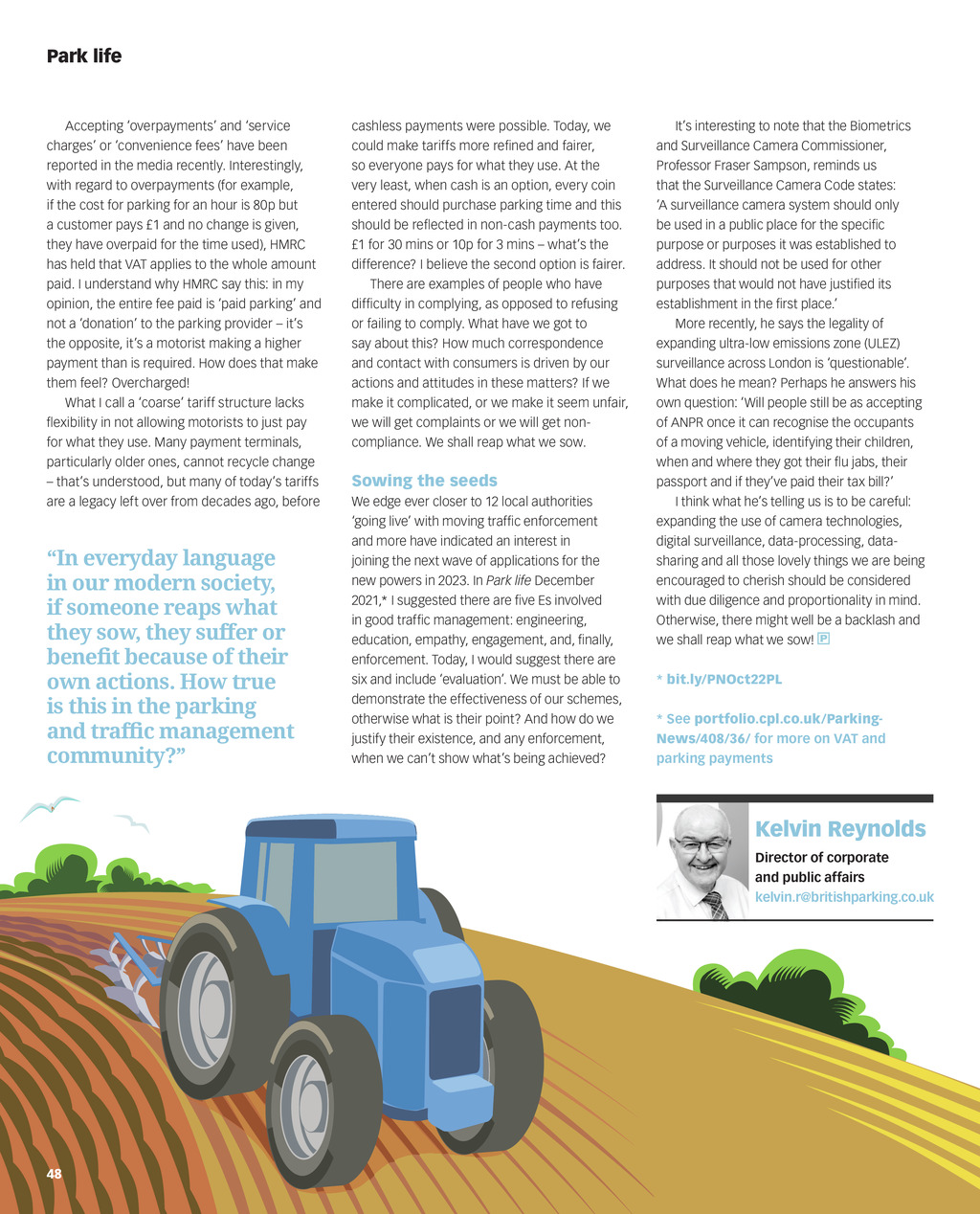

Park life Accepting overpayments and service charges or convenience fees have been reported in the media recently. Interestingly, with regard to overpayments (for example, if the cost for parking for an hour is 80p but a customer pays 1 and no change is given, they have overpaid for the time used), HMRC has held that VAT applies to the whole amount paid. I understand why HMRC say this: in my opinion, the entire fee paid is paid parking and not a donation to the parking provider its the opposite, its a motorist making a higher payment than is required. How does that make them feel? Overcharged! What I call a coarse tariff structure lacks flexibility in not allowing motorists to just pay for what they use. Many payment terminals, particularly older ones, cannot recycle change thats understood, but many of todays tariffs are a legacy left over from decades ago, before In everyday language in our modern society, if someone reaps what they sow, they suffer or benefit because of their own actions. How true is this in the parking and traffic management community? cashless payments were possible. Today, we could make tariffs more refined and fairer, so everyone pays for what they use. At the very least, when cash is an option, every coin entered should purchase parking time and this should be reflected in non-cash payments too. 1 for 30 mins or 10p for 3 mins whats the difference? I believe the second option is fairer. There are examples of people who have difficulty in complying, as opposed to refusing or failing to comply. What have we got to say about this? How much correspondence and contact with consumers is driven by our actions and attitudes in these matters? If we make it complicated, or we make it seem unfair, we will get complaints or we will get noncompliance. We shall reap what we sow. Sowing the seeds We edge ever closer to 12 local authorities going live with moving traffic enforcement and more have indicated an interest in joining the next wave of applications for the new powers in 2023. In Park life December 2021,* I suggested there are five Es involved in good traffic management: engineering, education, empathy, engagement, and, finally, enforcement. Today, I would suggest there are six and include evaluation. We must be able to demonstrate the effectiveness of our schemes, otherwise what is their point? And how do we justify their existence, and any enforcement, when we cant show whats being achieved? Its interesting to note that the Biometrics and Surveillance Camera Commissioner, Professor Fraser Sampson, reminds us that the Surveillance Camera Code states: A surveillance camera system should only be used in a public place for the specific purpose or purposes it was established to address. It should not be used for other purposes that would not have justified its establishment in the first place. More recently, he says the legality of expanding ultra-low emissions zone (ULEZ) surveillance across London is questionable. What does he mean? Perhaps he answers his own question: Will people still be as accepting of ANPR once it can recognise the occupants of a moving vehicle, identifying their children, when and where they got their flu jabs, their passport and if theyve paid their tax bill? I think what hes telling us is to be careful: expanding the use of camera technologies, digital surveillance, data-processing, datasharing and all those lovely things we are being encouraged to cherish should be considered with due diligence and proportionality in mind. Otherwise, there might well be a backlash and we shall reap what we sow! * bit.ly/PNOct22PL * See portfolio.cpl.co.uk/ParkingNews/408/36/ for more on VAT and parking payments Kelvin Reynolds Director of corporate and public affairs kelvin.r@britishparking.co.uk 48 PN Oct 2022 pp46-48 Kelvin.indd 48 23/09/2022 11:55