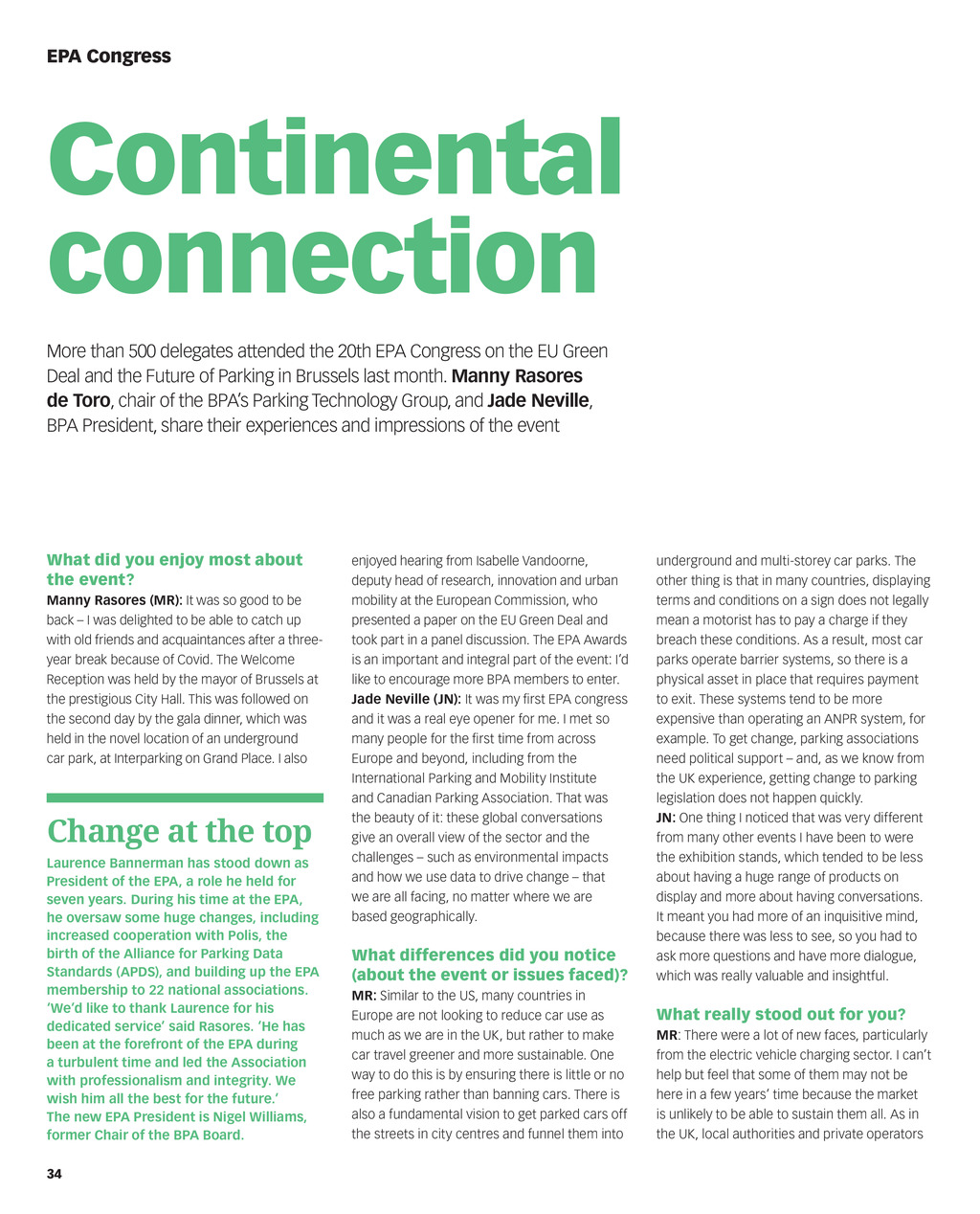
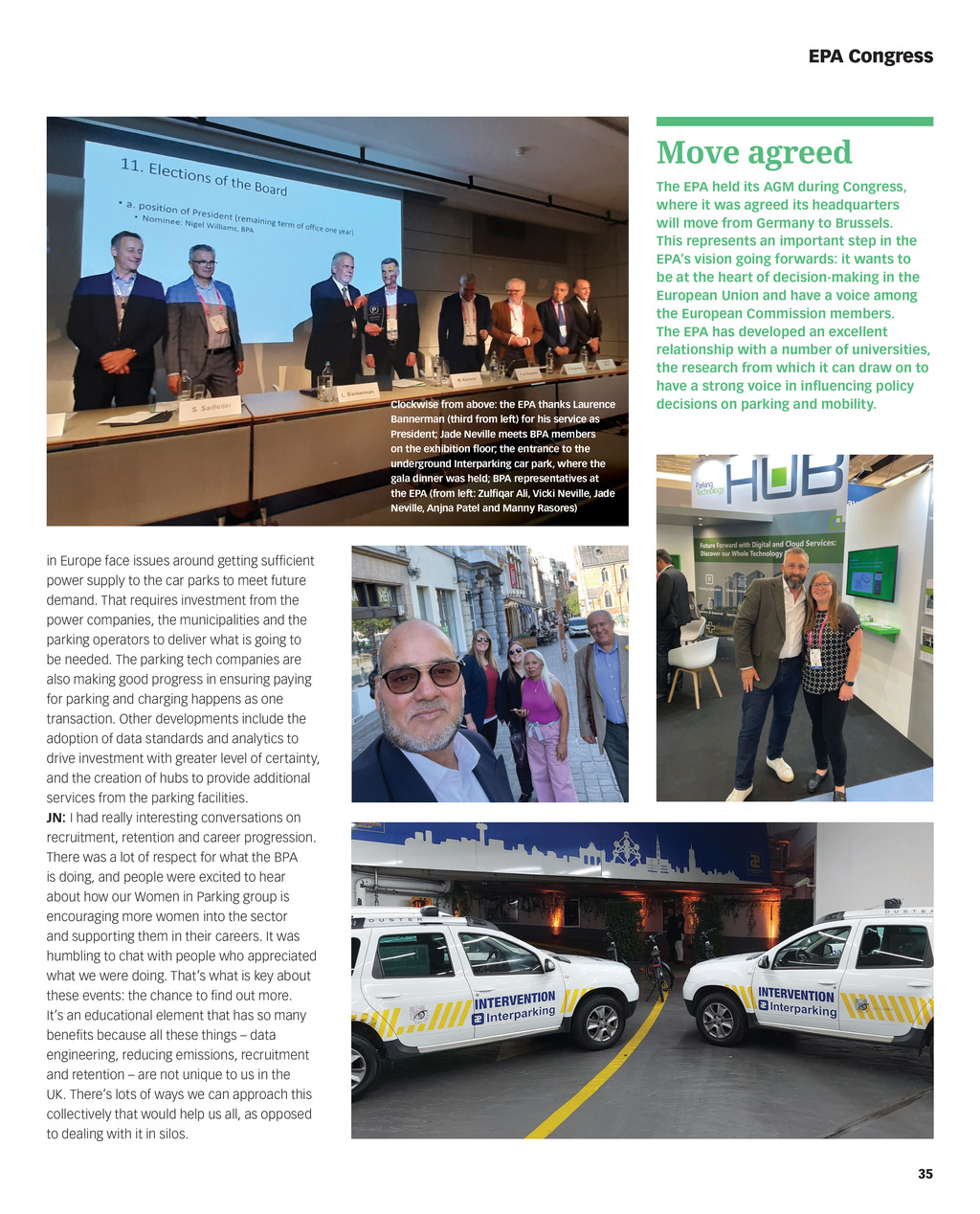
EPA Congress Continental connection More than 500 delegates attended the 20th EPA Congress on the EU Green Deal and the Future of Parking in Brussels last month. Manny Rasores de Toro, chair of the BPAs Parking Technology Group, and Jade Neville, BPA President, share their experiences and impressions of the event What did you enjoy most about the event? Manny Rasores (MR): It was so good to be back I was delighted to be able to catch up with old friends and acquaintances after a threeyear break because of Covid. The Welcome Reception was held by the mayor of Brussels at the prestigious City Hall. This was followed on the second day by the gala dinner, which was held in the novel location of an underground car park, at Interparking on Grand Place. I also Change at the top Laurence Bannerman has stood down as President of the EPA, a role he held for seven years. During his time at the EPA, he oversaw some huge changes, including increased cooperation with Polis, the birth of the Alliance for Parking Data Standards (APDS), and building up the EPA membership to 22 national associations. Wed like to thank Laurence for his dedicated service said Rasores. He has been at the forefront of the EPA during a turbulent time and led the Association with professionalism and integrity. We wish him all the best for the future. The new EPA President is Nigel Williams, former Chair of the BPA Board. enjoyed hearing from Isabelle Vandoorne, deputy head of research, innovation and urban mobility at the European Commission, who presented a paper on the EU Green Deal and took part in a panel discussion. The EPA Awards is an important and integral part of the event: Id like to encourage more BPA members to enter. Jade Neville (JN): It was my first EPA congress and it was a real eye opener for me. I met so many people for the first time from across Europe and beyond, including from the International Parking and Mobility Institute and Canadian Parking Association. That was the beauty of it: these global conversations give an overall view of the sector and the challenges such as environmental impacts and how we use data to drive change that we are all facing, no matter where we are based geographically. What differences did you notice (about the event or issues faced)? MR: Similar to the US, many countries in Europe are not looking to reduce car use as much as we are in the UK, but rather to make car travel greener and more sustainable. One way to do this is by ensuring there is little or no free parking rather than banning cars. There is also a fundamental vision to get parked cars off the streets in city centres and funnel them into underground and multi-storey car parks. The other thing is that in many countries, displaying terms and conditions on a sign does not legally mean a motorist has to pay a charge if they breach these conditions. As a result, most car parks operate barrier systems, so there is a physical asset in place that requires payment to exit. These systems tend to be more expensive than operating an ANPR system, for example. To get change, parking associations need political support and, as we know from the UK experience, getting change to parking legislation does not happen quickly. JN: One thing I noticed that was very different from many other events I have been to were the exhibition stands, which tended to be less about having a huge range of products on display and more about having conversations. It meant you had more of an inquisitive mind, because there was less to see, so you had to ask more questions and have more dialogue, which was really valuable and insightful. What really stood out for you? MR: There were a lot of new faces, particularly from the electric vehicle charging sector. I cant help but feel that some of them may not be here in a few years time because the market is unlikely to be able to sustain them all. As in the UK, local authorities and private operators 34 PN Oct 2022 pp34-35 EPA.indd 34 23/09/2022 11:46