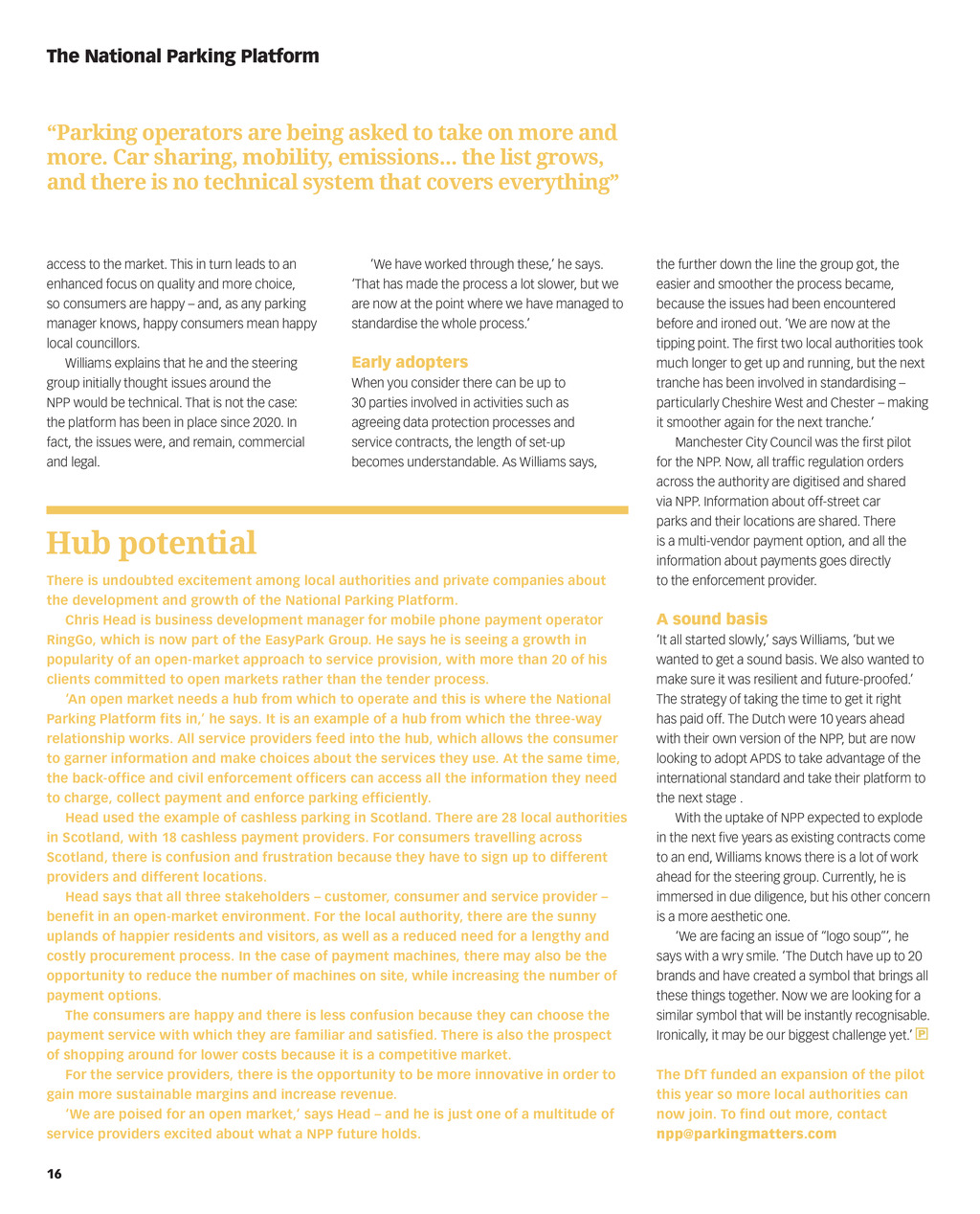

The National Parking Platform Parking operators are being asked to take on more and more. Car sharing, mobility, emissions... the list grows, and there is no technical system that covers everything access to the market. This in turn leads to an enhanced focus on quality and more choice, so consumers are happy and, as any parking manager knows, happy consumers mean happy local councillors. Williams explains that he and the steering group initially thought issues around the NPP would be technical. That is not the case: the platform has been in place since 2020. In fact, the issues were, and remain, commercial and legal. We have worked through these, he says. That has made the process a lot slower, but we are now at the point where we have managed to standardise the whole process. Early adopters When you consider there can be up to 30 parties involved in activities such as agreeing data protection processes and service contracts, the length of set-up becomes understandable. As Williams says, Hub potential There is undoubted excitement among local authorities and private companies about the development and growth of the National Parking Platform. Chris Head is business development manager for mobile phone payment operator RingGo, which is now part of the EasyPark Group. He says he is seeing a growth in popularity of an open-market approach to service provision, with more than 20 of his clients committed to open markets rather than the tender process. An open market needs a hub from which to operate and this is where the National Parking Platform fits in, he says. It is an example of a hub from which the three-way relationship works. All service providers feed into the hub, which allows the consumer to garner information and make choices about the services they use. At the same time, the back-office and civil enforcement officers can access all the information they need to charge, collect payment and enforce parking efficiently. Head used the example of cashless parking in Scotland. There are 28 local authorities in Scotland, with 18 cashless payment providers. For consumers travelling across Scotland, there is confusion and frustration because they have to sign up to different providers and different locations. Head says that all three stakeholders customer, consumer and service provider benefit in an open-market environment. For the local authority, there are the sunny uplands of happier residents and visitors, as well as a reduced need for a lengthy and costly procurement process. In the case of payment machines, there may also be the opportunity to reduce the number of machines on site, while increasing the number of payment options. The consumers are happy and there is less confusion because they can choose the payment service with which they are familiar and satisfied. There is also the prospect of shopping around for lower costs because it is a competitive market. For the service providers, there is the opportunity to be more innovative in order to gain more sustainable margins and increase revenue. We are poised for an open market, says Head and he is just one of a multitude of service providers excited about what a NPP future holds. the further down the line the group got, the easier and smoother the process became, because the issues had been encountered before and ironed out. We are now at the tipping point. The first two local authorities took much longer to get up and running, but the next tranche has been involved in standardising particularly Cheshire West and Chester making it smoother again for the next tranche. Manchester City Council was the first pilot for the NPP. Now, all traffic regulation orders across the authority are digitised and shared via NPP. Information about off-street car parks and their locations are shared. There is a multi-vendor payment option, and all the information about payments goes directly to the enforcement provider. A sound basis It all started slowly, says Williams, but we wanted to get a sound basis. We also wanted to make sure it was resilient and future-proofed. The strategy of taking the time to get it right has paid off. The Dutch were 10 years ahead with their own version of the NPP, but are now looking to adopt APDS to take advantage of the international standard and take their platform to the next stage . With the uptake of NPP expected to explode in the next five years as existing contracts come to an end, Williams knows there is a lot of work ahead for the steering group. Currently, he is immersed in due diligence, but his other concern is a more aesthetic one. We are facing an issue of logo soup, he says with a wry smile. The Dutch have up to 20 brands and have created a symbol that brings all these things together. Now we are looking for a similar symbol that will be instantly recognisable. Ironically, it may be our biggest challenge yet. The DfT funded an expansion of the pilot this year so more local authorities can now join. To find out more, contact npp@parkingmatters.com 16 PN Oct 2022 pp14-17 Lead Feature.indd 16 23/09/2022 11:24 m205