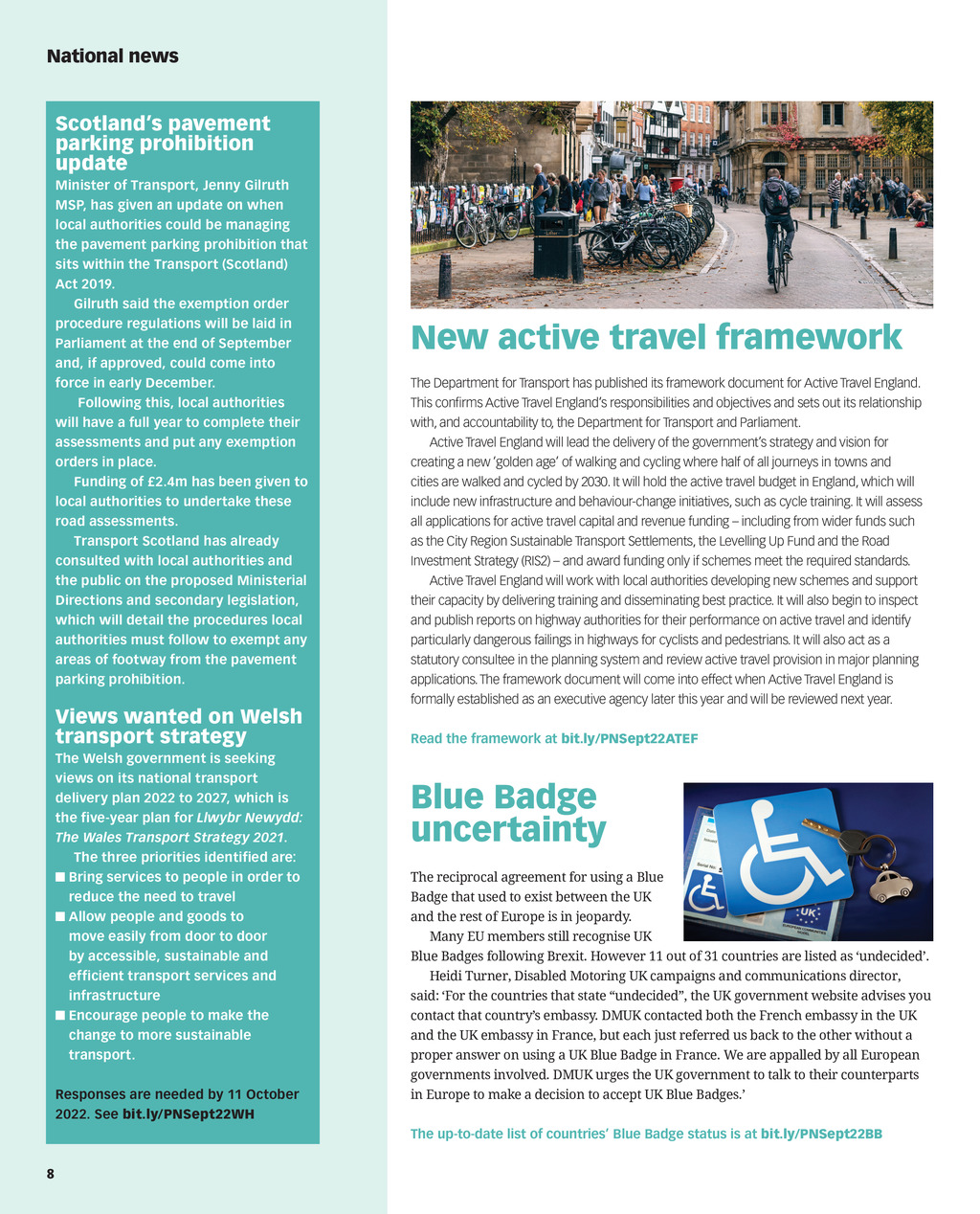


National news Scotlands pavement parking prohibition update Minister of Transport, Jenny Gilruth MSP, has given an update on when local authorities could be managing the pavement parking prohibition that sits within the Transport (Scotland) Act 2019. Gilruth said the exemption order procedure regulations will be laid in Parliament at the end of September and, if approved, could come into force in early December. Following this, local authorities will have a full year to complete their assessments and put any exemption orders in place. Funding of 2.4m has been given to local authorities to undertake these road assessments. Transport Scotland has already consulted with local authorities and the public on the proposed Ministerial Directions and secondary legislation, which will detail the procedures local authorities must follow to exempt any areas of footway from the pavement parking prohibition. Views wanted on Welsh transport strategy The Welsh government is seeking views on its national transport delivery plan 2022 to 2027, which is the five-year plan for Llwybr Newydd: The Wales Transport Strategy 2021. The three priorities identified are: Bring services to people in order to reduce the need to travel Allow people and goods to move easily from door to door by accessible, sustainable and efficient transport services and infrastructure Encourage people to make the change to more sustainable transport. Responses are needed by 11 October 2022. See bit.ly/PNSept22WH New active travel framework The Department for Transport has published its framework document for Active Travel England. This confirms Active Travel Englands responsibilities and objectives and sets out its relationship with, and accountability to, the Department for Transport and Parliament. Active Travel England will lead the delivery of the governments strategy and vision for creating a new golden age of walking and cycling where half of all journeys in towns and cities are walked and cycled by 2030. It will hold the active travel budget in England, which will include new infrastructure and behaviour-change initiatives, such as cycle training. It will assess all applications for active travel capital and revenue funding including from wider funds such as the City Region Sustainable Transport Settlements, the Levelling Up Fund and the Road Investment Strategy (RIS2) and award funding only if schemes meet the required standards. Active Travel England will work with local authorities developing new schemes and support their capacity by delivering training and disseminating best practice. It will also begin to inspect and publish reports on highway authorities for their performance on active travel and identify particularly dangerous failings in highways for cyclists and pedestrians. It will also act as a statutory consultee in the planning system and review active travel provision in major planning applications. The framework document will come into effect when Active Travel England is formally established as an executive agency later this year and will be reviewed next year. Read the framework at bit.ly/PNSept22ATEF Blue Badge uncertainty The reciprocal agreement for using a Blue Badge that used to exist between the UK and the rest of Europe is in jeopardy. Many EU members still recognise UK Blue Badges following Brexit. However 11 out of 31 countries are listed as undecided. Heidi Turner, Disabled Motoring UK campaigns and communications director, said: For the countries that state undecided, the UK government website advises you contact that countrys embassy. DMUK contacted both the French embassy in the UK and the UK embassy in France, but each just referred us back to the other without a proper answer on using a UK Blue Badge in France. We are appalled by all European governments involved. DMUK urges the UK government to talk to their counterparts in Europe to make a decision to accept UK Blue Badges. The up-to-date list of countries Blue Badge status is at bit.ly/PNSept22BB 8 PN Sept 2022 pp08-09 National News.indd 8 22/08/2022 09:10 m205