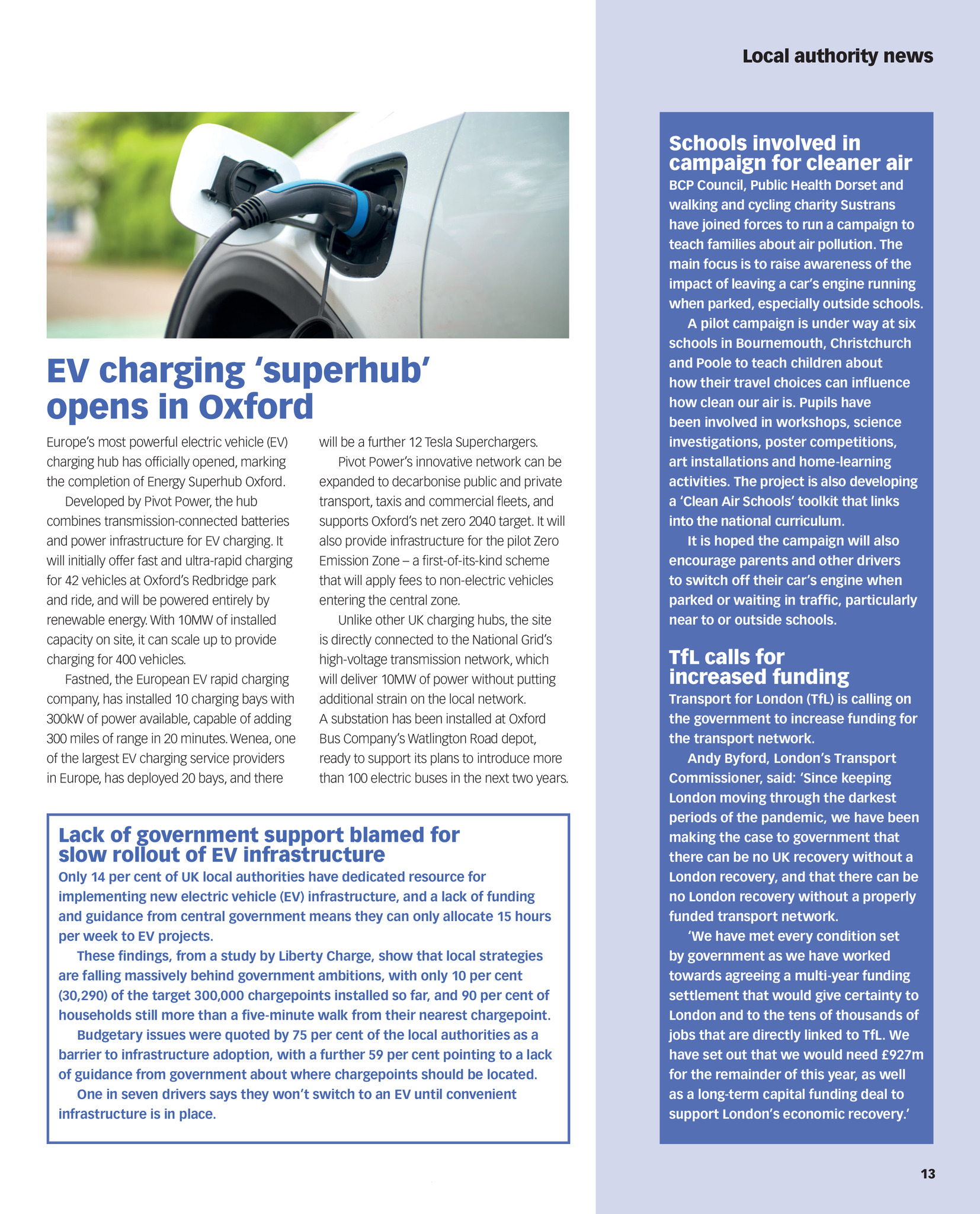
Local authority news Schools involved in campaign for cleaner air EV charging superhub opens in Oxford Europes most powerful electric vehicle (EV) charging hub has officially opened, marking the completion of Energy Superhub Oxford. Developed by Pivot Power, the hub combines transmission-connected batteries and power infrastructure for EV charging. It will initially offer fast and ultra-rapid charging for 42 vehicles at Oxfords Redbridge park and ride, and will be powered entirely by renewable energy. With 10MW of installed capacity on site, it can scale up to provide charging for 400 vehicles. Fastned, the European EV rapid charging company, has installed 10 charging bays with 300kW of power available, capable of adding 300 miles of range in 20 minutes. Wenea, one of the largest EV charging service providers in Europe, has deployed 20 bays, and there will be a further 12 Tesla Superchargers. Pivot Powers innovative network can be expanded to decarbonise public and private transport, taxis and commercial fleets, and supports Oxfords net zero 2040 target. It will also provide infrastructure for the pilot Zero Emission Zone a first-of-its-kind scheme that will apply fees to non-electric vehicles entering the central zone. Unlike other UK charging hubs, the site is directly connected to the National Grids high-voltage transmission network, which will deliver 10MW of power without putting additional strain on the local network. A substation has been installed at Oxford Bus Companys Watlington Road depot, ready to support its plans to introduce more than 100 electric buses in the next two years. Lack of government support blamed for slow rollout of EV infrastructure Only 14 per cent of UK local authorities have dedicated resource for implementing new electric vehicle (EV) infrastructure, and a lack of funding and guidance from central government means they can only allocate 15 hours per week to EV projects. These findings, from a study by Liberty Charge, show that local strategies are falling massively behind government ambitions, with only 10 per cent (30,290) of the target 300,000 chargepoints installed so far, and 90 per cent of households still more than a five-minute walk from their nearest chargepoint. Budgetary issues were quoted by 75 per cent of the local authorities as a barrier to infrastructure adoption, with a further 59 per cent pointing to a lack of guidance from government about where chargepoints should be located. One in seven drivers says they wont switch to an EV until convenient infrastructure is in place. BCP Council, Public Health Dorset and walking and cycling charity Sustrans have joined forces to run a campaign to teach families about air pollution. The main focus is to raise awareness of the impact of leaving a cars engine running when parked, especially outside schools. A pilot campaign is under way at six schools in Bournemouth, Christchurch and Poole to teach children about how their travel choices can influence how clean our air is. Pupils have been involved in workshops, science investigations, poster competitions, art installations and home-learning activities. The project is also developing a Clean Air Schools toolkit that links into the national curriculum. It is hoped the campaign will also encourage parents and other drivers to switch off their cars engine when parked or waiting in traffic, particularly near to or outside schools. TfL calls for increased funding Transport for London (TfL) is calling on the government to increase funding for the transport network. Andy Byford, Londons Transport Commissioner, said: Since keeping London moving through the darkest periods of the pandemic, we have been making the case to government that there can be no UK recovery without a London recovery, and that there can be no London recovery without a properly funded transport network. We have met every condition set by government as we have worked towards agreeing a multi-year funding settlement that would give certainty to London and to the tens of thousands of jobs that are directly linked to TfL. We have set out that we would need 927m for the remainder of this year, as well as a long-term capital funding deal to support Londons economic recovery. 13 PN Sept 2022 pp13 LA News.indd 13 22/08/2022 09:13