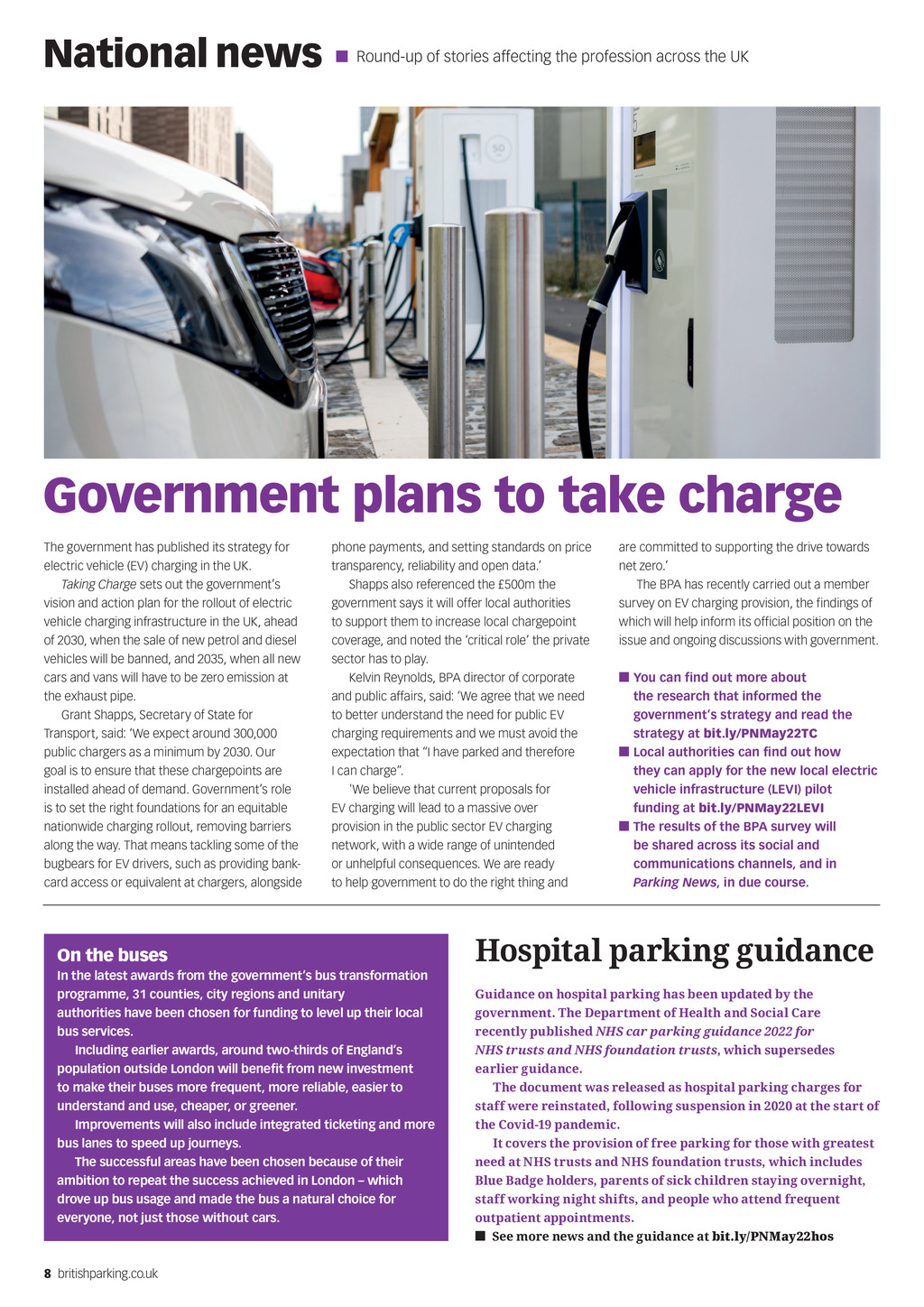

National news Round-up of stories affecting the profession across the UK Government plans to take charge The government has published its strategy for electric vehicle (EV) charging in the UK. Taking Charge sets out the governments vision and action plan for the rollout of electric vehicle charging infrastructure in the UK, ahead of 2030, when the sale of new petrol and diesel vehicles will be banned, and 2035, when all new cars and vans will have to be zero emission at the exhaust pipe. Grant Shapps, Secretary of State for Transport, said: We expect around 300,000 public chargers as a minimum by 2030. Our goal is to ensure that these chargepoints are installed ahead of demand. Governments role is to set the right foundations for an equitable nationwide charging rollout, removing barriers along the way. That means tackling some of the bugbears for EV drivers, such as providing bankcard access or equivalent at chargers, alongside phone payments, and setting standards on price transparency, reliability and open data. Shapps also referenced the 500m the government says it will offer local authorities to support them to increase local chargepoint coverage, and noted the critical role the private sector has to play. Kelvin Reynolds, BPA director of corporate and public affairs, said: We agree that we need to better understand the need for public EV charging requirements and we must avoid the expectation that I have parked and therefore I can charge. We believe that current proposals for EV charging will lead to a massive over provision in the public sector EV charging network, with a wide range of unintended or unhelpful consequences. We are ready to help government to do the right thing and On the buses In the latest awards from the governments bus transformation programme, 31 counties, city regions and unitary authorities have been chosen for funding to level up their local bus services. Including earlier awards, around two-thirds of Englands population outside London will benefit from new investment to make their buses more frequent, more reliable, easier to understand and use, cheaper, or greener. Improvements will also include integrated ticketing and more bus lanes to speed up journeys. The successful areas have been chosen because of their ambition to repeat the success achieved in London which drove up bus usage and made the bus a natural choice for everyone, not just those without cars. are committed to supporting the drive towards net zero. The BPA has recently carried out a member survey on EV charging provision, the findings of which will help inform its official position on the issue and ongoing discussions with government. n You can find out more about the research that informed the governments strategy and read the strategy at bit.ly/PNMay22TC n Local authorities can find out how they can apply for the new local electric vehicle infrastructure (LEVI) pilot funding at bit.ly/PNMay22LEVI n The results of the BPA survey will be shared across its social and communications channels, and in Parking News, in due course. Hospital parking guidance Guidance on hospital parking has been updated by the government. The Department of Health and Social Care recently published NHS car parking guidance 2022 for NHS trusts and NHS foundation trusts, which supersedes earlier guidance. The document was released as hospital parking charges for staff were reinstated, following suspension in 2020 at the start of the Covid-19 pandemic. It covers the provision of free parking for those with greatest need at NHS trusts and NHS foundation trusts, which includes Blue Badge holders, parents of sick children staying overnight, staff working night shifts, and people who attend frequent outpatient appointments. n See more news and the guidance at bit.ly/PNMay22hos 8 britishparking.co.uk PN May 2022 pp08-09 News.indd 8 21/04/2022 11:13