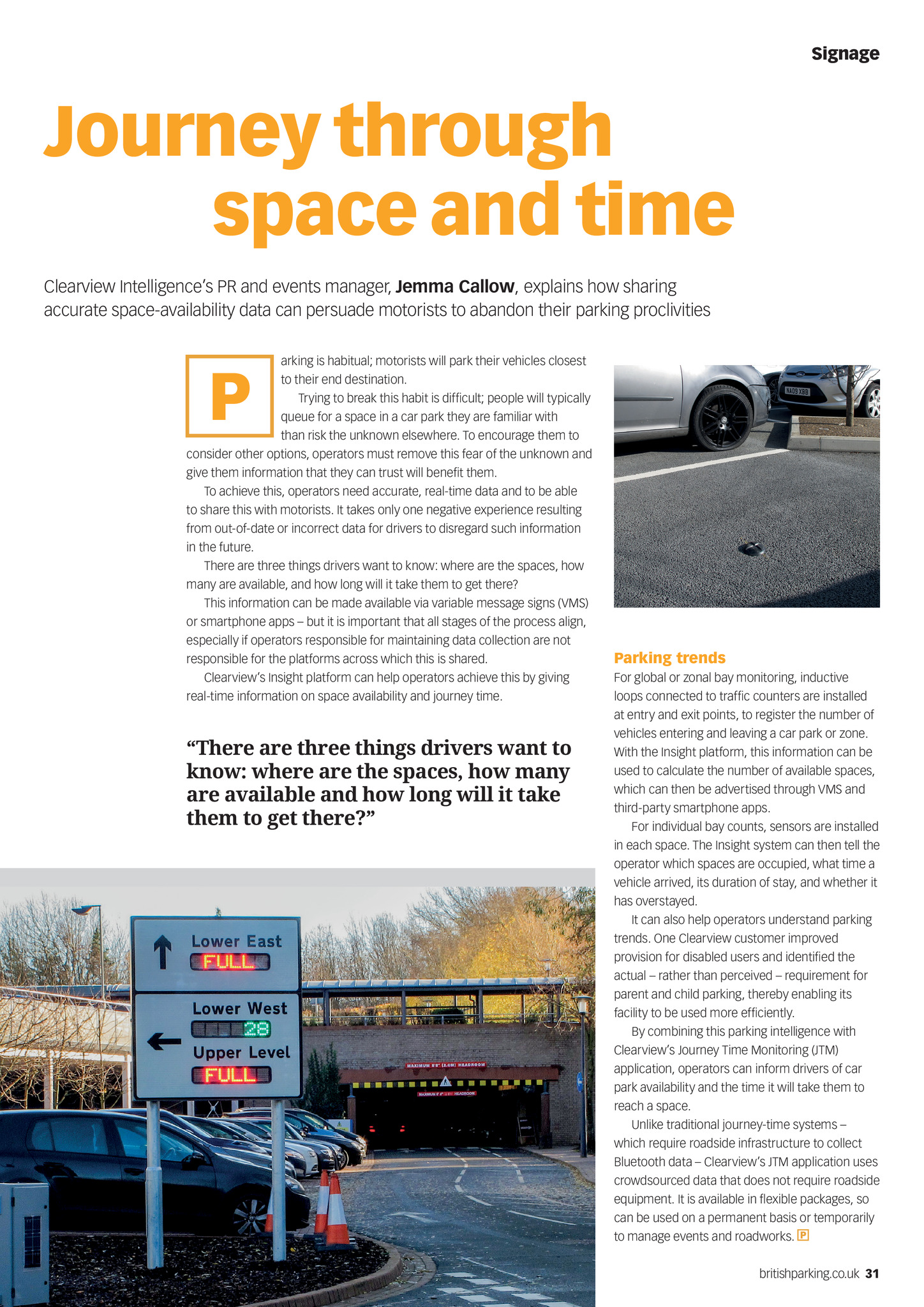
Signage Journey through space and time Clearview Intelligences PR and events manager, Jemma Callow, explains how sharing accurate space-availability data can persuade motorists to abandon their parking proclivities arking is habitual; motorists will park their vehicles closest to their end destination. Trying to break this habit is difficult; people will typically queue for a space in a car park they are familiar with than risk the unknown elsewhere. To encourage them to consider other options, operators must remove this fear of the unknown and give them information that they can trust will benefit them. To achieve this, operators need accurate, real-time data and to be able to share this with motorists. It takes only one negative experience resulting from out-of-date or incorrect data for drivers to disregard such information in the future. There are three things drivers want to know: where are the spaces, how many are available, and how long will it take them to get there? This information can be made available via variable message signs (VMS) or smartphone apps but it is important that all stages of the process align, especially if operators responsible for maintaining data collection are not responsible for the platforms across which this is shared. Clearviews Insight platform can help operators achieve this by giving real-time information on space availability and journey time. P There are three things drivers want to know: where are the spaces, how many are available and how long will it take them to get there? Parking trends For global or zonal bay monitoring, inductive loops connected to traffic counters are installed at entry and exit points, to register the number of vehicles entering and leaving a car park or zone. With the Insight platform, this information can be used to calculate the number of available spaces, which can then be advertised through VMS and third-party smartphone apps. For individual bay counts, sensors are installed in each space. The Insight system can then tell the operator which spaces are occupied, what time a vehicle arrived, its duration of stay, and whether it has overstayed. It can also help operators understand parking trends. One Clearview customer improved provision for disabled users and identified the actual rather than perceived requirement for parent and child parking, thereby enabling its facility to be used more efficiently. By combining this parking intelligence with Clearviews Journey Time Monitoring (JTM) application, operators can inform drivers of car park availability and the time it will take them to reach a space. Unlike traditional journey-time systems which require roadside infrastructure to collect Bluetooth data Clearviews JTM application uses crowdsourced data that does not require roadside equipment. It is available in flexible packages, so can be used on a permanent basis or temporarily to manage events and roadworks. britishparking.co.uk 31 PN Oct19 pp30-31 Clearview.indd 31 23/09/2019 13:59