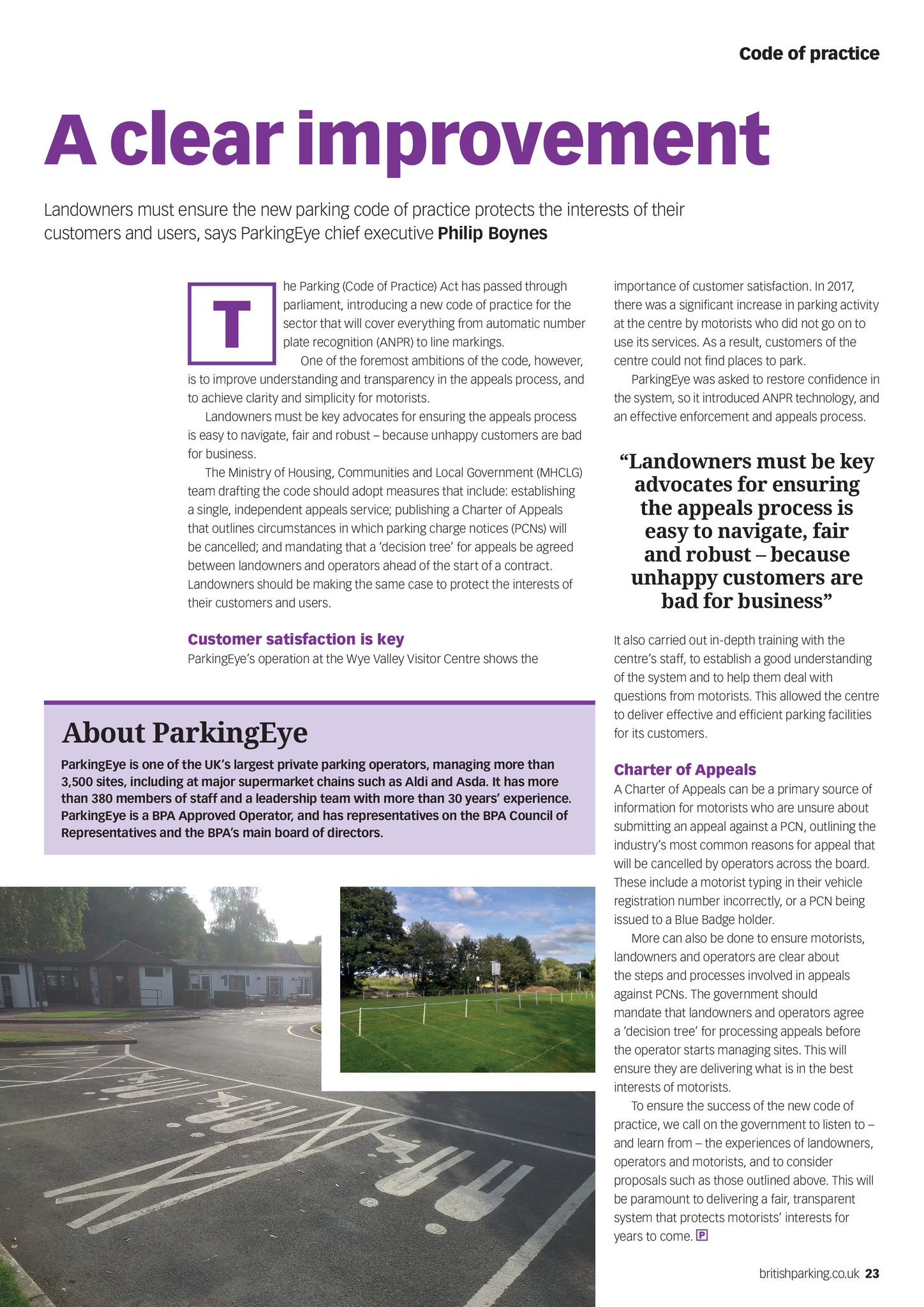
9 10:34 Code of practice A clear improvement Landowners must ensure the new parking code of practice protects the interests of their customers and users, says ParkingEye chief executive Philip Boynes he Parking (Code of Practice) Act has passed through parliament, introducing a new code of practice for the sector that will cover everything from automatic number plate recognition (ANPR) to line markings. One of the foremost ambitions of the code, however, is to improve understanding and transparency in the appeals process, and to achieve clarity and simplicity for motorists. Landowners must be key advocates for ensuring the appeals process is easy to navigate, fair and robust because unhappy customers are bad for business. The Ministry of Housing, Communities and Local Government (MHCLG) team drafting the code should adopt measures that include: establishing a single, independent appeals service; publishing a Charter of Appeals that outlines circumstances in which parking charge notices (PCNs) will be cancelled; and mandating that a decision tree for appeals be agreed between landowners and operators ahead of the start of a contract. Landowners should be making the same case to protect the interests of their customers and users. importance of customer satisfaction. In 2017, there was a significant increase in parking activity at the centre by motorists who did not go on to use its services. As a result, customers of the centre could not find places to park. ParkingEye was asked to restore confidence in the system, so it introduced ANPR technology, and an effective enforcement and appeals process. Customer satisfaction is key It also carried out in-depth training with the centres staff, to establish a good understanding of the system and to help them deal with questions from motorists. This allowed the centre to deliver effective and efficient parking facilities for its customers. T ParkingEyes operation at the Wye Valley Visitor Centre shows the About ParkingEye ParkingEye is one of the UKs largest private parking operators, managing more than 3,500 sites, including at major supermarket chains such as Aldi and Asda. It has more than 380 members of staff and a leadership team with more than 30 years experience. ParkingEye is a BPA Approved Operator, and has representatives on the BPA Council of Representatives and the BPAs main board of directors. Landowners must be key advocates for ensuring the appeals process is easy to navigate, fair and robust because unhappy customers are bad for business Charter of Appeals A Charter of Appeals can be a primary source of information for motorists who are unsure about submitting an appeal against a PCN, outlining the industrys most common reasons for appeal that will be cancelled by operators across the board. These include a motorist typing in their vehicle registration number incorrectly, or a PCN being issued to a Blue Badge holder. More can also be done to ensure motorists, landowners and operators are clear about the steps and processes involved in appeals against PCNs. The government should mandate that landowners and operators agree a decision tree for processing appeals before the operator starts managing sites. This will ensure they are delivering what is in the best interests of motorists. To ensure the success of the new code of practice, we call on the government to listen to and learn from the experiences of landowners, operators and motorists, and to consider proposals such as those outlined above. This will be paramount to delivering a fair, transparent system that protects motorists interests for years to come. britishparking.co.uk 23 PN Oct19 pp22-23 Parking Eye.indd 23 23/09/2019 13:56