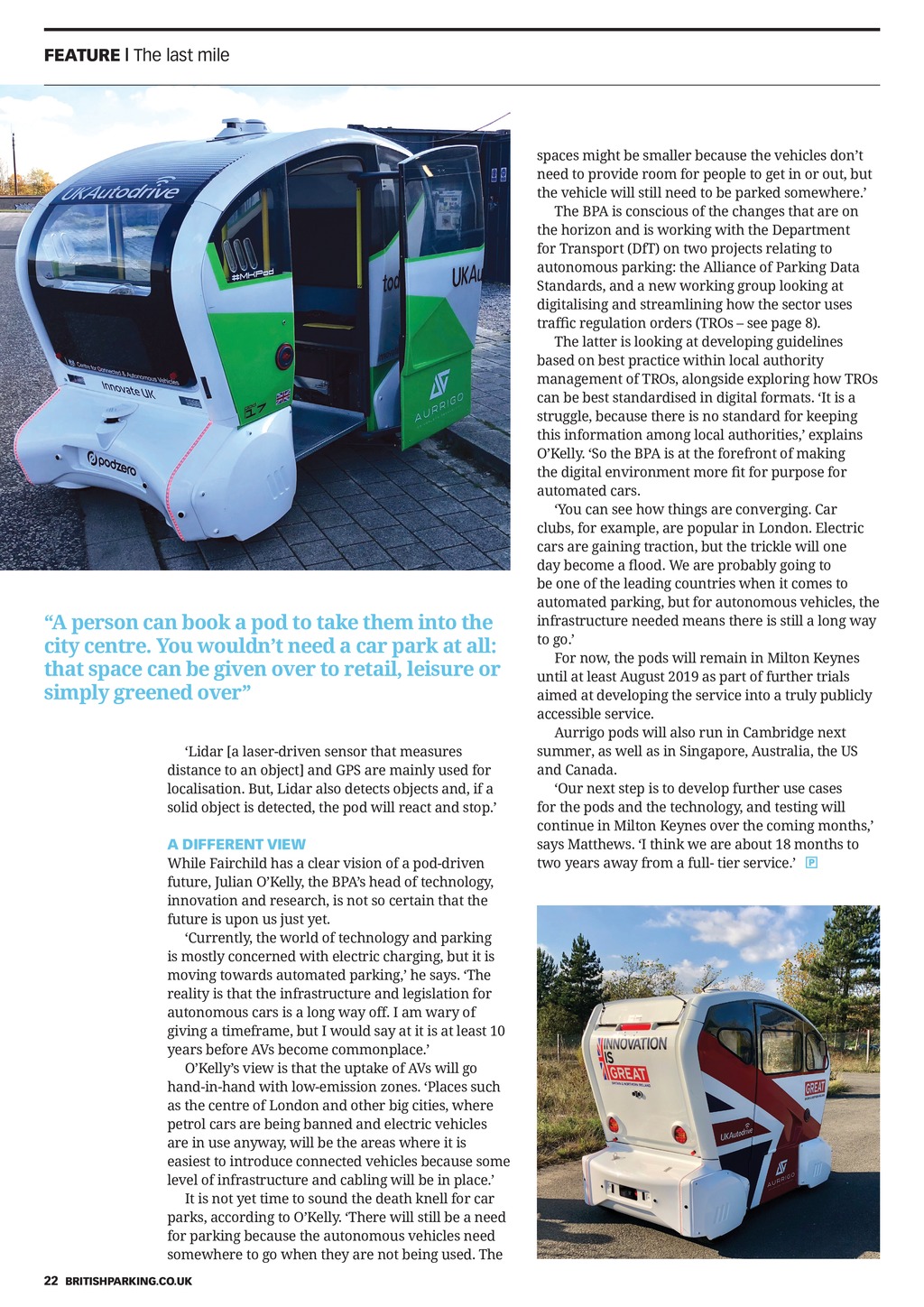

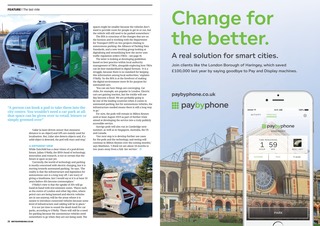
feature The last mile A person can book a pod to take them into the city centre. You wouldnt need a car park at all: that space can be given over to retail, leisure or simply greened over Lidar [a laser-driven sensor that measures distance to an object] and GPS are mainly used for localisation. But, Lidar also detects objects and, if a solid object is detected, the pod will react and stop. A different view While Fairchild has a clear vision of a pod-driven future, Julian OKelly, the BPAs head of technology, innovation and research, is not so certain that the future is upon us just yet. Currently, the world of technology and parking is mostly concerned with electric charging, but it is moving towards automated parking, he says. The reality is that the infrastructure and legislation for autonomous cars is a long way off. I am wary of giving a timeframe, but I would say at it is at least 10 years before AVs become commonplace. OKellys view is that the uptake of AVs will go hand-in-hand with low-emission zones. Places such as the centre of London and other big cities, where petrol cars are being banned and electric vehicles are in use anyway, will be the areas where it is easiest to introduce connected vehicles because some level of infrastructure and cabling will be in place. It is not yet time to sound the death knell for car parks, according to OKelly. There will still be a need for parking because the autonomous vehicles need somewhere to go when they are not being used. The spaces might be smaller because the vehicles dont need to provide room for people to get in or out, but the vehicle will still need to be parked somewhere. The BPA is conscious of the changes that are on the horizon and is working with the Department for Transport (DfT) on two projects relating to autonomous parking: the Alliance of Parking Data Standards, and a new working group looking at digitalising and streamlining how the sector uses traffic regulation orders (TROs see page 8). The latter is looking at developing guidelines based on best practice within local authority management of TROs, alongside exploring how TROs can be best standardised in digital formats. It is a struggle, because there is no standard for keeping this information among local authorities, explains OKelly. So the BPA is at the forefront of making the digital environment more fit for purpose for automated cars. You can see how things are converging. Car clubs, for example, are popular in London. Electric cars are gaining traction, but the trickle will one day become a flood. We are probably going to be one of the leading countries when it comes to automated parking, but for autonomous vehicles, the infrastructure needed means there is still a long way to go. For now, the pods will remain in Milton Keynes until at least August 2019 as part of further trials aimed at developing the service into a truly publicly accessible service. Aurrigo pods will also run in Cambridge next summer, as well as in Singapore, Australia, the US and Canada. Our next step is to develop further use cases for the pods and the technology, and testing will continue in Milton Keynes over the coming months, says Matthews. I think we are about 18 months to two years away from a full- tier service. C M Y CM MY CY CMY K 22 Britishparking.co.uk PNDec18 pp20-23 Lead Feature AMENDED.indd 22 26/11/2018 16:19