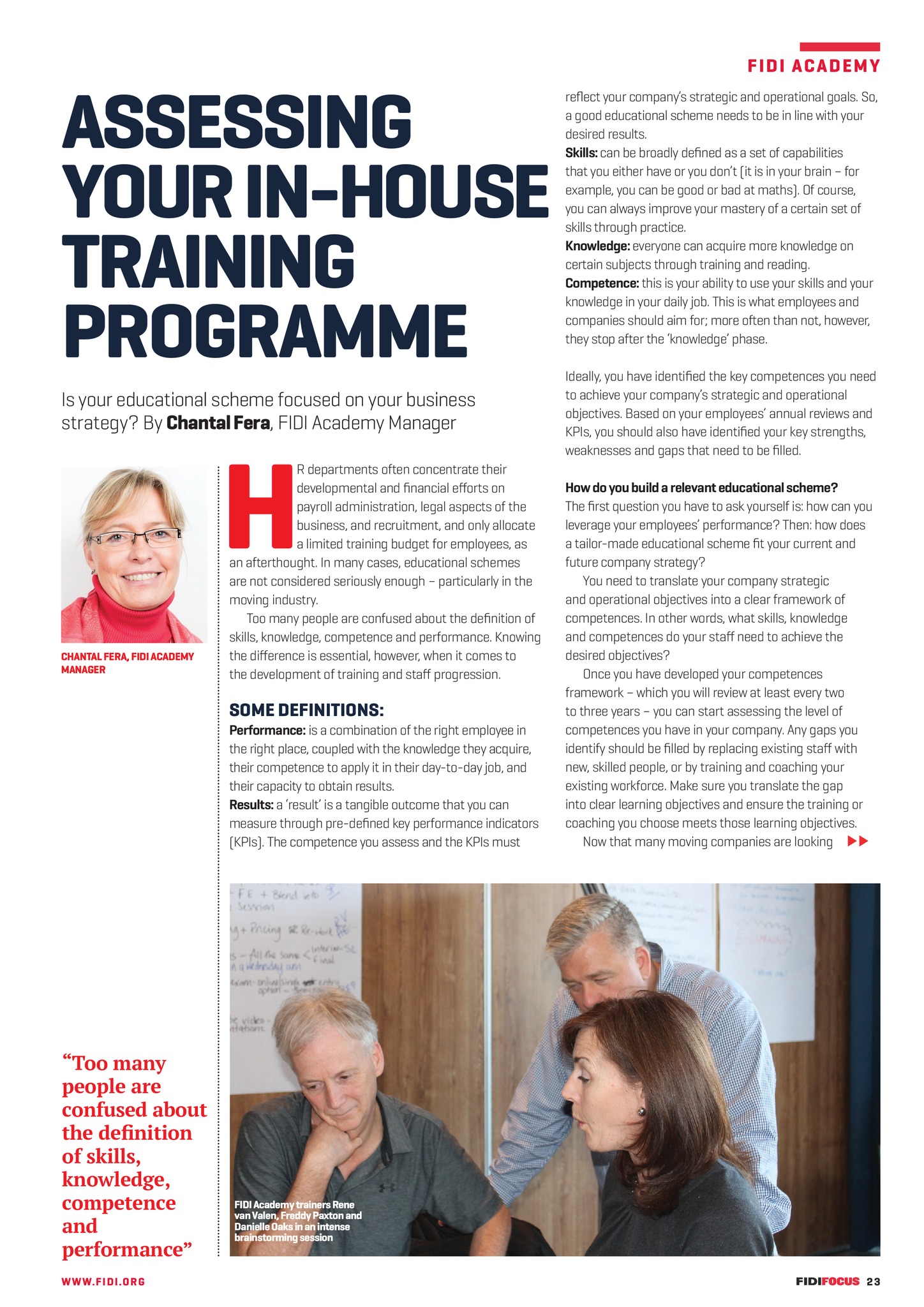
ASSESSING YOUR IN-HOUSE TRAINING PROGRAMME Is your educational scheme focused on your business strategy? By Chantal Fera, FIDI Academy Manager H CHANTAL FERA, FIDI ACADEMY MANAGER R departments often concentrate their developmental and nancial efforts on payroll administration, legal aspects of the business, and recruitment, and only allocate a limited training budget for employees, as an afterthought. In many cases, educational schemes are not considered seriously enough particularly in the moving industry. Too many people are confused about the denition of skills, knowledge, competence and performance. Knowing the difference is essential, however, when it comes to the development of training and staff progression. SOME DEFINITIONS: Performance: is a combination of the right employee in the right place, coupled with the knowledge they acquire, their competence to apply it in their day-to-day job, and their capacity to obtain results. Results: a result is a tangible outcome that you can measure through pre-dened key performance indicators (KPIs). The competence you assess and the KPIs must Too many people are confused about the denition of skills, knowledge, competence and performance WW W. F I D I. O R G FF292 AugSep19 pp22-24 Academy .indd 23 F I D I AC AD E M Y reect your companys strategic and operational goals. So, a good educational scheme needs to be in line with your desired results. Skills: can be broadly dened as a set of capabilities that you either have or you dont (it is in your brain for example, you can be good or bad at maths). Of course, you can always improve your mastery of a certain set of skills through practice. Knowledge: everyone can acquire more knowledge on certain subjects through training and reading. Competence: this is your ability to use your skills and your knowledge in your daily job. This is what employees and companies should aim for; more often than not, however, they stop after the knowledge phase. Ideally, you have identied the key competences you need to achieve your companys strategic and operational objectives. Based on your employees annual reviews and KPIs, you should also have identied your key strengths, weaknesses and gaps that need to be lled. How do you build a relevant educational scheme? The rst question you have to ask yourself is: how can you leverage your employees performance? Then: how does a tailor-made educational scheme t your current and future company strategy? You need to translate your company strategic and operational objectives into a clear framework of competences. In other words, what skills, knowledge and competences do your staff need to achieve the desired objectives? Once you have developed your competences framework which you will review at least every two to three years you can start assessing the level of competences you have in your company. Any gaps you identify should be lled by replacing existing staff with new, skilled people, or by training and coaching your existing workforce. Make sure you translate the gap into clear learning objectives and ensure the training or coaching you choose meets those learning objectives. Now that many moving companies are looking FIDI Academy trainers Rene van Valen, Freddy Paxton and Danielle Oaks in an intense brainstorming session 23 15/07/2019 14:48