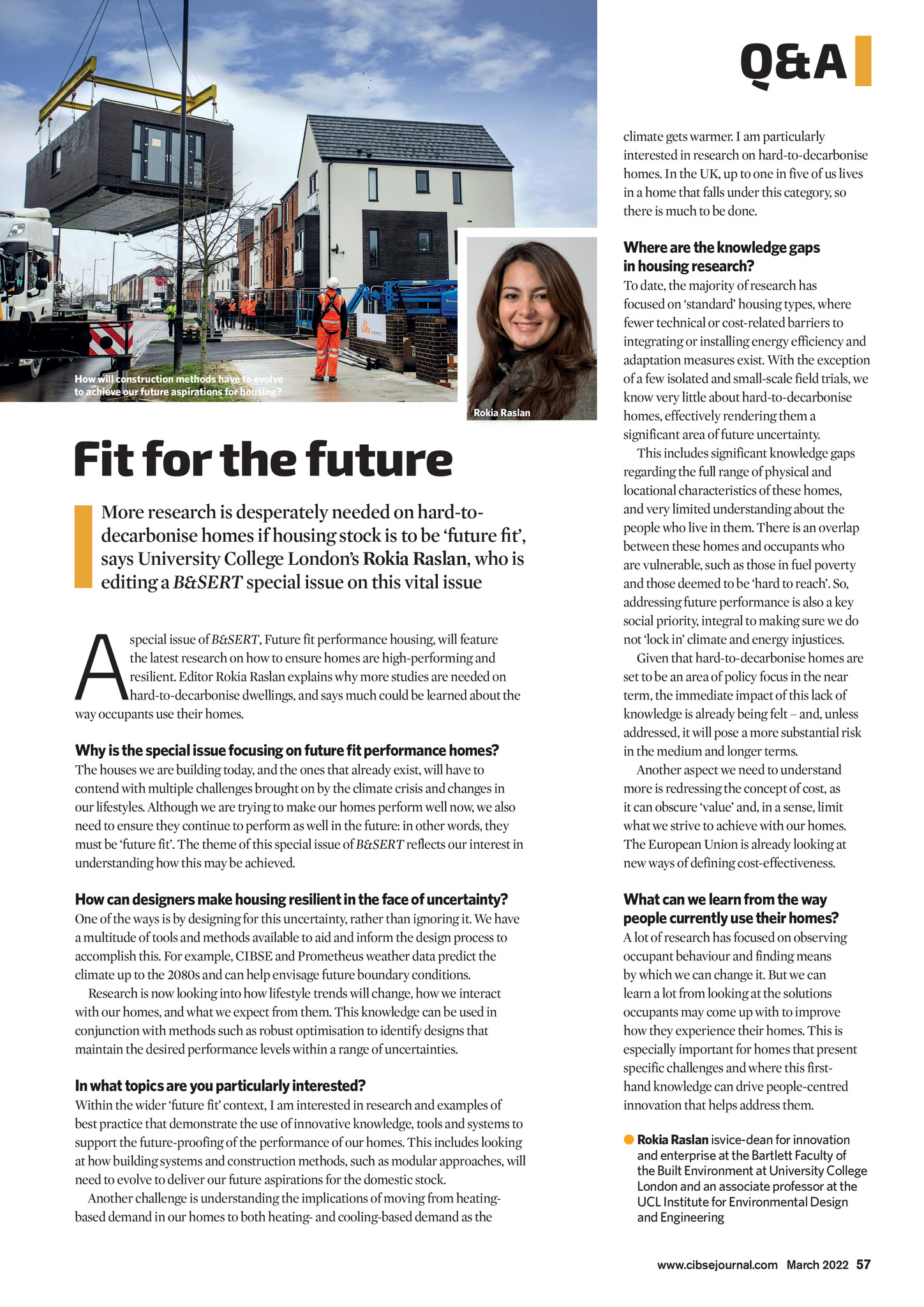
Q&A climate gets warmer. I am particularly interested in research on hard-to-decarbonise homes. In the UK, up to one in five of us lives in a home that falls under this category, so there is much to be done. Where are the knowledge gaps in housing research? How will construction methods have to evolve to achieve our future aspirations for housing? Rokia Raslan Fit for the future More research is desperately needed on hard-todecarbonise homes if housing stock is to be future t, says University College Londons Rokia Raslan, who is editing a B&SERT special issue on this vital issue A special issue of B&SERT, Future fit performance housing, will feature the latest research on how to ensure homes are high-performing and resilient. Editor Rokia Raslan explains why more studies are needed on hard-to-decarbonise dwellings, and says much could be learned about the way occupants use their homes. Why is the special issue focusing on future t performance homes? The houses we are building today, and the ones that already exist, will have to contend with multiple challenges brought on by the climate crisis and changes in our lifestyles. Although we are trying to make our homes perform well now, we also need to ensure they continue to perform as well in the future: in other words, they must be future fit. The theme of this special issue of B&SERT reflects our interest in understanding how this may be achieved. How can designers make housing resilient in the face of uncertainty? One of the ways is by designing for this uncertainty, rather than ignoring it. We have a multitude of tools and methods available to aid and inform the design process to accomplish this. For example, CIBSE and Prometheus weather data predict the climate up to the 2080s and can help envisage future boundary conditions. Research is now looking into how lifestyle trends will change, how we interact with our homes, and what we expect from them. This knowledge can be used in conjunction with methods such as robust optimisation to identify designs that maintain the desired performance levels within a range of uncertainties. In what topics are you particularly interested? Within the wider future fit context, I am interested in research and examples of best practice that demonstrate the use of innovative knowledge, tools and systems to support the future-proofing of the performance of our homes. This includes looking at how building systems and construction methods, such as modular approaches, will need to evolve to deliver our future aspirations for the domestic stock. Another challenge is understanding the implications of moving from heatingbased demand in our homes to both heating- and cooling-based demand as the To date, the majority of research has focused on standard housing types, where fewer technical or cost-related barriers to integrating or installing energy efficiency and adaptation measures exist. With the exception of a few isolated and small-scale field trials, we know very little about hard-to-decarbonise homes, effectively rendering them a significant area of future uncertainty. This includes significant knowledge gaps regarding the full range of physical and locational characteristics of these homes, and very limited understanding about the people who live in them. There is an overlap between these homes and occupants who are vulnerable, such as those in fuel poverty and those deemed to be hard to reach. So, addressing future performance is also a key social priority, integral to making sure we do not lock in climate and energy injustices. Given that hard-to-decarbonise homes are set to be an area of policy focus in the near term, the immediate impact of this lack of knowledge is already being felt and, unless addressed, it will pose a more substantial risk in the medium and longer terms. Another aspect we need to understand more is redressing the concept of cost, as it can obscure value and, in a sense, limit what we strive to achieve with our homes. The European Union is already looking at new ways of defining cost-effectiveness. What can we learn from the way people currently use their homes? A lot of research has focused on observing occupant behaviour and finding means by which we can change it. But we can learn a lot from looking at the solutions occupants may come up with to improve how they experience their homes. This is especially important for homes that present specific challenges and where this firsthand knowledge can drive people-centred innovation that helps address them. Rokia Raslan isvice-dean for innovation and enterprise at the Bartlett Faculty of the Built Environment at University College London and an associate professor at the UCL Institute for Environmental Design and Engineering www.cibsejournal.com March 2022 57 CIBSE March 22 pp57 Q&A.indd 57 25/02/2022 15:22