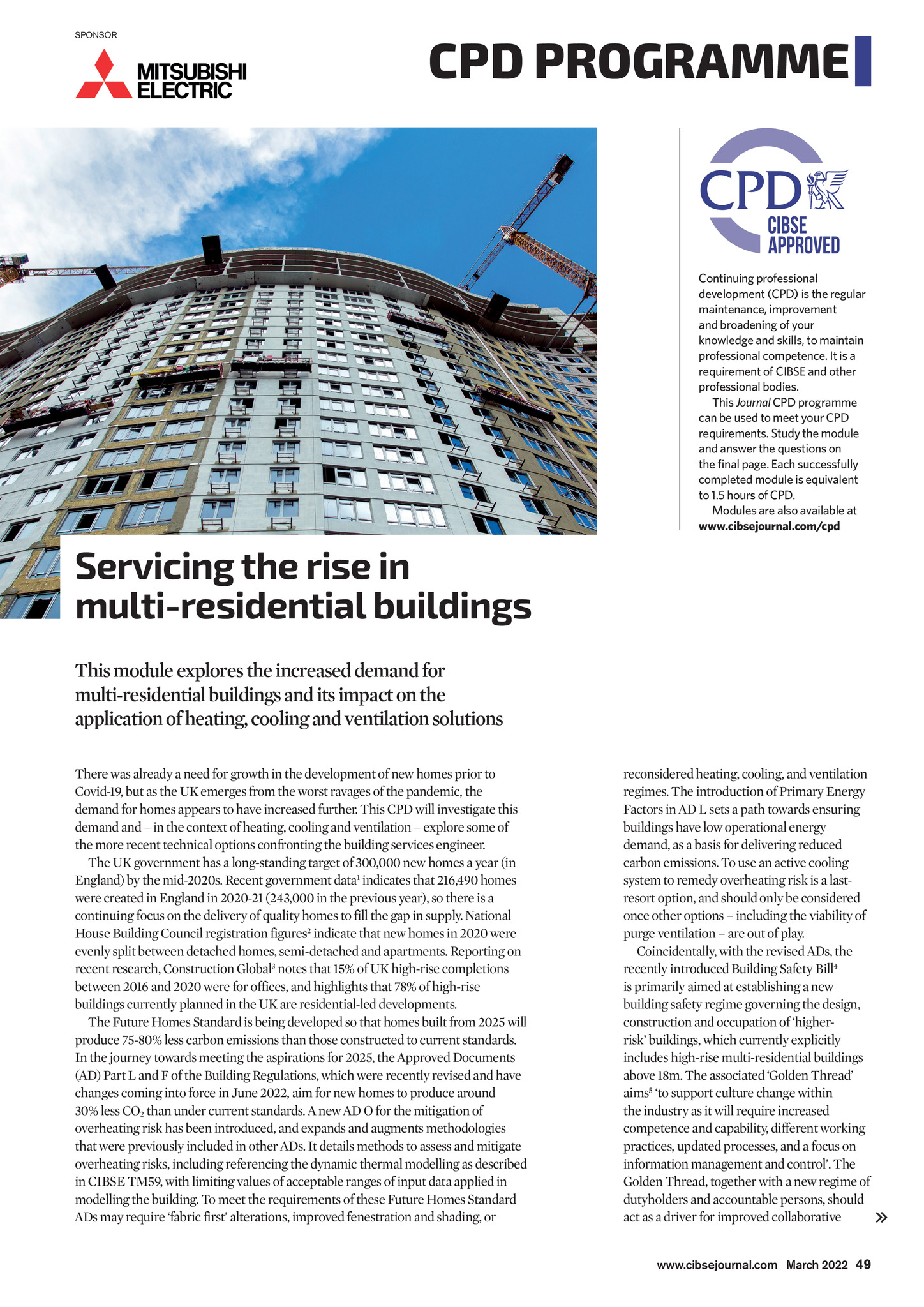
SPONSOR CPD PROGRAMME Continuing professional development (CPD) is the regular maintenance, improvement and broadening of your knowledge and skills, to maintain professional competence. It is a requirement of CIBSE and other professional bodies. This Journal CPD programme can be used to meet your CPD requirements. Study the module and answer the questions on the final page. Each successfully completed module is equivalent to 1.5 hours of CPD. Modules are also available at www.cibsejournal.com/cpd Servicing the rise in multi-residential buildings This module explores the increased demand for multi-residential buildings and its impact on the application of heating, cooling and ventilation solutions There was already a need for growth in the development of new homes prior to Covid-19, but as the UK emerges from the worst ravages of the pandemic, the demand for homes appears to have increased further. This CPD will investigate this demand and in the context of heating, cooling and ventilation explore some of the more recent technical options confronting the building services engineer. The UK government has a long-standing target of 300,000 new homes a year (in England) by the mid-2020s. Recent government data1 indicates that 216,490 homes were created in England in 2020-21 (243,000 in the previous year), so there is a continuing focus on the delivery of quality homes to fill the gap in supply. National House Building Council registration figures2 indicate that new homes in 2020 were evenly split between detached homes, semi-detached and apartments. Reporting on recent research, Construction Global3 notes that 15% of UK high-rise completions between 2016 and 2020 were for offices, and highlights that 78% of high-rise buildings currently planned in the UK are residential-led developments. The Future Homes Standard is being developed so that homes built from 2025 will produce 75-80% less carbon emissions than those constructed to current standards. In the journey towards meeting the aspirations for 2025, the Approved Documents (AD) Part L and F of the Building Regulations, which were recently revised and have changes coming into force in June 2022, aim for new homes to produce around 30% less CO2 than under current standards. A new AD O for the mitigation of overheating risk has been introduced, and expands and augments methodologies that were previously included in other ADs. It details methods to assess and mitigate overheating risks, including referencing the dynamic thermal modelling as described in CIBSE TM59, with limiting values of acceptable ranges of input data applied in modelling the building. To meet the requirements of these Future Homes Standard ADs may require fabric first alterations, improved fenestration and shading, or reconsidered heating, cooling, and ventilation regimes. The introduction of Primary Energy Factors in AD L sets a path towards ensuring buildings have low operational energy demand, as a basis for delivering reduced carbon emissions. To use an active cooling system to remedy overheating risk is a lastresort option, and should only be considered once other options including the viability of purge ventilation are out of play. Coincidentally, with the revised ADs, the recently introduced Building Safety Bill4 is primarily aimed at establishing a new building safety regime governing the design, construction and occupation of higherrisk buildings, which currently explicitly includes high-rise multi-residential buildings above 18m. The associated Golden Thread aims5 to support culture change within the industry as it will require increased competence and capability, different working practices, updated processes, and a focus on information management and control. The Golden Thread, together with a new regime of dutyholders and accountable persons, should act as a driver for improved collaborative www.cibsejournal.com March 2022 49 CIBSE March 22 pp49-52 CPD 192.indd 49 25/02/2022 16:59