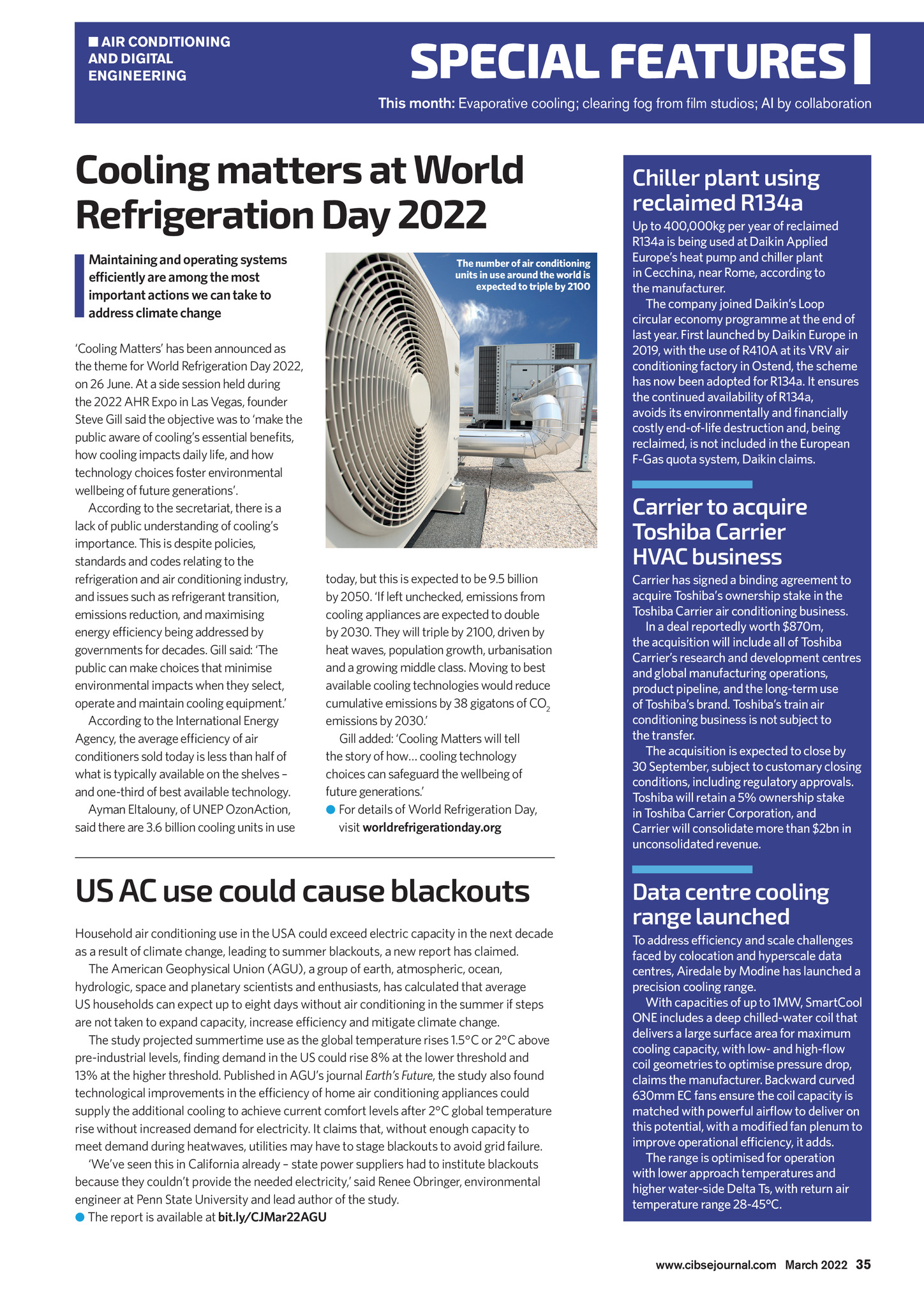
AIR CONDITIONING AND DIGITAL ENGINEERING SPECIAL FEATURES This month: Evaporative cooling; clearing fog from film studios; AI by collaboration Cooling matters at World Refrigeration Day 2022 Maintaining and operating systems efficiently are among the most important actions we can take to address climate change Cooling Matters has been announced as the theme for World Refrigeration Day 2022, on 26 June. At a side session held during the 2022 AHR Expo in Las Vegas, founder Steve Gill said the objective was to make the public aware of coolings essential benefits, how cooling impacts daily life, and how technology choices foster environmental wellbeing of future generations. According to the secretariat, there is a lack of public understanding of coolings importance. This is despite policies, standards and codes relating to the refrigeration and air conditioning industry, and issues such as refrigerant transition, emissions reduction, and maximising energy efficiency being addressed by governments for decades. Gill said: The public can make choices that minimise environmental impacts when they select, operate and maintain cooling equipment. According to the International Energy Agency, the average efficiency of air conditioners sold today is less than half of what is typically available on the shelves and one-third of best available technology. Ayman Eltalouny, of UNEP OzonAction, said there are 3.6 billion cooling units in use The number of air conditioning units in use around the world is expected to triple by 2100 today, but this is expected to be 9.5 billion by 2050. If left unchecked, emissions from cooling appliances are expected to double by 2030. They will triple by 2100, driven by heat waves, population growth, urbanisation and a growing middle class. Moving to best available cooling technologies would reduce cumulative emissions by 38 gigatons of CO2 emissions by 2030. Gill added: Cooling Matters will tell the story of how cooling technology choices can safeguard the wellbeing of future generations. For details of World Refrigeration Day, visit worldrefrigerationday.org US AC use could cause blackouts Household air conditioning use in the USA could exceed electric capacity in the next decade as a result of climate change, leading to summer blackouts, a new report has claimed. The American Geophysical Union (AGU), a group of earth, atmospheric, ocean, hydrologic, space and planetary scientists and enthusiasts, has calculated that average US households can expect up to eight days without air conditioning in the summer if steps are not taken to expand capacity, increase efficiency and mitigate climate change. The study projected summertime use as the global temperature rises 1.5C or 2C above pre-industrial levels, finding demand in the US could rise 8% at the lower threshold and 13% at the higher threshold. Published in AGUs journal Earths Future, the study also found technological improvements in the efficiency of home air conditioning appliances could supply the additional cooling to achieve current comfort levels after 2C global temperature rise without increased demand for electricity. It claims that, without enough capacity to meet demand during heatwaves, utilities may have to stage blackouts to avoid grid failure. Weve seen this in California already state power suppliers had to institute blackouts because they couldnt provide the needed electricity, said Renee Obringer, environmental engineer at Penn State University and lead author of the study. The report is available at bit.ly/CJMar22AGU Chiller plant using reclaimed R134a Up to 400,000kg per year of reclaimed R134a is being used at Daikin Applied Europes heat pump and chiller plant in Cecchina, near Rome, according to the manufacturer. The company joined Daikins Loop circular economy programme at the end of last year. First launched by Daikin Europe in 2019, with the use of R410A at its VRV air conditioning factory in Ostend, the scheme has now been adopted for R134a. It ensures the continued availability of R134a, avoids its environmentally and financially costly end-of-life destruction and, being reclaimed, is not included in the European F-Gas quota system, Daikin claims. Carrier to acquire Toshiba Carrier HVAC business Carrier has signed a binding agreement to acquire Toshibas ownership stake in the Toshiba Carrier air conditioning business. In a deal reportedly worth $870m, the acquisition will include all of Toshiba Carriers research and development centres and global manufacturing operations, product pipeline, and the long-term use of Toshibas brand. Toshibas train air conditioning business is not subject to the transfer. The acquisition is expected to close by 30 September, subject to customary closing conditions, including regulatory approvals. Toshiba will retain a 5% ownership stake in Toshiba Carrier Corporation, and Carrier will consolidate more than $2bn in unconsolidated revenue. Data centre cooling range launched To address efficiency and scale challenges faced by colocation and hyperscale data centres, Airedale by Modine has launched a precision cooling range. With capacities of up to 1MW, SmartCool ONE includes a deep chilled-water coil that delivers a large surface area for maximum cooling capacity, with low- and high-flow coil geometries to optimise pressure drop, claims the manufacturer. Backward curved 630mm EC fans ensure the coil capacity is matched with powerful airflow to deliver on this potential, with a modified fan plenum to improve operational efficiency, it adds. The range is optimised for operation with lower approach temperatures and higher water-side Delta Ts, with return air temperature range 28-45C. www.cibsejournal.com March 2022 35 CIBSE March 22 pp35 Specials News.indd 35 25/02/2022 15:19