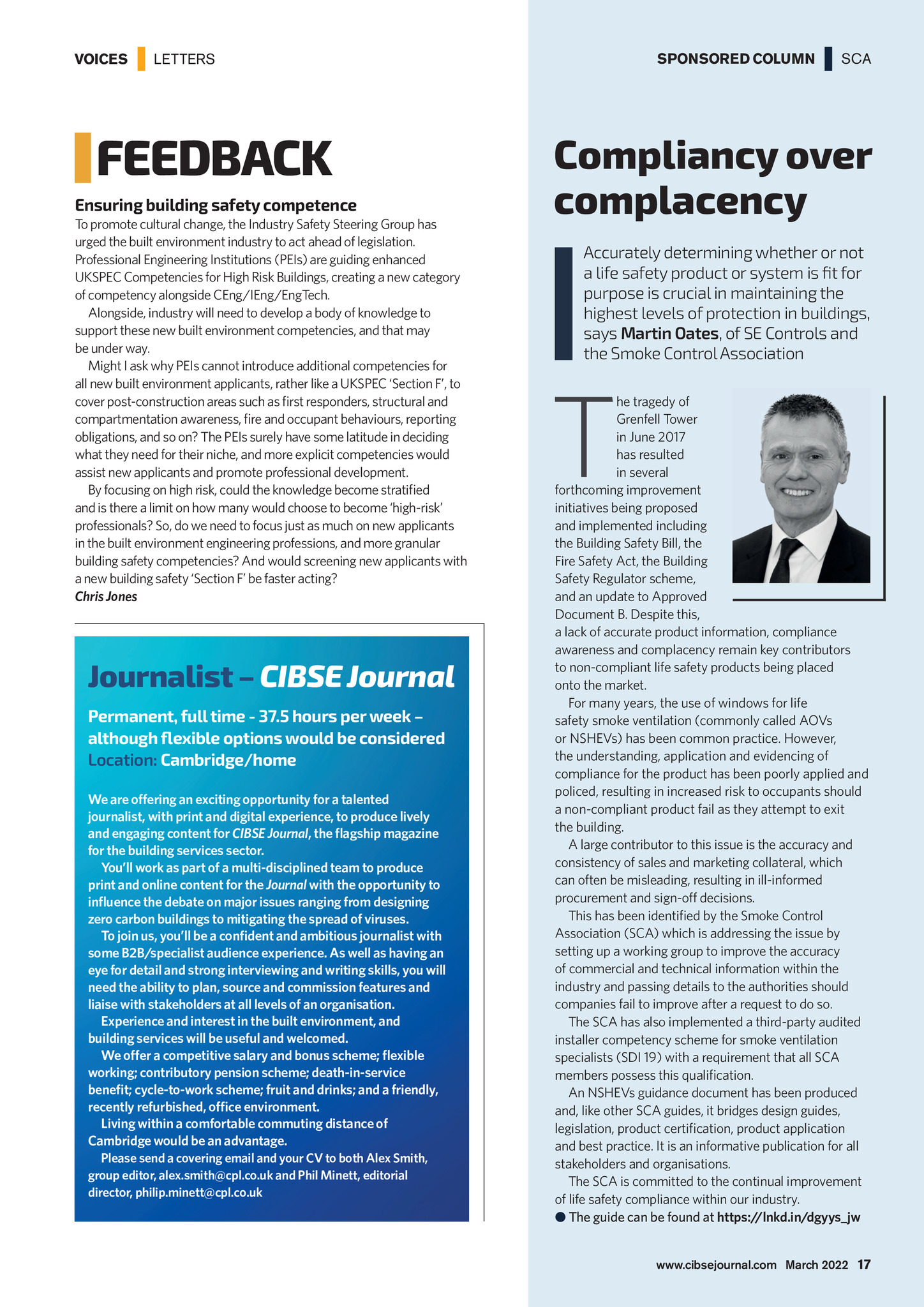
VOICES | LETTERS FEEDBACK Ensuring building safety competence To promote cultural change, the Industry Safety Steering Group has urged the built environment industry to act ahead of legislation. Professional Engineering Institutions (PEIs) are guiding enhanced UKSPEC Competencies for High Risk Buildings, creating a new category of competency alongside CEng/IEng/EngTech. Alongside, industry will need to develop a body of knowledge to support these new built environment competencies, and that may be under way. Might I ask why PEIs cannot introduce additional competencies for all new built environment applicants, rather like a UKSPEC Section F, to cover post-construction areas such as rst responders, structural and compartmentation awareness, re and occupant behaviours, reporting obligations, and so on? The PEIs surely have some latitude in deciding what they need for their niche, and more explicit competencies would assist new applicants and promote professional development. By focusing on high risk, could the knowledge become stratied and is there a limit on how many would choose to become high-risk professionals? So, do we need to focus just as much on new applicants in the built environment engineering professions, and more granular building safety competencies? And would screening new applicants with a new building safety Section F be faster acting? Chris Jones Journalist CIBSE Journal Permanent, full time - 37.5 hours per week although flexible options would be considered Location: Cambridge/home We are offering an exciting opportunity for a talented journalist, with print and digital experience, to produce lively and engaging content for CIBSE Journal, the agship magazine for the building services sector. Youll work as part of a multi-disciplined team to produce print and online content for the Journal with the opportunity to inuence the debate on major issues ranging from designing zero carbon buildings to mitigating the spread of viruses. To join us, youll be a condent and ambitious journalist with some B2B/specialist audience experience. As well as having an eye for detail and strong interviewing and writing skills, you will need the ability to plan, source and commission features and liaise with stakeholders at all levels of an organisation. Experience and interest in the built environment, and building services will be useful and welcomed. We offer a competitive salary and bonus scheme; exible working; contributory pension scheme; death-in-service benet; cycle-to-work scheme; fruit and drinks; and a friendly, recently refurbished, ofce environment. Living within a comfortable commuting distance of Cambridge would be an advantage. Please send a covering email and your CV to both Alex Smith, group editor, alex.smith@cpl.co.uk and Phil Minett, editorial director, philip.minett@cpl.co.uk SPONSORED COLUMN | SCA Compliancy over complacency Accurately determining whether or not a life safety product or system is fit for purpose is crucial in maintaining the highest levels of protection in buildings, says Martin Oates, of SE Controls and the Smoke Control Association T he tragedy of Grenfell Tower in June 2017 has resulted in several forthcoming improvement initiatives being proposed and implemented including the Building Safety Bill, the Fire Safety Act, the Building Safety Regulator scheme, and an update to Approved Document B. Despite this, a lack of accurate product information, compliance awareness and complacency remain key contributors to non-compliant life safety products being placed onto the market. For many years, the use of windows for life safety smoke ventilation (commonly called AOVs or NSHEVs) has been common practice. However, the understanding, application and evidencing of compliance for the product has been poorly applied and policed, resulting in increased risk to occupants should a non-compliant product fail as they attempt to exit the building. A large contributor to this issue is the accuracy and consistency of sales and marketing collateral, which can often be misleading, resulting in ill-informed procurement and sign-off decisions. This has been identied by the Smoke Control Association (SCA) which is addressing the issue by setting up a working group to improve the accuracy of commercial and technical information within the industry and passing details to the authorities should companies fail to improve after a request to do so. The SCA has also implemented a third-party audited installer competency scheme for smoke ventilation specialists (SDI 19) with a requirement that all SCA members possess this qualication. An NSHEVs guidance document has been produced and, like other SCA guides, it bridges design guides, legislation, product certication, product application and best practice. It is an informative publication for all stakeholders and organisations. The SCA is committed to the continual improvement of life safety compliance within our industry. The guide can be found at https://lnkd.in/dgyys_jw www.cibsejournal.com March 2022 17 CIBSE March 22 pp17 Letters SCA column.indd 17 25/02/2022 18:44