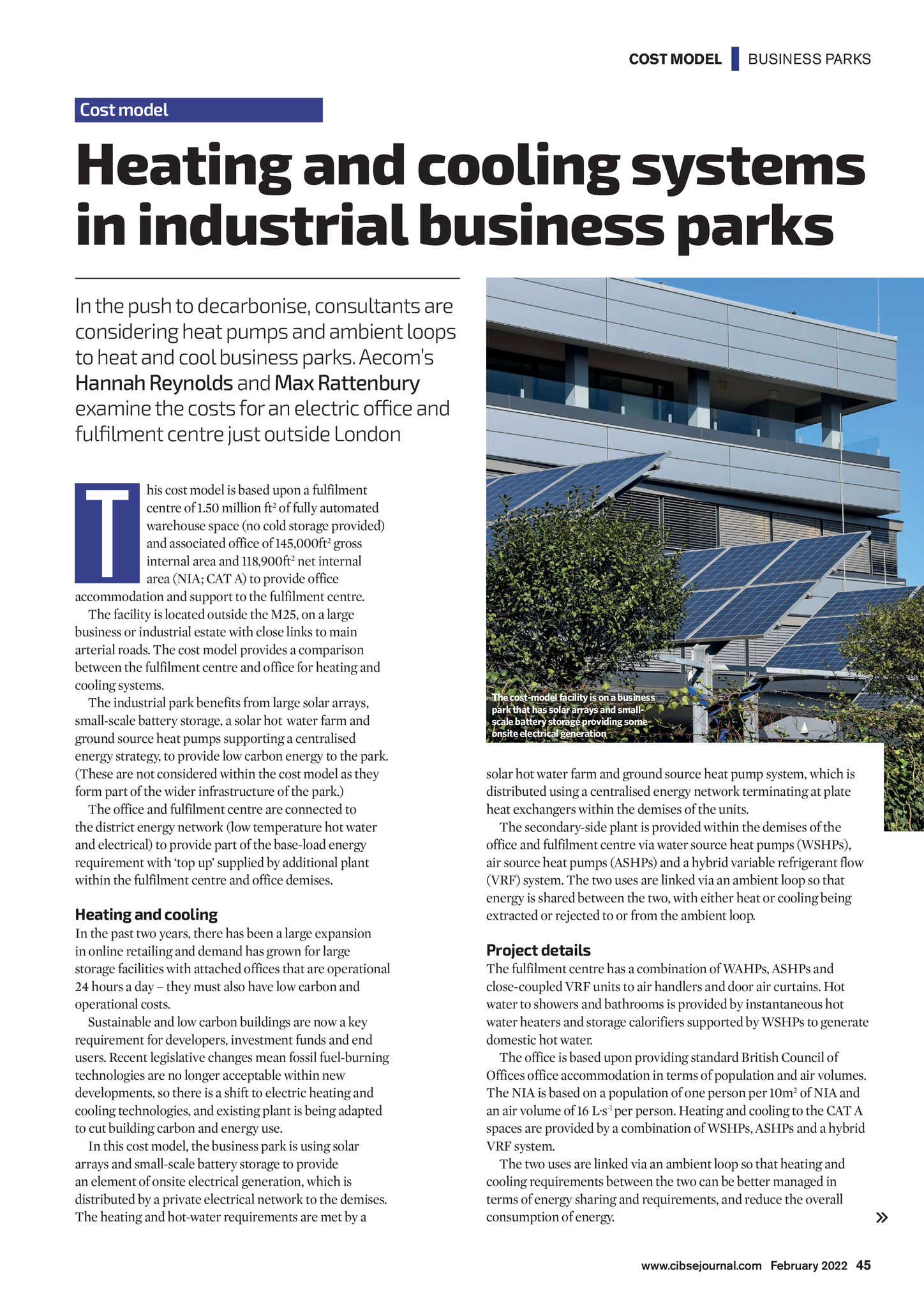
COST MODEL | BUSINESS PARKS Cost model Heating and cooling systems in industrial business parks In the push to decarbonise, consultants are considering heat pumps and ambient loops to heat and cool business parks. Aecoms Hannah Reynolds and Max Rattenbury examine the costs for an electric office and fulfilment centre just outside London T his cost model is based upon a fulfilment centre of 1.50 million ft2 of fully automated warehouse space (no cold storage provided) and associated office of 145,000ft2 gross internal area and 118,900ft2 net internal area (NIA; CAT A) to provide office accommodation and support to the fulfilment centre. The facility is located outside the M25, on a large business or industrial estate with close links to main arterial roads. The cost model provides a comparison between the fulfilment centre and office for heating and cooling systems. The industrial park benefits from large solar arrays, small-scale battery storage, a solar hot water farm and ground source heat pumps supporting a centralised energy strategy, to provide low carbon energy to the park. (These are not considered within the cost model as they form part of the wider infrastructure of the park.) The office and fulfilment centre are connected to the district energy network (low temperature hot water and electrical) to provide part of the base-load energy requirement with top up supplied by additional plant within the fulfilment centre and office demises. Heating and cooling In the past two years, there has been a large expansion in online retailing and demand has grown for large storage facilities with attached offices that are operational 24 hours a day they must also have low carbon and operational costs. Sustainable and low carbon buildings are now a key requirement for developers, investment funds and end users. Recent legislative changes mean fossil fuel-burning technologies are no longer acceptable within new developments, so there is a shift to electric heating and cooling technologies, and existing plant is being adapted to cut building carbon and energy use. In this cost model, the business park is using solar arrays and small-scale battery storage to provide an element of onsite electrical generation, which is distributed by a private electrical network to the demises. The heating and hot-water requirements are met by a The cost-model facility is on a business park that has solar arrays and smallscale battery storage providing some onsite electrical generation solar hot water farm and ground source heat pump system, which is distributed using a centralised energy network terminating at plate heat exchangers within the demises of the units. The secondary-side plant is provided within the demises of the office and fulfilment centre via water source heat pumps (WSHPs), air source heat pumps (ASHPs) and a hybrid variable refrigerant flow (VRF) system. The two uses are linked via an ambient loop so that energy is shared between the two, with either heat or cooling being extracted or rejected to or from the ambient loop. Project details The fulfilment centre has a combination of WAHPs, ASHPs and close-coupled VRF units to air handlers and door air curtains. Hot water to showers and bathrooms is provided by instantaneous hot water heaters and storage calorifiers supported by WSHPs to generate domestic hot water. The office is based upon providing standard British Council of Offices office accommodation in terms of population and air volumes. The NIA is based on a population of one person per 10m2 of NIA and an air volume of 16 Ls-1 per person. Heating and cooling to the CAT A spaces are provided by a combination of WSHPs, ASHPs and a hybrid VRF system. The two uses are linked via an ambient loop so that heating and cooling requirements between the two can be better managed in terms of energy sharing and requirements, and reduce the overall consumption of energy. www.cibsejournal.com February 2022 45 CIBSE Feb22 pp45-46 Cost Model.indd 45 28/01/2022 16:24