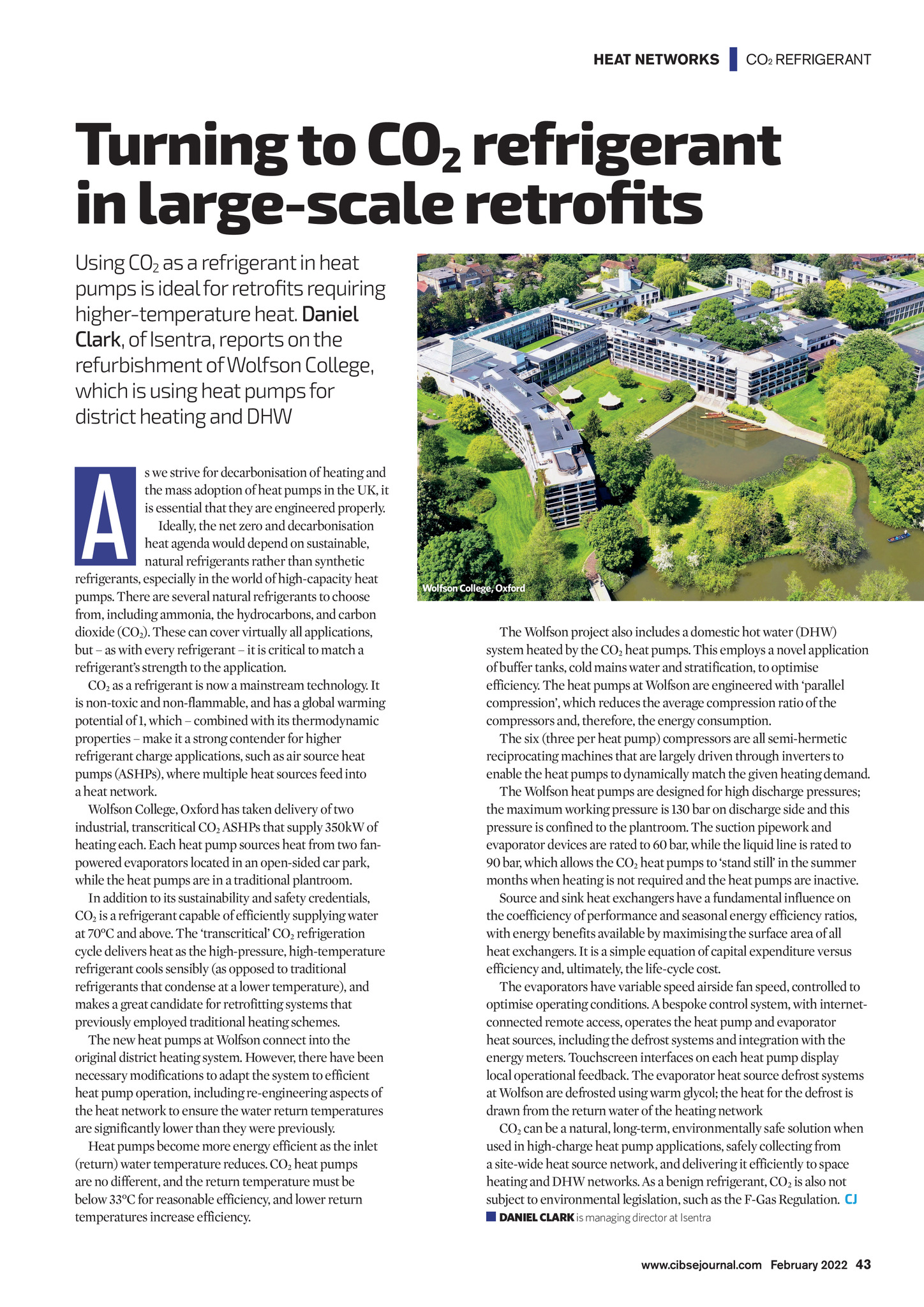

HEAT NETWORKS | CO 2 REFRIGERANT Turning to CO2 refrigerant in large-scale retrofits Using CO2 as a refrigerant in heat pumps is ideal for retrofits requiring higher-temperature heat. Daniel Clark, of Isentra, reports on the refurbishment of Wolfson College, which is using heat pumps for district heating and DHW A s we strive for decarbonisation of heating and the mass adoption of heat pumps in the UK, it is essential that they are engineered properly. Ideally, the net zero and decarbonisation heat agenda would depend on sustainable, natural refrigerants rather than synthetic refrigerants, especially in the world of high-capacity heat pumps. There are several natural refrigerants to choose from, including ammonia, the hydrocarbons, and carbon dioxide (CO2). These can cover virtually all applications, but as with every refrigerant it is critical to match a refrigerants strength to the application. CO2 as a refrigerant is now a mainstream technology. It is non-toxic and non-flammable, and has a global warming potential of 1, which combined with its thermodynamic properties make it a strong contender for higher refrigerant charge applications, such as air source heat pumps (ASHPs), where multiple heat sources feed into a heat network. Wolfson College, Oxford has taken delivery of two industrial, transcritical CO2 ASHPs that supply 350kW of heating each. Each heat pump sources heat from two fanpowered evaporators located in an open-sided car park, while the heat pumps are in a traditional plantroom. In addition to its sustainability and safety credentials, CO2 is a refrigerant capable of efficiently supplying water at 70C and above. The transcritical CO2 refrigeration cycle delivers heat as the high-pressure, high-temperature refrigerant cools sensibly (as opposed to traditional refrigerants that condense at a lower temperature), and makes a great candidate for retrofitting systems that previously employed traditional heating schemes. The new heat pumps at Wolfson connect into the original district heating system. However, there have been necessary modifications to adapt the system to efficient heat pump operation, including re-engineering aspects of the heat network to ensure the water return temperatures are significantly lower than they were previously. Heat pumps become more energy efficient as the inlet (return) water temperature reduces. CO2 heat pumps are no different, and the return temperature must be below 33C for reasonable efficiency, and lower return temperatures increase efficiency. Wolfson College, Oxford The Wolfson project also includes a domestic hot water (DHW) system heated by the CO2 heat pumps. This employs a novel application of buffer tanks, cold mains water and stratification, to optimise efficiency. The heat pumps at Wolfson are engineered with parallel compression, which reduces the average compression ratio of the compressors and, therefore, the energy consumption. The six (three per heat pump) compressors are all semi-hermetic reciprocating machines that are largely driven through inverters to enable the heat pumps to dynamically match the given heating demand. The Wolfson heat pumps are designed for high discharge pressures; the maximum working pressure is 130 bar on discharge side and this pressure is confined to the plantroom. The suction pipework and evaporator devices are rated to 60 bar, while the liquid line is rated to 90 bar, which allows the CO2 heat pumps to stand still in the summer months when heating is not required and the heat pumps are inactive. Source and sink heat exchangers have a fundamental influence on the coefficiency of performance and seasonal energy efficiency ratios, with energy benefits available by maximising the surface area of all heat exchangers. It is a simple equation of capital expenditure versus efficiency and, ultimately, the life-cycle cost. The evaporators have variable speed airside fan speed, controlled to optimise operating conditions. A bespoke control system, with internetconnected remote access, operates the heat pump and evaporator heat sources, including the defrost systems and integration with the energy meters. Touchscreen interfaces on each heat pump display local operational feedback. The evaporator heat source defrost systems at Wolfson are defrosted using warm glycol; the heat for the defrost is drawn from the return water of the heating network CO2 can be a natural, long-term, environmentally safe solution when used in high-charge heat pump applications, safely collecting from a site-wide heat source network, and delivering it efficiently to space heating and DHW networks. As a benign refrigerant, CO2 is also not subject to environmental legislation, such as the F-Gas Regulation. CJ DANIEL CLARK is managing director at Isentra www.cibsejournal.com February 2022 43 CIBSE Feb22 pp43 CO2 heat pumps.indd 43 28/01/2022 16:23