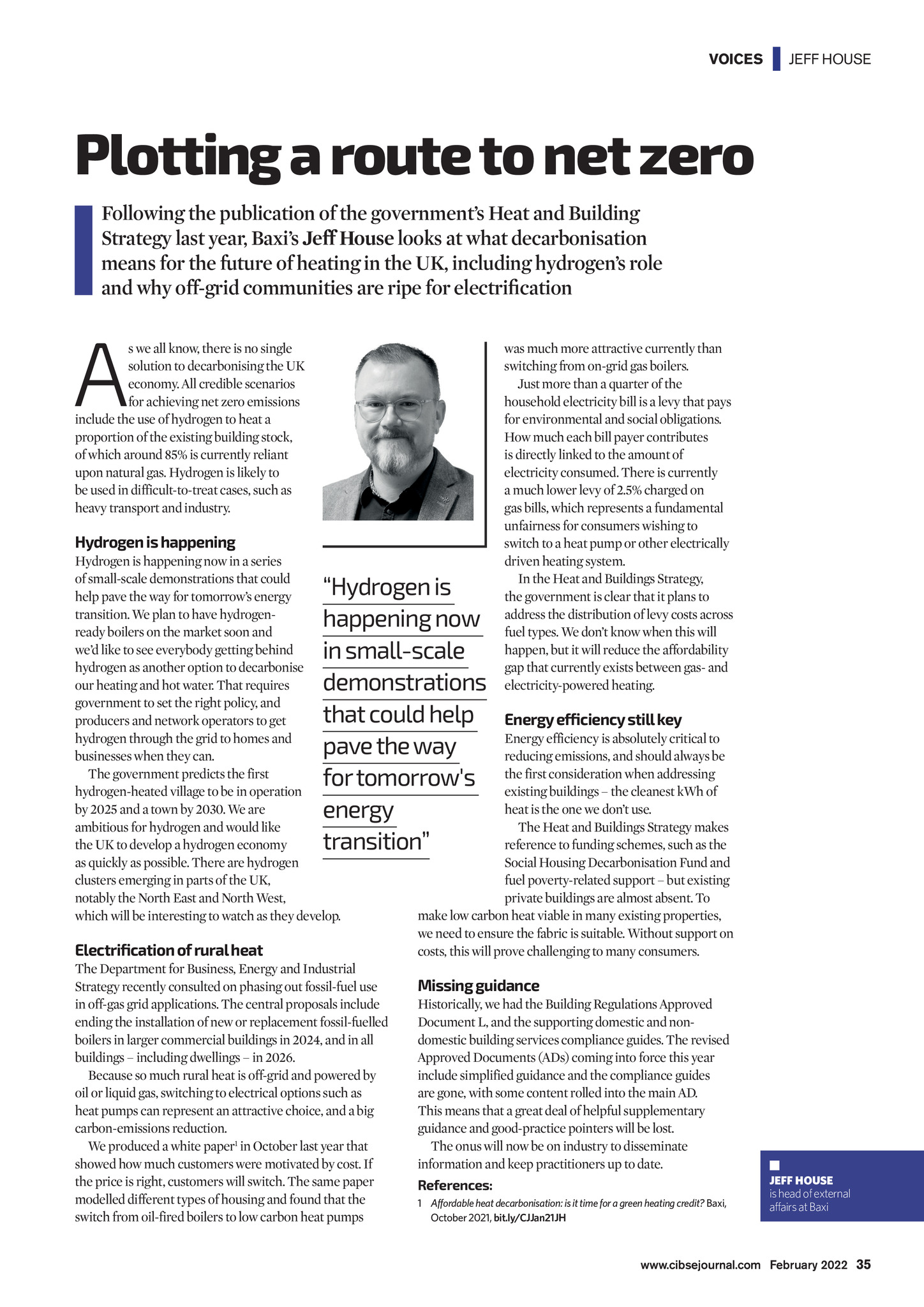

VOICES | JEFF HOUSE Plotting a route to net zero Following the publication of the governments Heat and Building Strategy last year, Baxis Jeff House looks at what decarbonisation means for the future of heating in the UK, including hydrogens role and why off-grid communities are ripe for electrication A s we all know, there is no single solution to decarbonising the UK economy. All credible scenarios for achieving net zero emissions include the use of hydrogen to heat a proportion of the existing building stock, of which around 85% is currently reliant upon natural gas. Hydrogen is likely to be used in difficult-to-treat cases, such as heavy transport and industry. Hydrogen is happening Hydrogen is happening now in a series of small-scale demonstrations that could help pave the way for tomorrows energy transition. We plan to have hydrogenready boilers on the market soon and wed like to see everybody getting behind hydrogen as another option to decarbonise our heating and hot water. That requires government to set the right policy, and producers and network operators to get hydrogen through the grid to homes and businesses when they can. The government predicts the first hydrogen-heated village to be in operation by 2025 and a town by 2030. We are ambitious for hydrogen and would like the UK to develop a hydrogen economy as quickly as possible. There are hydrogen clusters emerging in parts of the UK, notably the North East and North West, which will be interesting to watch as they develop. Hydrogen is happening now in small-scale demonstrations that could help pave the way for tomorrow s energy transition Electrification of rural heat The Department for Business, Energy and Industrial Strategy recently consulted on phasing out fossil-fuel use in off-gas grid applications. The central proposals include ending the installation of new or replacement fossil-fuelled boilers in larger commercial buildings in 2024, and in all buildings including dwellings in 2026. Because so much rural heat is off-grid and powered by oil or liquid gas, switching to electrical options such as heat pumps can represent an attractive choice, and a big carbon-emissions reduction. We produced a white paper1 in October last year that showed how much customers were motivated by cost. If the price is right, customers will switch. The same paper modelled different types of housing and found that the switch from oil-fired boilers to low carbon heat pumps was much more attractive currently than switching from on-grid gas boilers. Just more than a quarter of the household electricity bill is a levy that pays for environmental and social obligations. How much each bill payer contributes is directly linked to the amount of electricity consumed. There is currently a much lower levy of 2.5% charged on gas bills, which represents a fundamental unfairness for consumers wishing to switch to a heat pump or other electrically driven heating system. In the Heat and Buildings Strategy, the government is clear that it plans to address the distribution of levy costs across fuel types. We dont know when this will happen, but it will reduce the affordability gap that currently exists between gas- and electricity-powered heating. Energy efficiency still key Energy efficiency is absolutely critical to reducing emissions, and should always be the first consideration when addressing existing buildings the cleanest kWh of heat is the one we dont use. The Heat and Buildings Strategy makes reference to funding schemes, such as the Social Housing Decarbonisation Fund and fuel poverty-related support but existing private buildings are almost absent. To make low carbon heat viable in many existing properties, we need to ensure the fabric is suitable. Without support on costs, this will prove challenging to many consumers. Missing guidance Historically, we had the Building Regulations Approved Document L, and the supporting domestic and nondomestic building services compliance guides. The revised Approved Documents (ADs) coming into force this year include simplified guidance and the compliance guides are gone, with some content rolled into the main AD. This means that a great deal of helpful supplementary guidance and good-practice pointers will be lost. The onus will now be on industry to disseminate information and keep practitioners up to date. References: 1 Affordable heat decarbonisation: is it time for a green heating credit? Baxi, October 2021, bit.ly/CJJan21JH JEFF HOUSE is head of external affairs at Baxi www.cibsejournal.com February 2022 35 CIBSE Feb22 pp35 Jeff House.indd 35 28/01/2022 16:22