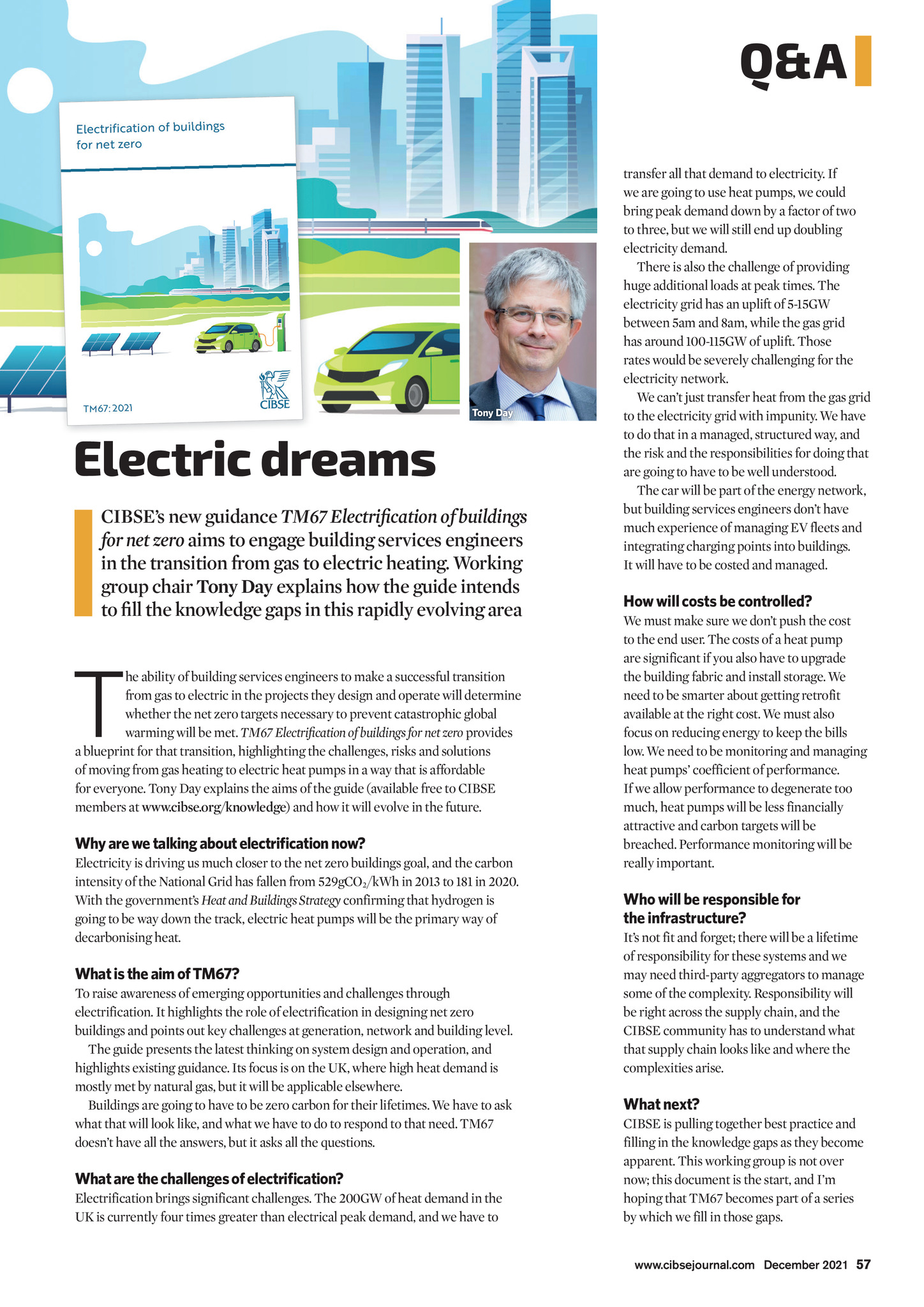
Q&A Tony Day Electric dreams CIBSEs new guidance aims to engage building services engineers in the transition from gas to electric heating. Working group chair Tony Day explains how the guide intends T he ability of building services engineers to make a successful transition from gas to electric in the projects they design and operate will determine whether the net zero targets necessary to prevent catastrophic global warming will be met. provides a blueprint for that transition, highlighting the challenges, risks and solutions of moving from gas heating to electric heat pumps in a way that is affordable for everyone. Tony Day explains the aims of the guide (available free to CIBSE members at www.cibse.org/knowledge) and how it will evolve in the future. Electricity is driving us much closer to the net zero buildings goal, and the carbon intensity of the National Grid has fallen from 529gCO2/kWh in 2013 to 181 in 2020. With the governments confirming that hydrogen is going to be way down the track, electric heat pumps will be the primary way of decarbonising heat. To raise awareness of emerging opportunities and challenges through electrification. It highlights the role of electrification in designing net zero buildings and points out key challenges at generation, network and building level. The guide presents the latest thinking on system design and operation, and highlights existing guidance. Its focus is on the UK, where high heat demand is mostly met by natural gas, but it will be applicable elsewhere. Buildings are going to have to be zero carbon for their lifetimes. We have to ask what that will look like, and what we have to do to respond to that need. TM67 doesnt have all the answers, but it asks all the questions. Electrification brings significant challenges. The 200GW of heat demand in the UK is currently four times greater than electrical peak demand, and we have to transfer all that demand to electricity. If we are going to use heat pumps, we could bring peak demand down by a factor of two to three, but we will still end up doubling electricity demand. There is also the challenge of providing huge additional loads at peak times. The electricity grid has an uplift of 5-15GW between 5am and 8am, while the gas grid has around 100-115GW of uplift. Those rates would be severely challenging for the electricity network. We cant just transfer heat from the gas grid to the electricity grid with impunity. We have to do that in a managed, structured way, and the risk and the responsibilities for doing that are going to have to be well understood. The car will be part of the energy network, but building services engineers dont have much experience of managing EV fleets and integrating charging points into buildings. It will have to be costed and managed. We must make sure we dont push the cost to the end user. The costs of a heat pump are significant if you also have to upgrade the building fabric and install storage. We need to be smarter about getting retrofit available at the right cost. We must also focus on reducing energy to keep the bills low. We need to be monitoring and managing heat pumps coefficient of performance. If we allow performance to degenerate too much, heat pumps will be less financially attractive and carbon targets will be breached. Performance monitoring will be really important. Who will be responsible for Its not fit and forget; there will be a lifetime of responsibility for these systems and we may need third-party aggregators to manage some of the complexity. Responsibility will be right across the supply chain, and the CIBSE community has to understand what that supply chain looks like and where the complexities arise. CIBSE is pulling together best practice and filling in the knowledge gaps as they become apparent. This working group is not over now; this document is the start, and Im hoping that TM67 becomes part of a series by which we fill in those gaps. www.cibsejournal.com December 2021 57 CIBSE Dec21 pp57 Q&A.indd 57 26/11/2021 15:05