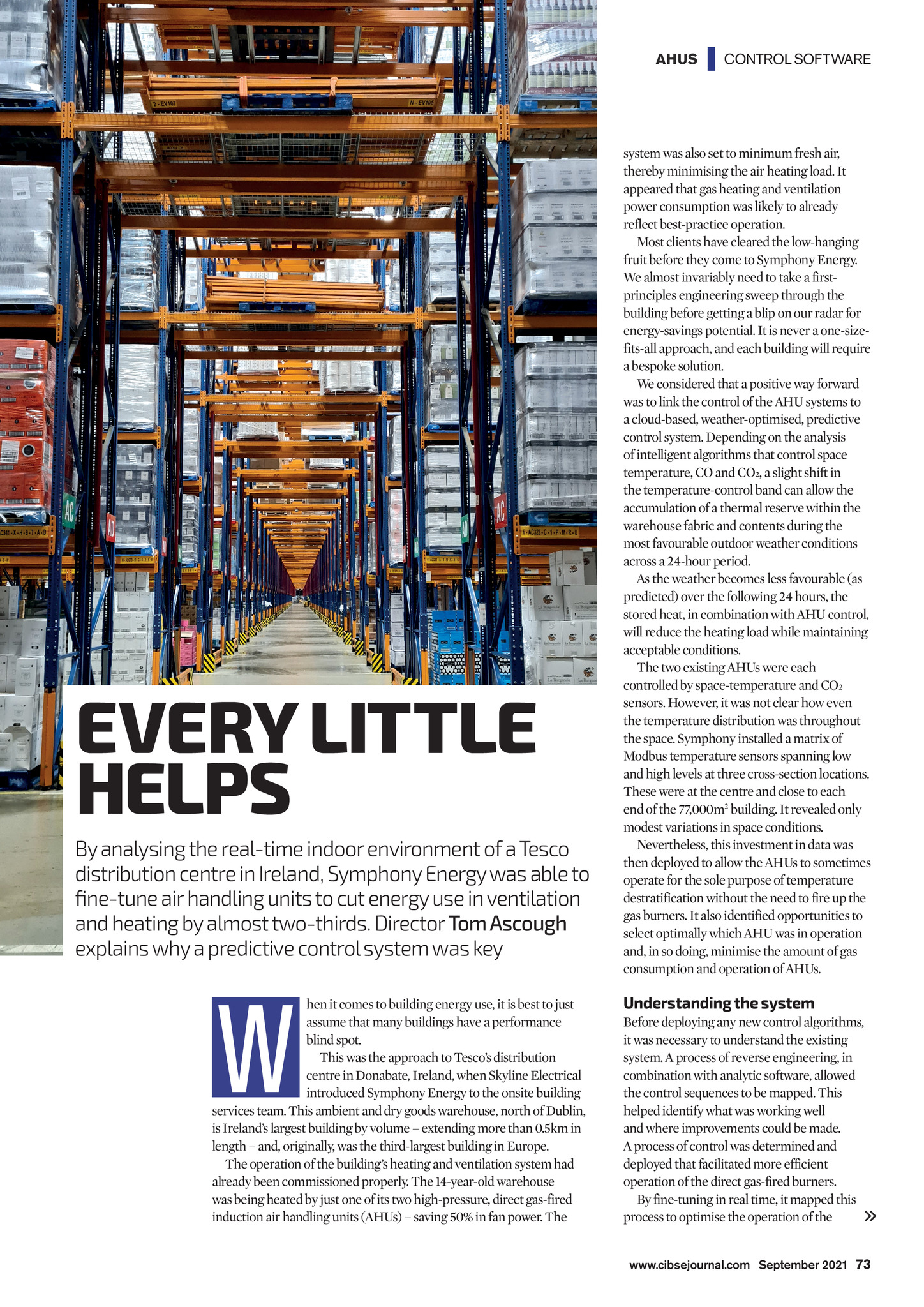

AHUS EVERY LITTLE HELPS By analysing the real-time indoor environment of a Tesco distribution centre in Ireland, Symphony Energy was able to fine-tune air handling units to cut energy use in ventilation and heating by almost two-thirds. Director Tom Ascough explains why a predictive control system was key W hen it comes to building energy use, it is best to just assume that many buildings have a performance blind spot. This was the approach to Tescos distribution centre in Donabate, Ireland, when Skyline Electrical introduced Symphony Energy to the onsite building services team. This ambient and dry goods warehouse, north of Dublin, is Irelands largest building by volume extending more than 0.5km in length and, originally, was the third-largest building in Europe. The operation of the buildings heating and ventilation system had already been commissioned properly. The 14-year-old warehouse was being heated by just one of its two high-pressure, direct gas-fired induction air handling units (AHUs) saving 50% in fan power. The | CONTROL SOFTWARE system was also set to minimum fresh air, thereby minimising the air heating load. It appeared that gas heating and ventilation power consumption was likely to already reflect best-practice operation. Most clients have cleared the low-hanging fruit before they come to Symphony Energy. We almost invariably need to take a firstprinciples engineering sweep through the building before getting a blip on our radar for energy-savings potential. It is never a one-sizefits-all approach, and each building will require a bespoke solution. We considered that a positive way forward was to link the control of the AHU systems to a cloud-based, weather-optimised, predictive control system. Depending on the analysis of intelligent algorithms that control space temperature, CO and CO2, a slight shift in the temperature-control band can allow the accumulation of a thermal reserve within the warehouse fabric and contents during the most favourable outdoor weather conditions across a 24-hour period. As the weather becomes less favourable (as predicted) over the following 24 hours, the stored heat, in combination with AHU control, will reduce the heating load while maintaining acceptable conditions. The two existing AHUs were each controlled by space-temperature and CO2 sensors. However, it was not clear how even the temperature distribution was throughout the space. Symphony installed a matrix of Modbus temperature sensors spanning low and high levels at three cross-section locations. These were at the centre and close to each end of the 77,000m2 building. It revealed only modest variations in space conditions. Nevertheless, this investment in data was then deployed to allow the AHUs to sometimes operate for the sole purpose of temperature destratification without the need to fire up the gas burners. It also identified opportunities to select optimally which AHU was in operation and, in so doing, minimise the amount of gas consumption and operation of AHUs. Understanding the system Before deploying any new control algorithms, it was necessary to understand the existing system. A process of reverse engineering, in combination with analytic software, allowed the control sequences to be mapped. This helped identify what was working well and where improvements could be made. A process of control was determined and deployed that facilitated more efficient operation of the direct gas-fired burners. By fine-tuning in real time, it mapped this process to optimise the operation of the www.cibsejournal.com September 2021 73 CIBSE Sep 21 pp73-74 Symphony Tesco.indd 73 27/08/2021 13:57