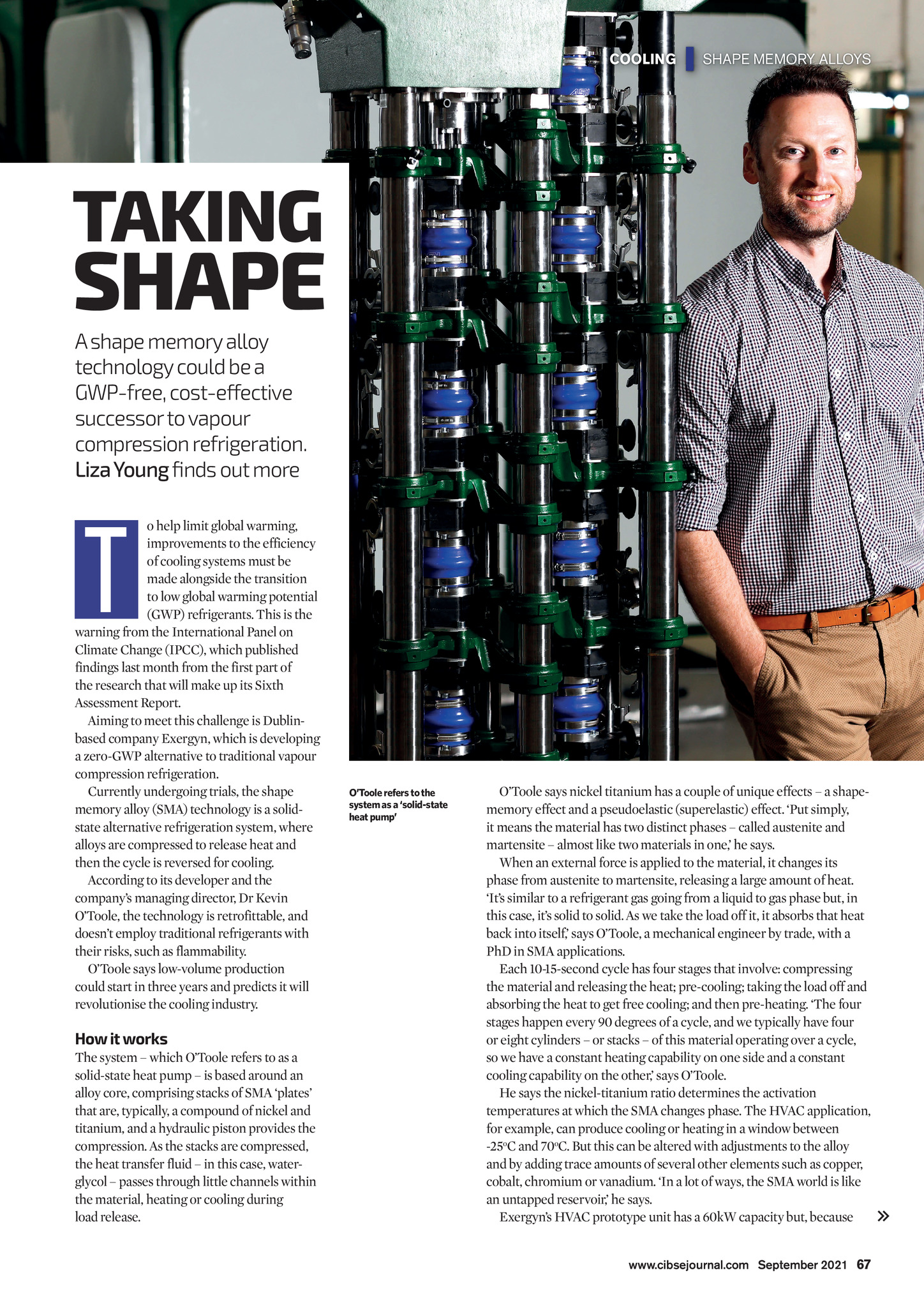
COOLING | SHAPE MEMORY ALLOYS TAKING SHAPE A shape memory alloy technology could be a GWP-free, cost-effective successor to vapour compression refrigeration. Liza Young finds out more T o help limit global warming, improvements to the efficiency of cooling systems must be made alongside the transition to low global warming potential (GWP) refrigerants. This is the warning from the International Panel on Climate Change (IPCC), which published findings last month from the first part of the research that will make up its Sixth Assessment Report. Aiming to meet this challenge is Dublinbased company Exergyn, which is developing a zero-GWP alternative to traditional vapour compression refrigeration. Currently undergoing trials, the shape memory alloy (SMA) technology is a solidstate alternative refrigeration system, where alloys are compressed to release heat and then the cycle is reversed for cooling. According to its developer and the companys managing director, Dr Kevin OToole, the technology is retrofittable, and doesnt employ traditional refrigerants with their risks, such as flammability. OToole says low-volume production could start in three years and predicts it will revolutionise the cooling industry. How it works The system which OToole refers to as a solid-state heat pump is based around an alloy core, comprising stacks of SMA plates that are, typically, a compound of nickel and titanium, and a hydraulic piston provides the compression. As the stacks are compressed, the heat transfer fluid in this case, waterglycol passes through little channels within the material, heating or cooling during load release. OToole refers to the system as a solid-state heat pump OToole says nickel titanium has a couple of unique effects a shapememory effect and a pseudoelastic (superelastic) effect. Put simply, it means the material has two distinct phases called austenite and martensite almost like two materials in one, he says. When an external force is applied to the material, it changes its phase from austenite to martensite, releasing a large amount of heat. Its similar to a refrigerant gas going from a liquid to gas phase but, in this case, its solid to solid. As we take the load off it, it absorbs that heat back into itself, says OToole, a mechanical engineer by trade, with a PhD in SMA applications. Each 10-15-second cycle has four stages that involve: compressing the material and releasing the heat; pre-cooling; taking the load off and absorbing the heat to get free cooling; and then pre-heating. The four stages happen every 90 degrees of a cycle, and we typically have four or eight cylinders or stacks of this material operating over a cycle, so we have a constant heating capability on one side and a constant cooling capability on the other, says OToole. He says the nickel-titanium ratio determines the activation temperatures at which the SMA changes phase. The HVAC application, for example, can produce cooling or heating in a window between -25oC and 70oC. But this can be altered with adjustments to the alloy and by adding trace amounts of several other elements such as copper, cobalt, chromium or vanadium. In a lot of ways, the SMA world is like an untapped reservoir, he says. Exergyns HVAC prototype unit has a 60kW capacity but, because www.cibsejournal.com September 2021 67 CIBSE Sep 21 pp67-68, 70 Exergyn.indd 67 27/08/2021 13:43