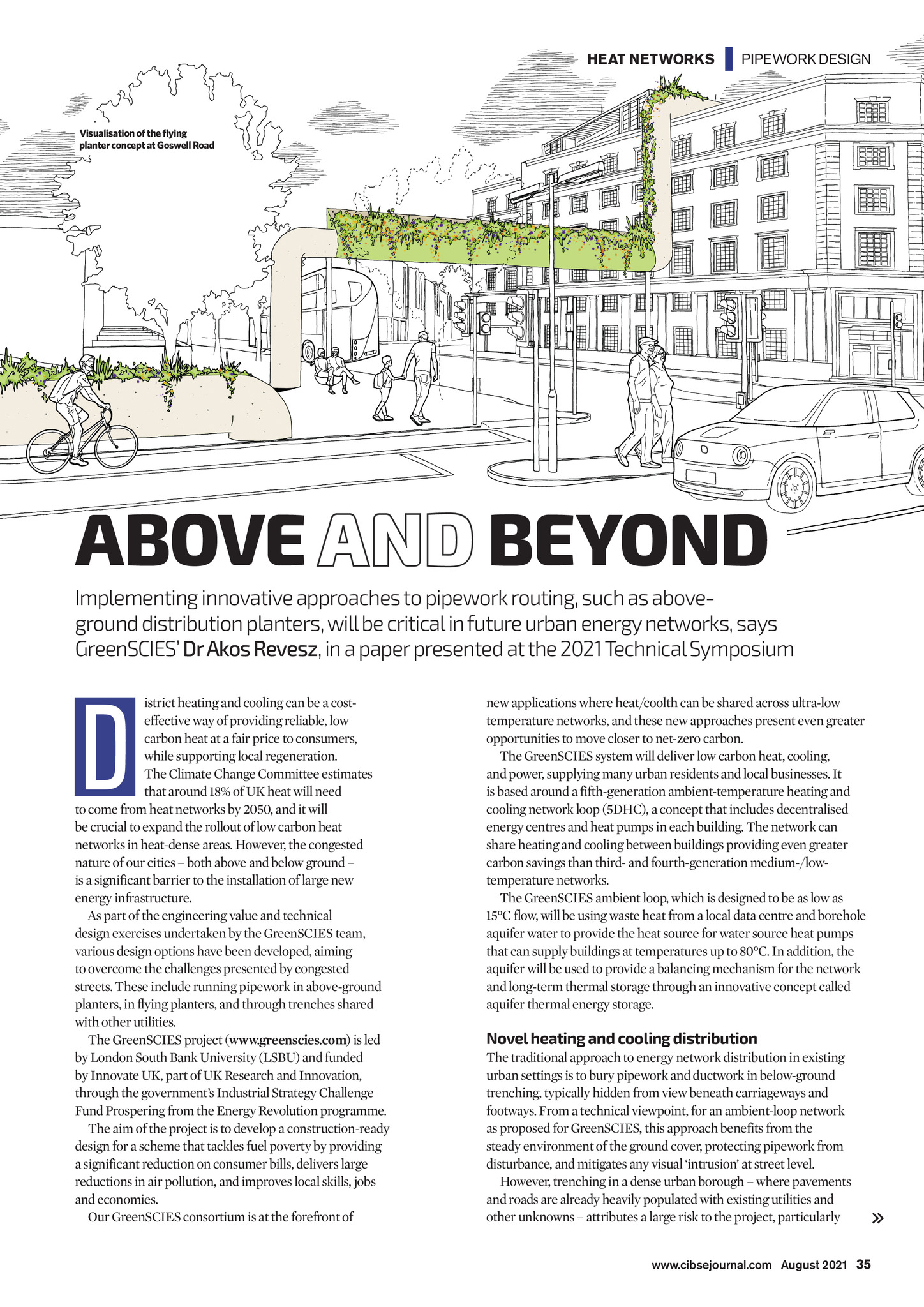
HEAT NETWORKS | PIPEWORK DESIGN planter concept at Goswell Road ABOVE AND BEYOND Implementing innovative approaches to pipework routing, such as aboveground distribution planters, will be critical in future urban energy networks, says GreenSCIES Dr Akos Revesz, in a paper presented at the 2021 Technical Symposium D istrict heating and cooling can be a costeffective way of providing reliable, low carbon heat at a fair price to consumers, while supporting local regeneration. The Climate Change Committee estimates that around 18% of UK heat will need to come from heat networks by 2050, and it will be crucial to expand the rollout of low carbon heat networks in heat-dense areas. However, the congested nature of our cities both above and below ground is a significant barrier to the installation of large new energy infrastructure. As part of the engineering value and technical design exercises undertaken by the GreenSCIES team, various design options have been developed, aiming to overcome the challenges presented by congested streets. These include running pipework in above-ground planters, in flying planters, and through trenches shared with other utilities. The GreenSCIES project (www.greenscies.com) is led by London South Bank University (LSBU) and funded by Innovate UK, part of UK Research and Innovation, through the governments Industrial Strategy Challenge Fund Prospering from the Energy Revolution programme. The aim of the project is to develop a construction-ready design for a scheme that tackles fuel poverty by providing a significant reduction on consumer bills, delivers large reductions in air pollution, and improves local skills, jobs and economies. Our GreenSCIES consortium is at the forefront of new applications where heat/coolth can be shared across ultra-low temperature networks, and these new approaches present even greater opportunities to move closer to net-zero carbon. The GreenSCIES system will deliver low carbon heat, cooling, and power, supplying many urban residents and local businesses. It is based around a fifth-generation ambient-temperature heating and cooling network loop (5DHC), a concept that includes decentralised energy centres and heat pumps in each building. The network can share heating and cooling between buildings providing even greater carbon savings than third- and fourth-generation medium-/lowtemperature networks. The GreenSCIES ambient loop, which is designed to be as low as 15C flow, will be using waste heat from a local data centre and borehole aquifer water to provide the heat source for water source heat pumps that can supply buildings at temperatures up to 80C. In addition, the aquifer will be used to provide a balancing mechanism for the network and long-term thermal storage through an innovative concept called aquifer thermal energy storage. Novel heating and cooling distribution The traditional approach to energy network distribution in existing urban settings is to bury pipework and ductwork in below-ground trenching, typically hidden from view beneath carriageways and footways. From a technical viewpoint, for an ambient-loop network as proposed for GreenSCIES, this approach benefits from the steady environment of the ground cover, protecting pipework from disturbance, and mitigates any visual intrusion at street level. However, trenching in a dense urban borough where pavements and roads are already heavily populated with existing utilities and other unknowns attributes a large risk to the project, particularly www.cibsejournal.com August 2021 35 CIBSE Aug 21 pp35-36 Heat networks tech symp.indd 35 23/07/2021 12:10