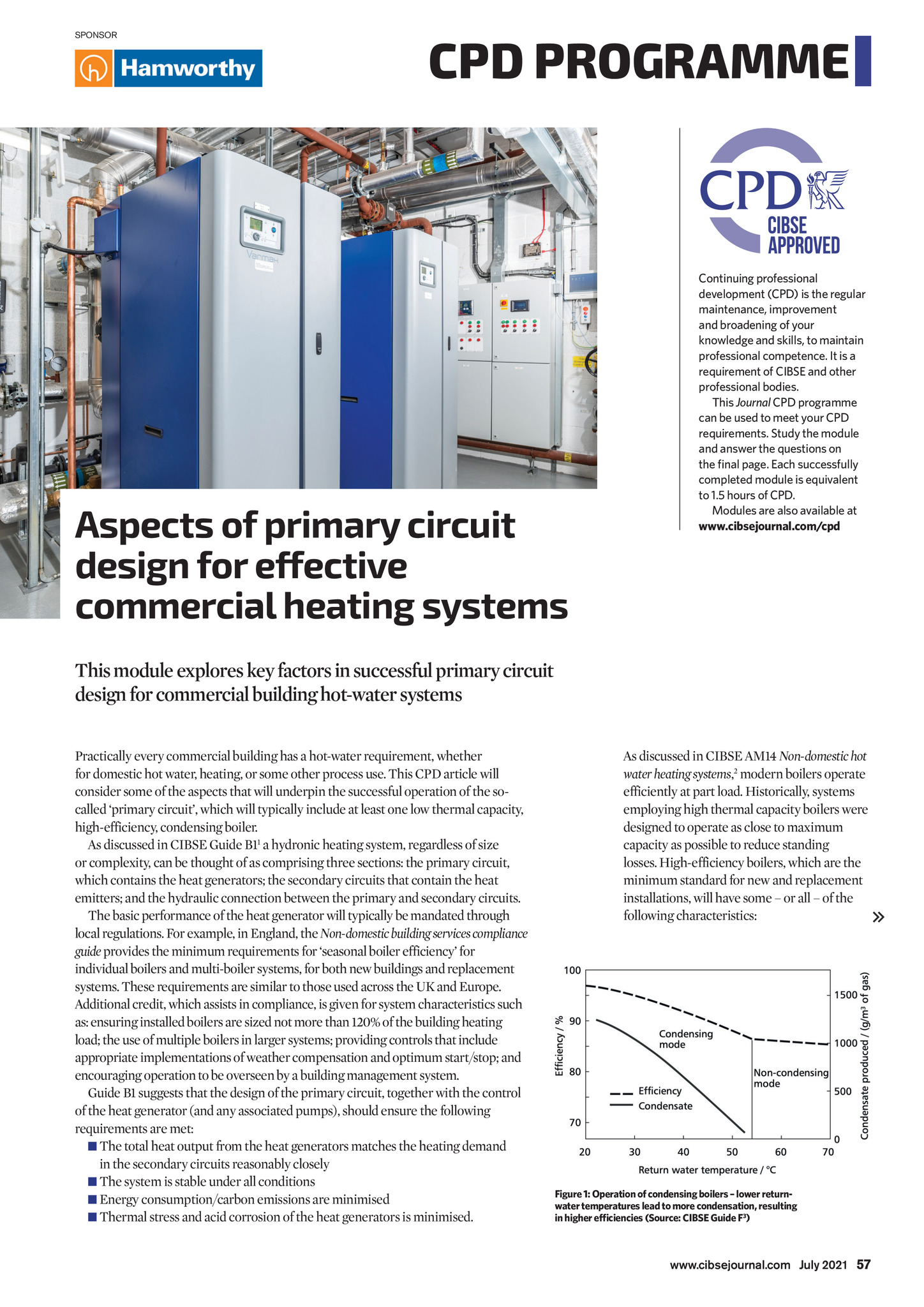

SPONSOR CPD PROGRAMME Continuing professional development (CPD) is the regular maintenance, improvement and broadening of your knowledge and skills, to maintain professional competence. It is a requirement of CIBSE and other professional bodies. This Journal CPD programme can be used to meet your CPD requirements. Study the module and answer the questions on Aspects of primary circuit design for effective commercial heating systems completed module is equivalent to 1.5 hours of CPD. Modules are also available at www.cibsejournal.com/cpd This module explores key factors in successful primary circuit design for commercial building hot-water systems Practically every commercial building has a hot-water requirement, whether for domestic hot water, heating, or some other process use. This CPD article will consider some of the aspects that will underpin the successful operation of the socalled primary circuit, which will typically include at least one low thermal capacity, high-efficiency, condensing boiler. As discussed in CIBSE Guide B11 a hydronic heating system, regardless of size or complexity, can be thought of as comprising three sections: the primary circuit, which contains the heat generators; the secondary circuits that contain the heat emitters; and the hydraulic connection between the primary and secondary circuits. The basic performance of the heat generator will typically be mandated through local regulations. For example, in England, the Non-domestic building services compliance guide provides the minimum requirements for seasonal boiler efficiency for individual boilers and multi-boiler systems, for both new buildings and replacement systems. These requirements are similar to those used across the UK and Europe. Additional credit, which assists in compliance, is given for system characteristics such as: ensuring installed boilers are sized not more than 120% of the building heating load; the use of multiple boilers in larger systems; providing controls that include appropriate implementations of weather compensation and optimum start/stop; and encouraging operation to be overseen by a building management system. Guide B1 suggests that the design of the primary circuit, together with the control of the heat generator (and any associated pumps), should ensure the following requirements are met: The total heat output from the heat generators matches the heating demand in the secondary circuits reasonably closely The system is stable under all conditions Energy consumption/carbon emissions are minimised Thermal stress and acid corrosion of the heat generators is minimised. As discussed in CIBSE AM14 Non-domestic hot water heating systems,2 modern boilers operate efficiently at part load. Historically, systems employing high thermal capacity boilers were designed to operate as close to maximum capacity as possible to reduce standing losses. High-efficiency boilers, which are the minimum standard for new and replacement installations, will have some or all of the following characteristics: Figure 1: Operation of condensing boilers lower returnwater temperatures lead to more condensation, resulting 3 ) www.cibsejournal.com July 2021 57 CIBSE July 21 pp57-60 CPD 182.indd 57 25/06/2021 17:04