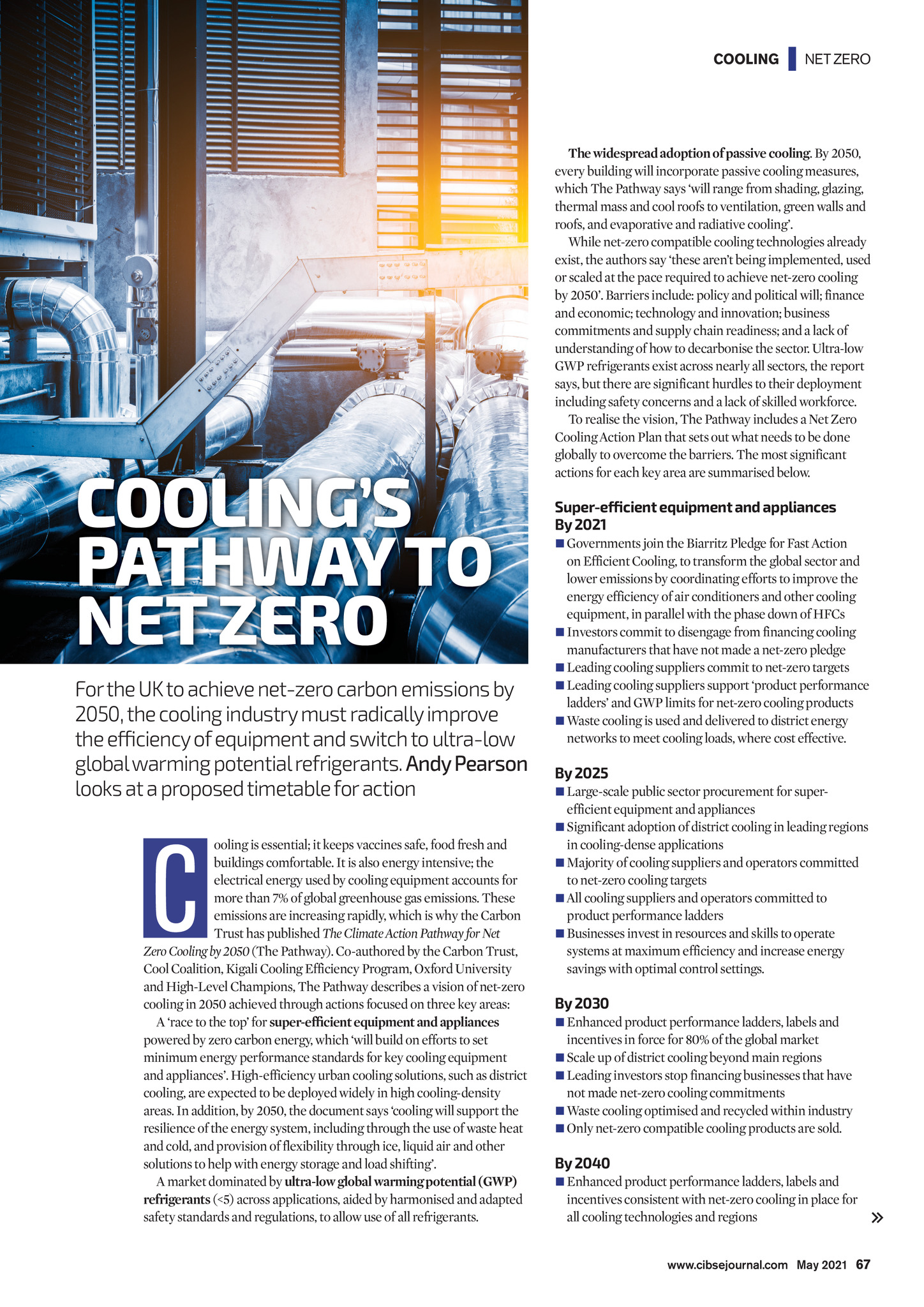
COOLING COOLINGS PATHWAY TO NET ZERO For the UK to achieve net-zero carbon emissions by 2050, the cooling industry must radically improve the efficiency of equipment and switch to ultra-low global warming potential refrigerants. Andy Pearson looks at a proposed timetable for action C ooling is essential; it keeps vaccines safe, food fresh and buildings comfortable. It is also energy intensive; the electrical energy used by cooling equipment accounts for more than 7% of global greenhouse gas emissions. These emissions are increasing rapidly, which is why the Carbon Trust has published The Climate Action Pathway for Net Zero Cooling by 2050 (The Pathway). Co-authored by the Carbon Trust, Cool Coalition, Kigali Cooling Efficiency Program, Oxford University and High-Level Champions, The Pathway describes a vision of net-zero cooling in 2050 achieved through actions focused on three key areas: A race to the top for powered by zero carbon energy, which will build on efforts to set minimum energy performance standards for key cooling equipment and appliances. High-efficiency urban cooling solutions, such as district cooling, are expected to be deployed widely in high cooling-density areas. In addition, by 2050, the document says cooling will support the resilience of the energy system, including through the use of waste heat and cold, and provision of flexibility through ice, liquid air and other solutions to help with energy storage and load shifting. A market dominated by (<5) across applications, aided by harmonised and adapted safety standards and regulations, to allow use of all refrigerants. | NET ZERO . By 2050, every building will incorporate passive cooling measures, which The Pathway says will range from shading, glazing, thermal mass and cool roofs to ventilation, green walls and roofs, and evaporative and radiative cooling. While net-zero compatible cooling technologies already exist, the authors say these arent being implemented, used or scaled at the pace required to achieve net-zero cooling by 2050. Barriers include: policy and political will; finance and economic; technology and innovation; business commitments and supply chain readiness; and a lack of understanding of how to decarbonise the sector. Ultra-low GWP refrigerants exist across nearly all sectors, the report says, but there are significant hurdles to their deployment including safety concerns and a lack of skilled workforce. To realise the vision, The Pathway includes a Net Zero Cooling Action Plan that sets out what needs to be done globally to overcome the barriers. The most significant actions for each key area are summarised below. Super-efficient equipment and appliances By 2021 Governments join the Biarritz Pledge for Fast Action on Efficient Cooling, to transform the global sector and lower emissions by coordinating efforts to improve the energy efficiency of air conditioners and other cooling equipment, in parallel with the phase down of HFCs Investors commit to disengage from financing cooling manufacturers that have not made a net-zero pledge Leading cooling suppliers commit to net-zero targets Leading cooling suppliers support product performance ladders and GWP limits for net-zero cooling products Waste cooling is used and delivered to district energy networks to meet cooling loads, where cost effective. By 2025 Large-scale public sector procurement for superefficient equipment and appliances Significant adoption of district cooling in leading regions in cooling-dense applications Majority of cooling suppliers and operators committed to net-zero cooling targets All cooling suppliers and operators committed to product performance ladders Businesses invest in resources and skills to operate systems at maximum efficiency and increase energy savings with optimal control settings. By 2030 Enhanced product performance ladders, labels and incentives in force for 80% of the global market Scale up of district cooling beyond main regions Leading investors stop financing businesses that have not made net-zero cooling commitments Waste cooling optimised and recycled within industry Only net-zero compatible cooling products are sold. By 2040 Enhanced product performance ladders, labels and incentives consistent with net-zero cooling in place for all cooling technologies and regions www.cibsejournal.com May 2021 67 CIBSE May 21 pp67-68 Net zero cooling.indd 67 23/04/2021 16:14