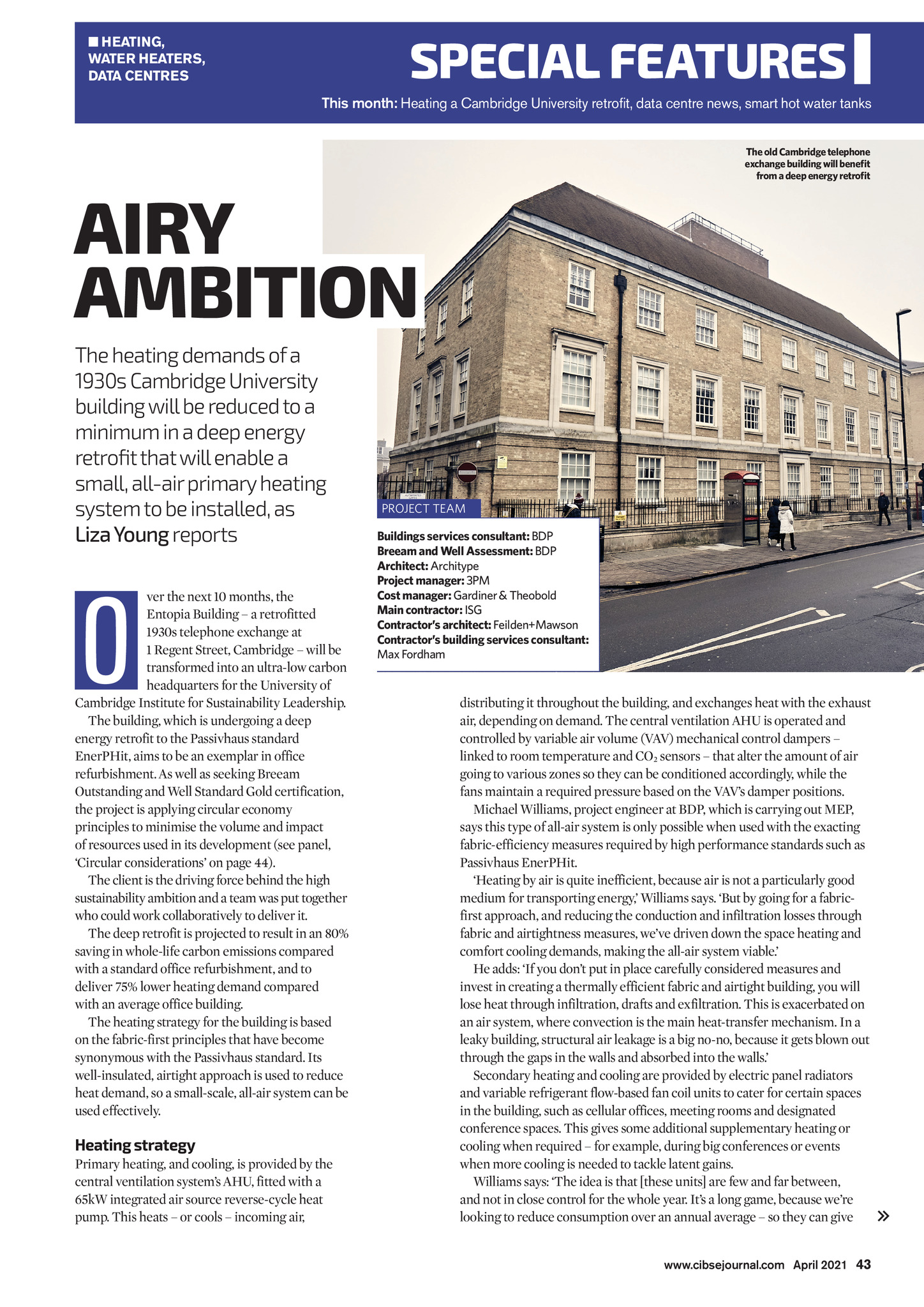
SPECIAL FEATURES HEATING, WATER HEATERS, DATA CENTRES This month: Heating a Cambridge University retrofit, data centre news, smart hot water tanks The old Cambridge telephone exchange building will benefit from a deep energy retrofit AIRY AMBITION The heating demands of a 1930s Cambridge University building will be reduced to a minimum in a deep energy retrofit that will enable a small, all-air primary heating system to be installed, as Liza Young reports O ver the next 10 months, the Entopia Building a retrofitted 1930s telephone exchange at 1 Regent Street, Cambridge will be transformed into an ultra-low carbon headquarters for the University of Cambridge Institute for Sustainability Leadership. The building, which is undergoing a deep energy retrofit to the Passivhaus standard EnerPHit, aims to be an exemplar in office refurbishment. As well as seeking Breeam Outstanding and Well Standard Gold certification, the project is applying circular economy principles to minimise the volume and impact of resources used in its development (see panel, Circular considerations on page 44). The client is the driving force behind the high sustainability ambition and a team was put together who could work collaboratively to deliver it. The deep retrofit is projected to result in an 80% saving in whole-life carbon emissions compared with a standard office refurbishment, and to deliver 75% lower heating demand compared with an average office building. The heating strategy for the building is based on the fabric-first principles that have become synonymous with the Passivhaus standard. Its well-insulated, airtight approach is used to reduce heat demand, so a small-scale, all-air system can be used effectively. Heating strategy Primary heating, and cooling, is provided by the central ventilation systems AHU, fitted with a 65kW integrated air source reverse-cycle heat pump. This heats or cools incoming air, PROJECT TEAM Buildings services consultant: BDP Breeam and Well Assessment: BDP Architect: Architype Project manager: 3PM Cost manager: Gardiner & Theobold Main contractor: ISG Contractors architect: Feilden+Mawson Contractors building services consultant: Max Fordham distributing it throughout the building, and exchanges heat with the exhaust air, depending on demand. The central ventilation AHU is operated and controlled by variable air volume (VAV) mechanical control dampers linked to room temperature and CO2 sensors that alter the amount of air going to various zones so they can be conditioned accordingly, while the fans maintain a required pressure based on the VAVs damper positions. Michael Williams, project engineer at BDP, which is carrying out MEP, says this type of all-air system is only possible when used with the exacting fabric-efficiency measures required by high performance standards such as Passivhaus EnerPHit. Heating by air is quite inefficient, because air is not a particularly good medium for transporting energy, Williams says. But by going for a fabricfirst approach, and reducing the conduction and infiltration losses through fabric and airtightness measures, weve driven down the space heating and comfort cooling demands, making the all-air system viable. He adds: If you dont put in place carefully considered measures and invest in creating a thermally efficient fabric and airtight building, you will lose heat through infiltration, drafts and exfiltration. This is exacerbated on an air system, where convection is the main heat-transfer mechanism. In a leaky building, structural air leakage is a big no-no, because it gets blown out through the gaps in the walls and absorbed into the walls. Secondary heating and cooling are provided by electric panel radiators and variable refrigerant flow-based fan coil units to cater for certain spaces in the building, such as cellular offices, meeting rooms and designated conference spaces. This gives some additional supplementary heating or cooling when required for example, during big conferences or events when more cooling is needed to tackle latent gains. Williams says: The idea is that [these units] are few and far between, and not in close control for the whole year. Its a long game, because were looking to reduce consumption over an annual average so they can give www.cibsejournal.com April 2021 43